Yin & Yang
Balance in motion
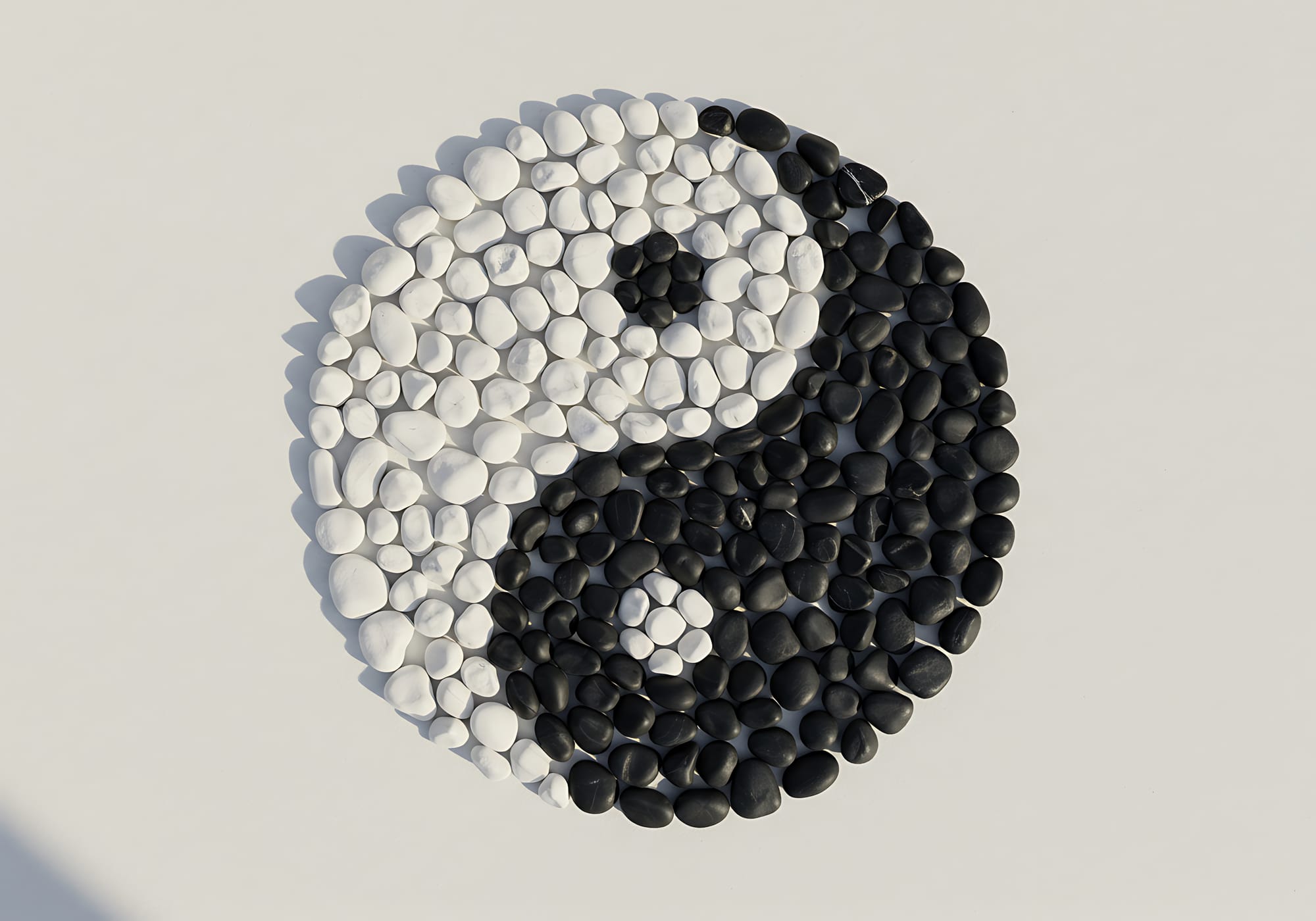
Yin and Yang are often recognized through the familiar black-and-white circle divided into two curving halves. That image can easily reduce the idea to a neat set of pairs: darkness and light, stillness and movement, feminine and masculine.
Yin-Yang thought began with observing change in the natural world: the shaded and sunlit sides of a hill, night giving way to day, cold yielding to warmth, one season declining as another begins to grow. Each side becomes visible through its relationship with the other.
Light stands out beside darkness; movement is easier to recognize against a slower state. A period of withdrawal may also be preparing the ground for what comes next.
Yin and Yang shift with circumstance. Neither remains permanently fixed within a single category.
From the hillside to a way of seeing the world
From the hillside to a way of seeing the world
The earliest meanings of yin and yang are often connected to two sides of a hill: one sheltered from the sun, the other facing its light.
From that concrete image, both terms developed wider associations:
- Yin became linked with darkness, cold, receptivity, contraction, and inward movement.
- Yang became linked with light, warmth, activity, expansion, and outward movement.
These associations depend on context rather than belonging permanently to the thing itself.
Water may appear Yin when compared with fire. A fast-moving river, however, can appear more Yang than a still lake. Winter is Yin beside summer, while a bright winter day may be considered Yang beside a freezing night.
The same thing may be read as Yin or Yang when the context of comparison changes.
This relativity makes Yin-Yang a flexible way of observing the world. It draws attention to context, timing, and the direction in which something is moving instead of fastening every condition to a single label.
Reading the Taijitu
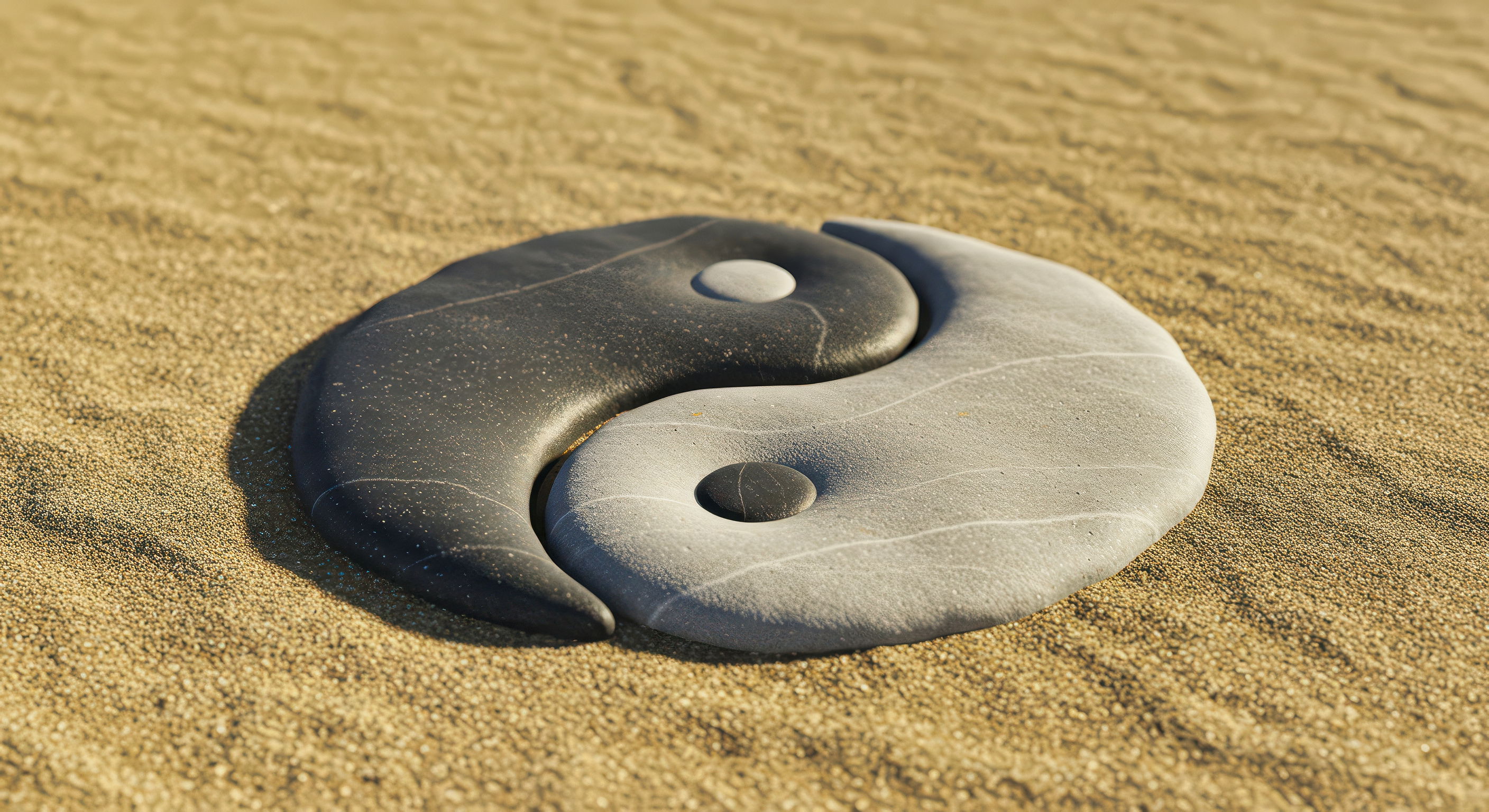
The symbol commonly called the “Yin-Yang symbol” is a form of the Taijitu, or Diagram of the Supreme Ultimate. The familiar black-and-white design condenses several ideas into a structure that can be recognized at a glance.
The outer circle holds both sides within a single whole. Yin and Yang differ, yet they remain part of the same relationship.
The curved division creates a sense of movement. Each side appears to enter the space of the other rather than being held apart by a permanent boundary.
The contrasting dots suggest that every state already contains the possibility of changing direction. As one tendency approaches its extreme, the conditions for its opposite may begin to emerge.
The diagram is sometimes treated as a call to divide everything into two equal parts. In Yin-Yang thought, balance is closer to adjusting proportions according to circumstance than keeping both sides perfectly even.
Day and night are rarely equal in length throughout the year. Activity and rest do not need to occupy the same number of hours each day. Their proportions may shift, provided each side still has room to fulfil its function and give way when conditions change.
From Yin and Yang to the Bagua and feng shui
In the Yijing, Yin and Yang are represented by two kinds of lines: broken and unbroken. Three lines stacked together form a trigram. Eight basic combinations make up the Bagua, associated with images such as heaven, earth, thunder, wind, water, fire, mountain, and lake.
Two trigrams joined together form a hexagram, creating the system of sixty-four hexagrams. Through them, Yin and Yang can be observed within more complex situations, where several conditions interact and change over time.
In feng shui, Yin and Yang are considered alongside the Five Phases, direction, terrain, and the ways in which people use a space. A bright room filled with movement and social activity may lean toward Yang. A darker, quieter space intended for rest may lean toward Yin.
Adjustment depends on the function of each place. A bedroom does not need the same level of activity as a living room; a workspace also calls for different light, sound, and patterns of use from an area intended for rest.
The Bagua serves as a map for orientation and spatial division in some schools of feng shui. Its placement and interpretation vary between traditions, while many versions in common use today have passed through long periods of development, combination, and simplification.
The familiar arrangement of a Taijitu at the centre of the Bagua emerged through the gradual joining of several symbolic traditions over time.
Opposition, complementarity, and alternation
Yin and Yang can relate in several ways. Light and darkness stand in opposition; contraction and expansion complement each other within a breath; day and night, warm and cold seasons, activity and recovery appear in alternating rhythms.
Two different directions can coexist without producing conflict. The tension between them may even create movement.
Instability often appears when one side is pushed too far or when the movement between them becomes blocked. Prolonged activity without recovery leads to exhaustion. Withdrawal that continues for too long may harden into stagnation. Stability can protect a system, yet a structure that refuses to respond after conditions have changed will gradually become fragile.
Used as a modern lens, Yin-Yang can help us observe relationships and change between different states. Turn it into a formula for every situation, and it collapses back into the rigid classifications it was meant to move beyond.
The limits of popular readings
In popular culture, Yin is often associated with weakness, passivity, or negativity, while Yang is treated as strong, active, and positive. That hierarchy strips both concepts of their relational and flexible character.
Darkness carries no built-in moral value, and receptivity does not mean powerlessness. Rest has its own function, just as action does. Either side may become helpful or harmful depending on context, degree, and timing.
Associating Yin with women and Yang with men can also turn a flexible way of seeing into a rigid model of gender. Such associations have existed within the history of Chinese thought and were sometimes used to reinforce social order. They belong to particular historical settings and do not exhaust the full range of Yin-Yang as a concept.
A symbol can carry both wisdom and the traces of power from the age that used it.
Balance never stands still
Yin and Yang offer an image of balance unlike a motionless scale.
Here, balance depends on the ability to adjust as conditions change. Some moments call for forward movement; others call for withdrawal. One period may require protecting an existing structure, while another asks that the structure be allowed to shift.
Today’s midpoint may no longer suit tomorrow.
The black-and-white diagram has endured because it reflects a familiar experience: every state is already passing through a process. While something is growing, the first signs of decline may already be present; a slower period may also be preparing the conditions for the next movement.
In this sense, balance means noticing when a state is changing and responding before it travels too far.
- Internet Encyclopedia of Philosophy — Yinyang (Yin-yang)
- Stanford Encyclopedia of Philosophy — Metaphysics in Chinese Philosophy
- Stanford Encyclopedia of Philosophy — Chinese Philosophy of Change (Yijing)
- Encyclopaedia Britannica — Early Eclectic Contributions / Yin and Yang
- Encyclopaedia Britannica — Feng Shui
- The Metropolitan Museum of Art — Daoism and Daoist Art
- Internet Encyclopedia of Philosophy — Gender in Chinese Philosophy
☯️ Back