APPLE
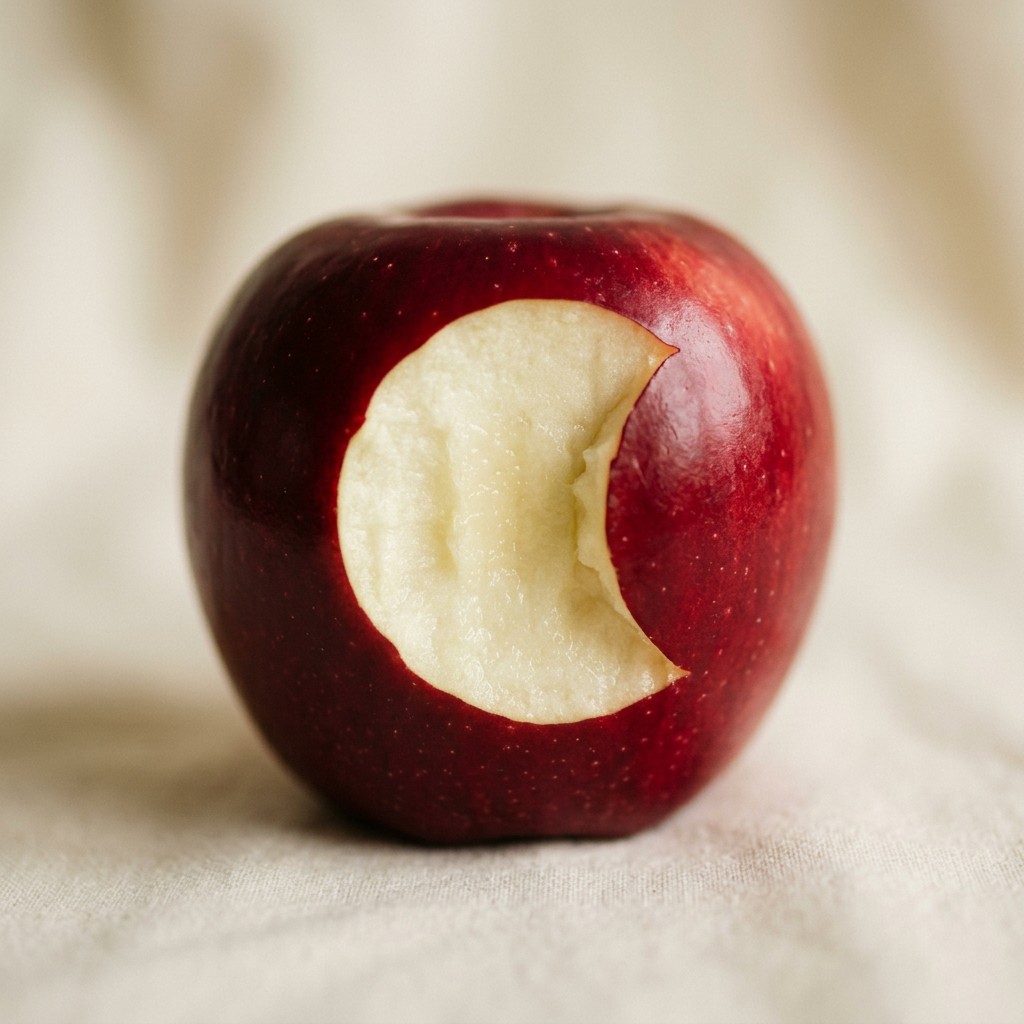
The apple and the first bite
The apple is small, round, and familiar. It fits in the hand, sits easily on a table, hangs from a branch, or travels with someone after the first bite.
That familiarity lets it enter a story without warning. It appears far less threatening than symbols of power, danger, or prohibition.
Across many stories, the apple arrives when a boundary is about to be crossed. Something becomes known. Something else is lost. Once the bite has been taken, neither the person nor the world can be seen in quite the same way.
The bite turns desire into action. Knowledge passes through the mouth, enters the body, and becomes part of the one who knows.
The forbidden fruit was not necessarily an apple
In Genesis, the fruit in the Garden of Eden is never named. The text refers only to the fruit of the tree of the knowledge of good and evil. The apple became attached to the story later through Western art, literature, and repeated retelling. [1]
One familiar theory links the association to the Latin word malum, which may refer to “apple” or “evil” depending on spelling, pronunciation, and context. The surviving evidence does not establish a single moment when that wordplay transformed the forbidden fruit into an apple. [2]
Symbols often take shape through processes like this. A detail left undefined is painted, retold, and repeated across generations. Over time, the familiar image fills the space left open by the original text.
When people now picture the forbidden fruit as an apple, they are seeing an image shaped and condensed by centuries of culture.
When knowledge changes the knower
After eating the fruit, Adam and Eve become aware of their nakedness. Their eyes are open, and the ease that existed before is gone. The body, shame, choice, and consequence enter the story together. [3]
Knowledge changes their position in the world. They become aware that they are looking, that they can be seen, and that their actions carry consequences.
The apple gives this change a physical form. It is picked up, held, tasted, and swallowed. Knowledge no longer remains outside the body as something observed from a safe distance.
The bite marks the moment when knowing becomes experience.
The cost of knowing
Greater knowledge can widen the range of possible choices. It can also remove a form of peace that once existed.
Some truths about another person, the self, family, love, work, belief, or power make an earlier way of seeing impossible to maintain. The world may have seemed simpler before, even when that simplicity depended on something remaining hidden.
A child realises that adults can be wrong. Someone learns that love cannot repair everything. A belief that once offered support begins to reveal what it had concealed.
Such moments are often quiet. There is no thunder and no gate swinging open. One way of seeing simply loses the ability to return to its former place.
The apple ties knowledge to a cost because the bite leaves a mark on both the fruit and the person who takes it.
Desire and what has been hidden
Prohibition draws attention toward the forbidden object.
A room that must not be entered, a door that should remain closed, a question that should not be asked, or a piece of information that should not be known can occupy the imagination more completely than anything freely available.
The apple gives that desire a concrete shape. It sits within reach, fits the hand, and allows the boundary to be crossed in a single movement.
Before the bite, the person remains outside what they want to know. After it, the distance disappears.
The apple feels alluring and unsettling for the same reason: the person holding it knows that hidden knowledge is within reach and that reaching for it may alter their own position.
From forbidden fruit to the apple of science
The story of Newton watching an apple fall has become one of the most famous legends in the history of science. William Stukeley recorded an account he heard from Newton, while later retellings expanded the scene into something close to myth. [4]
Here, the falling apple carries no prohibition. It draws attention to an ordinary event: why do objects fall toward the ground?
An apple falls. Someone notices. A familiar occurrence becomes the beginning of a new way of understanding nature.
In Eden, the bite changes the person who sees. In the Newton story, the act of seeing changes the meaning of the falling object.
The apple can mark a fall from innocence or the beginning of discovery. Both stories begin when something familiar suddenly stops being simple.
The apple in technological culture
Today, the apple is also closely tied to technology, design, and digital life. The bitten-apple logo has become one of the most recognisable images of the age of personal computers and smartphones.
The logo does not need to be forced into the Eden story for the visual echo to remain noticeable. The old bite appears in a world where knowledge is reached through the movement of a hand.
Touch the screen. Unlock the device. Search, read, save, and share. Knowledge has moved from fruit on a tree to a device held in the palm.
Technology creates its own points of no return. Information that has been read, an image that has been seen, or a connection that has been opened may continue to shape what follows. People gain access to more, preserve more, and are also recorded more extensively.
Once something has been learned, how does a person live with it?
After the bite
TWOR reads the apple at the moment when a small piece of information changes the position of the person receiving it.
It may be a message, a sentence, an image, a discovery, or the first time someone asks why they are still living by something that no longer feels true.
The content itself may be small. Its force appears in the way the surrounding picture must be reconsidered. Work, relationships, beliefs, and habits may continue, though the person no longer sees them from the same place.
While the apple remains untouched, the choice still lies ahead. Once the bite has been taken, the story shifts toward the knower and the life they build around what has entered them.
_______
References
- The Book of Genesis, Chapters 2–3 — United States Conference of Catholic Bishops
- Azzan Yadin-Israel — Temptation Transformed: The Story of How the Forbidden Fruit Became an Apple
- William Stukeley — Memoirs of Sir Isaac Newton’s Life — The Royal Society Archives
- The Royal Society — Newton’s Apple Tree