INFINITY
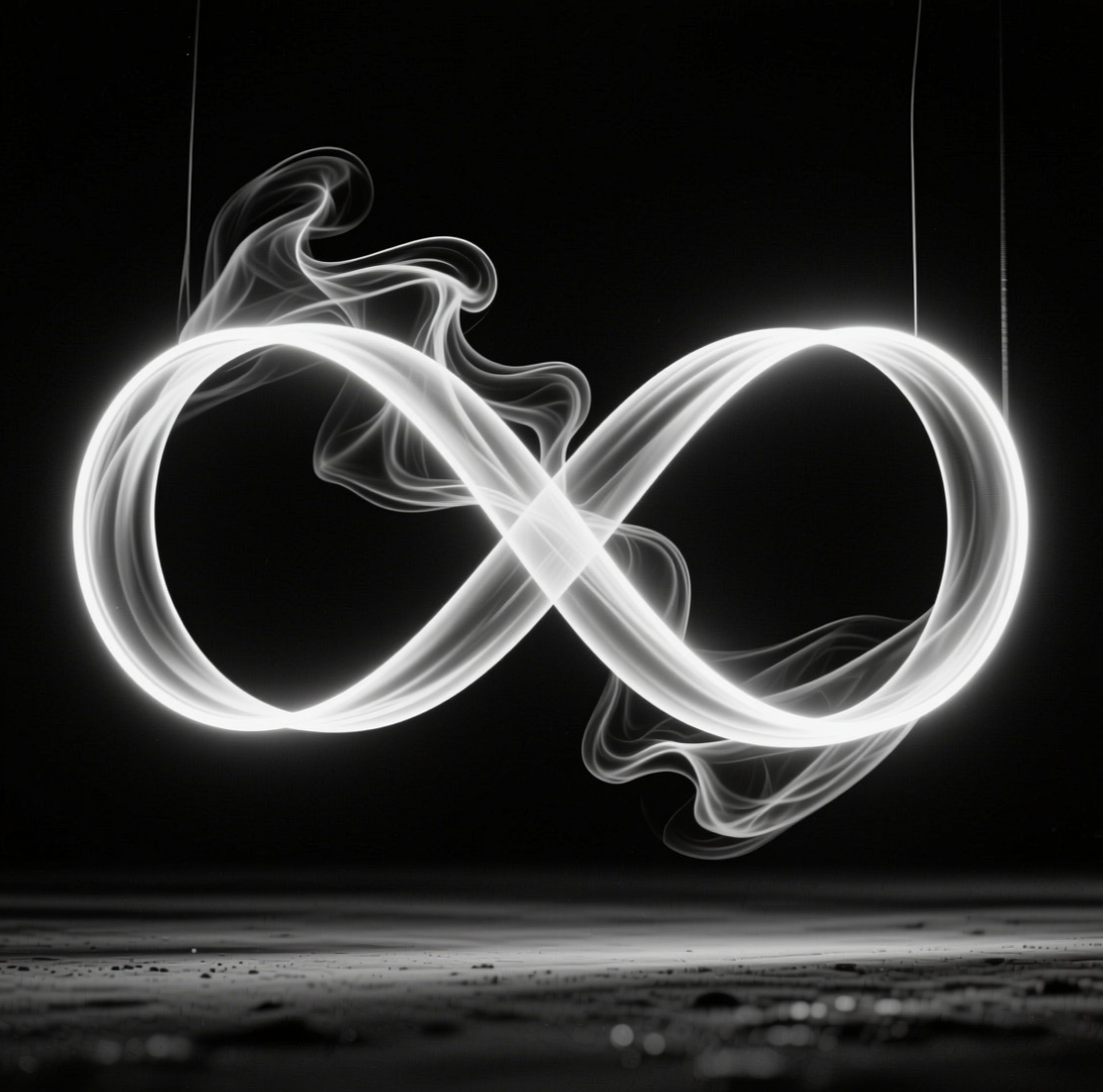
When a path no longer ends at a point
Infinity is usually recognised as a sideways figure eight: a continuous curve that returns to itself before crossing into the opposite side.
The shape is remarkably simple. One unbroken line, two balanced loops, and a crossing at the centre. There are no sharp corners or clear stopping points to tell the eye where the path begins or ends.
That simplicity has allowed the symbol to move easily across mathematics, jewellery, tattoos, art, philosophy, and visual languages of love or connection.
Infinity is often read as “forever,” yet its form carries a more specific kind of movement: travelling outward, returning to the centre, changing sides, and continuing.
Unlike a circle, it does not remain within a single enclosed loop. The line passes through the crossing, enters the other side, and retraces the pattern in reverse.
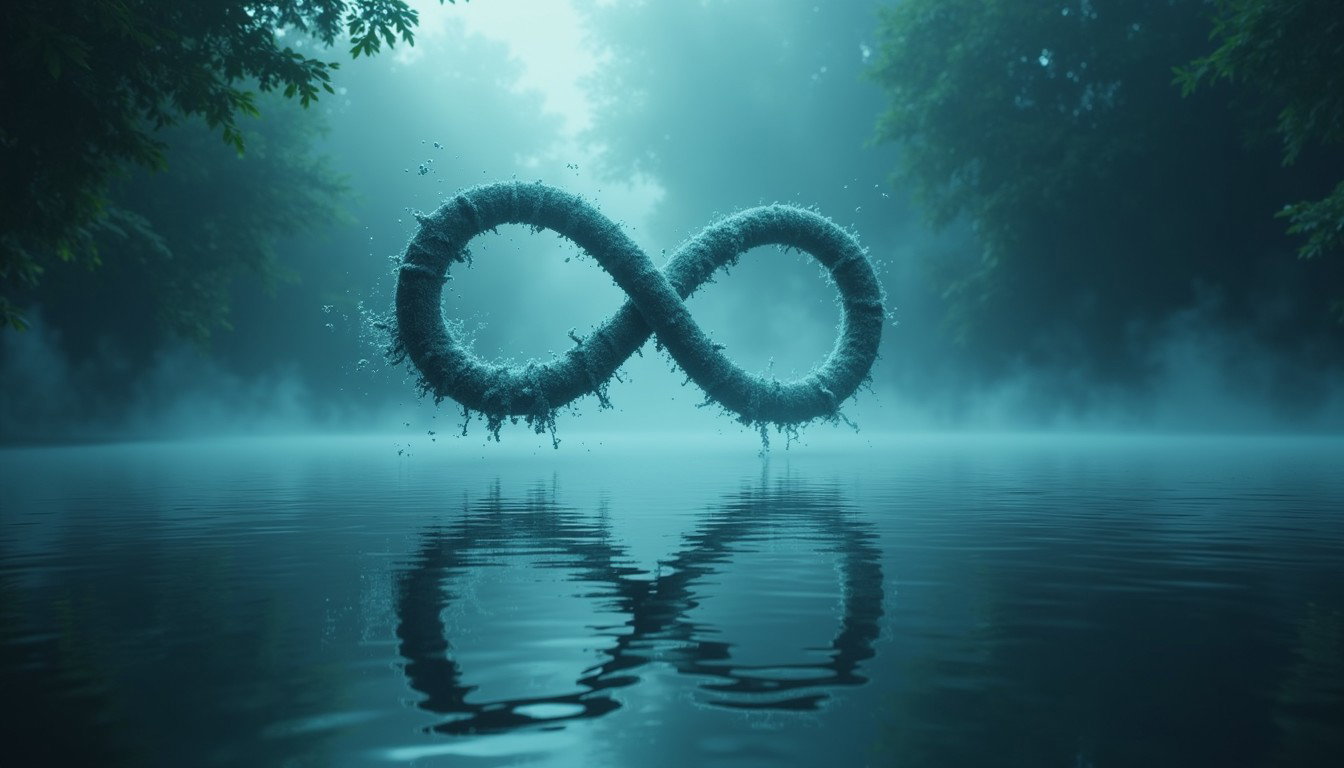
A sign for what cannot be fully measured
In mathematics, infinity is not an ordinary number that can be added, subtracted, or placed on a scale. It refers to something that is not bounded by a finite value.
When a sequence can continue indefinitely, there is no need to imagine one final number waiting at a great distance. The meaning lies in the fact that another step can always follow.
The sideways figure eight, often called a lemniscate, gives that idea a visible form. Rather than stretching outward as a line that disappears into the distance, it returns to the centre and opens into the opposite side.
Infinity carries the sense of a process that has not been sealed by a single endpoint.
The crossing at the centre
The two loops meet at one point in the middle. This detail separates Infinity from a simple circle.
A circle suggests enclosure, completion, and return. Infinity also carries a cyclical quality, though its path continually moves from one side to the other.
Each passage through the centre changes the direction of travel. The same point is reached more than once, but the way into it and the way out are different.
Symbolically, the crossing can be read as a meeting place between two sides of an experience: past and present, inner and outer, loss and continuation.
The force of Infinity lies in that change of direction. The line remains unbroken without being confined to a single loop.
Different from the Ouroboros
Infinity and the Ouroboros are often placed beside each other because both evoke repetition, continuation, and the absence of a clear endpoint.
Their images work in very different ways.
The Ouroboros is a serpent biting its own tail. Its circle is formed by a body that sustains itself while consuming itself. It is often linked with cycles of birth and death, renewal, instinct, and patterns that can draw a person back into the same enclosed movement.
Infinity has no body, head, tail, or act of self-consumption. It is an abstract curve moving through two sides that meet at the centre.
The Ouroboros draws attention to the cost of the cycle. Infinity leans toward the continuation of the path.
One closes the loop by returning to its point of origin. The other keeps changing sides through the same crossing.
Infinity in modern life
Today, Infinity appears on paired rings, necklaces, tattoos, logos, spiritual illustrations, and designs connected with love, memory, or lasting promises.
The appeal is easy to understand. A line without a visible ending readily becomes an image of enduring love, an unbroken bond, or something that continues through time.
Its popularity has also reduced it to decoration in many contexts. Combined with the word forever, a name, a date, or a heart, it often serves only to promise that a connection will last.
Even in its most familiar uses, the structure retains one distinctive feature: the two sides remain linked, and the passage between them always runs through the centre.
When a limit changes the direction of the path
Human life unfolds within many limits: time, the body, circumstance, memory, language, and perception.
Some limits give life enough structure to remain coherent. Others keep a person returning to the same response, the same choice, or the same story about themselves.
Infinity does not erase the boundary of its form. The curve remains contained within a recognisable structure, but when it reaches the far edge of one side, it turns, crosses the centre, and enters the other.
That movement offers another way to read continuation. Moving forward can include returning to an old point, approaching it from another direction, and leaving along a different path.
Infinity is tied to movement rather than permanence. The form remains recognisable while the direction within it keeps changing.
Each return to the crossing preserves the connection with what came before, though the path beyond it no longer runs the same way.
_______