ANKH
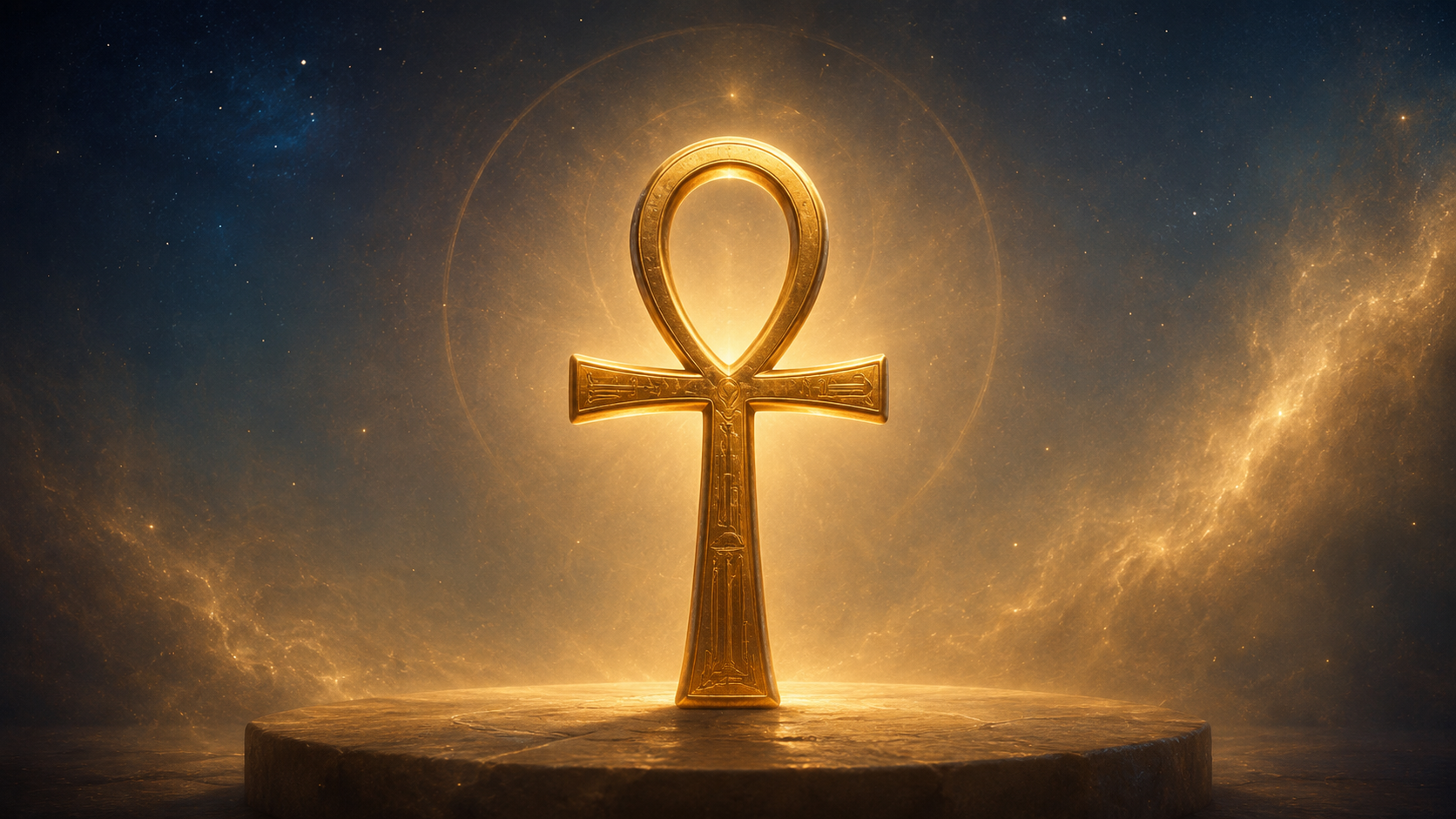
When life takes the shape of a key
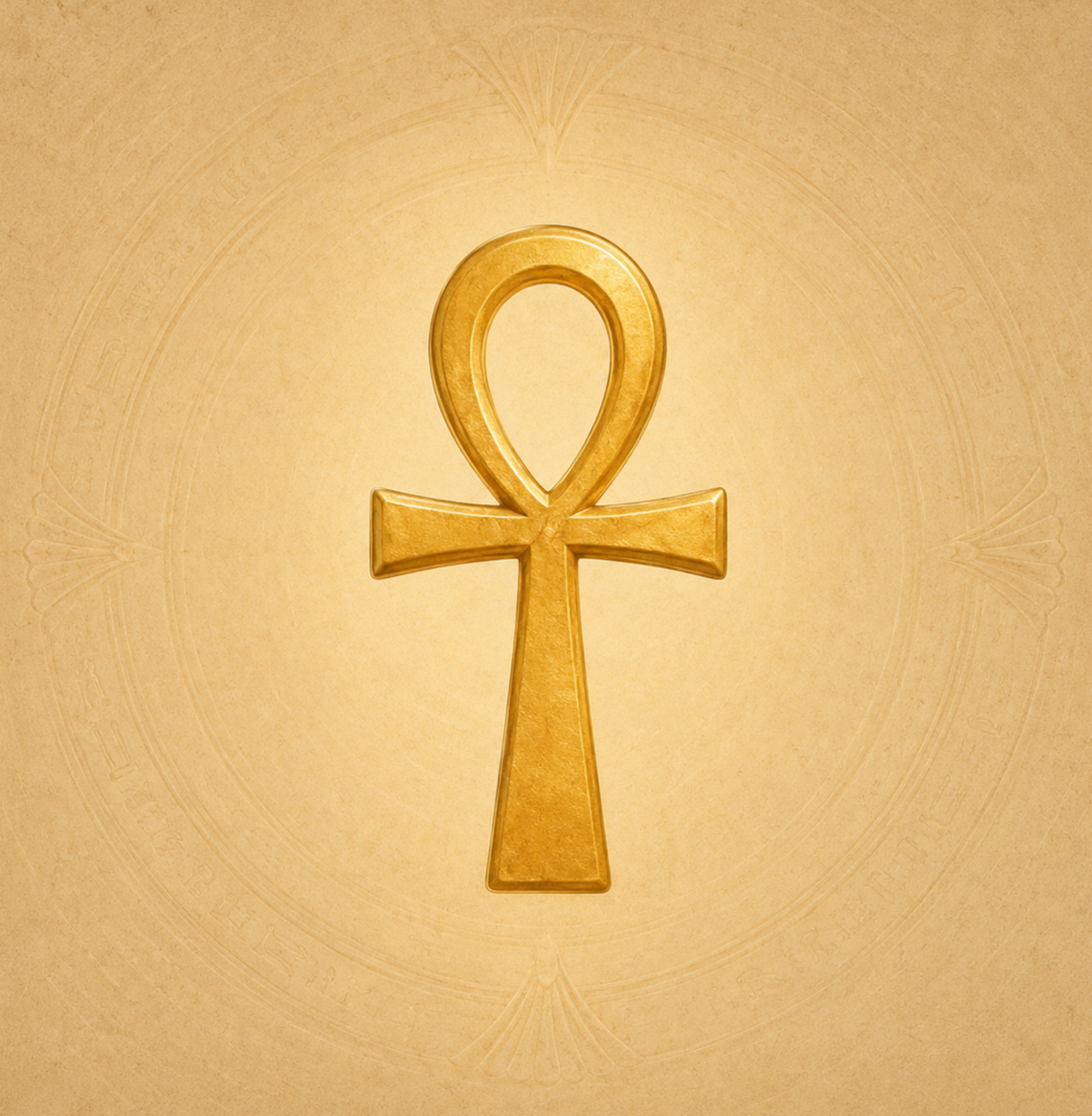
The Ankh is one of the most recognisable signs of ancient Egypt: a closed loop at the top, a horizontal bar across the centre, and a long stem extending downward.
At a glance, it resembles a handled cross or a key. The familiar name “key of life” comes from that appearance. In Egyptian hieroglyphic writing, the Ankh was used in words connected with life, living, and being alive. [1]
It appears in inscriptions, reliefs, ritual objects, and images of the gods. Divine figures often hold it in their hands or extend it toward a king or the deceased.
In those scenes, life takes on a visible form. It can be held, offered, and received.
A word held in the hand
The Ankh belonged to written language, yet Egyptian art also treated it like a physical object.
Gods are shown carrying it, presenting it to the king, or placing it close to the face of the recipient. In some images, the Ankh appears near the nose, linking life with the breath entering the body. During purification scenes, streams of Ankh signs may stand in for water being poured. [2]
An abstract word becomes tangible. Life rests in the hand of a god and passes toward a human figure.
This gives the Ankh a character of its own. It does not depict an organism growing or a cycle moving by itself. Its attention rests on the moment life is transferred.
A shape without a final answer
The original source of the Ankh’s shape remains uncertain.
It has been associated with a knot, a sandal strap, or an object made from flexible material with two hanging ends. Later interpretations have connected it with the womb, sexual union, the sun on the horizon, or a key opening the passage to the afterlife.
These explanations do not carry equal historical weight. Many familiar readings emerged long after the Ankh had left its original cultural setting.
Its ancient use is clearer. The Ankh functioned as a written sign and an image of life, closely linked with gods, kingship, breath, ritual, and the journey beyond death.
The shape still leaves room for association. The upper loop closes around an empty space, the horizontal bar creates a divide, and the vertical stem connects what lies above with what lies below. The resemblance to a key remains visually compelling, even though no single interpretation fully accounts for the form.
Life as something given
In ancient Egyptian thought, life belonged within a larger order involving the gods, kingship, cosmic balance, and the forces that kept the world functioning.
The gods could grant life, protect the king, and support the deceased on the journey that followed death. When an Ankh is extended toward a human figure, the image presents life as a power maintained within that wider order.
The recipient does not hold life as a possession entirely their own. It arrives from another source, sustains the body for a time, and depends on protection if the connection is to continue.
The Ankh often appears alongside the Djed, associated with stability, and the Was sceptre, associated with power or dominion. Together, they form a visual language of life, endurance, and authority. [3]
Life in this setting has structure. It is supported by breath, water, divine power, protection, and the order that keeps the world from falling apart.
Across the boundary of death
The Ankh appears frequently in funerary settings and images of the afterlife.
For the ancient Egyptians, death opened into another journey. The deceased required protection, restoration, and the means to continue existing beyond the limits of the physical body.
The Ankh stands within these scenes of passage. A god may offer it to the king or the dead as a sign that life can be renewed across the boundary between worlds.
This places the symbol close to death without turning it into an image of ending. The Ankh enters precisely where continuity has become fragile.
Its later association with a key grows naturally from that position. The form seems able to open a passage, though its clearest role in Egyptian art remains the giving and restoration of life.
The Ankh in modern life
Today, the Ankh appears in jewellery, tattoos, fashion, music, gothic art, African-centred cultural movements, and many forms of modern spirituality.
It is often used to evoke life, immortality, ancient wisdom, feminine power, or a connection with Egypt.
Its wide circulation has allowed the symbol to enter new cultural settings. It has also made the Ankh easy to detach from its older meanings and use as a general sign of mystery.
A symbol survives by being read again. Some connection with its earlier context still needs to remain, or the shape becomes an empty shell that can be made to represent anything.
For the Ankh, the clearest anchor is life itself: life in relation to breath, divine power, authority, death, and continuation.
When life needs to be sustained
The Ankh is often presented as a promise of eternal life. Its ancient imagery also carries another idea: life needs to be given, protected, and renewed.
A body lives through breath. A king receives legitimacy through divine recognition. The deceased continues through ritual care and protection.
Life never appears as a completely isolated force.
TWOR reads the Ankh at the point where life passes through a threshold. One side holds the source of renewal; the other opens to receive it.
There are periods when a person still works, speaks, and completes daily responsibilities while the inner sense of being alive grows faint. The body continues, though the connection to what once nourished it has weakened.
The Ankh brings attention back to that source: breath, the body, relationships, belief, work, care, or anything that still gives a person a reason to remain present.
A key gains meaning from the door before it. The Ankh holds the image of life crossing that door and continuing on the other side.
_______
References
- The Metropolitan Museum of Art — Ceremonial Implement in the Shape of an Ankh
- The Metropolitan Museum of Art — Libation Dish Depicting Ka-Arms Presenting an Ankh-Sign
- The Metropolitan Museum of Art — Ankh, Djed and Was Signs
🔑 Back