OUROBOROS
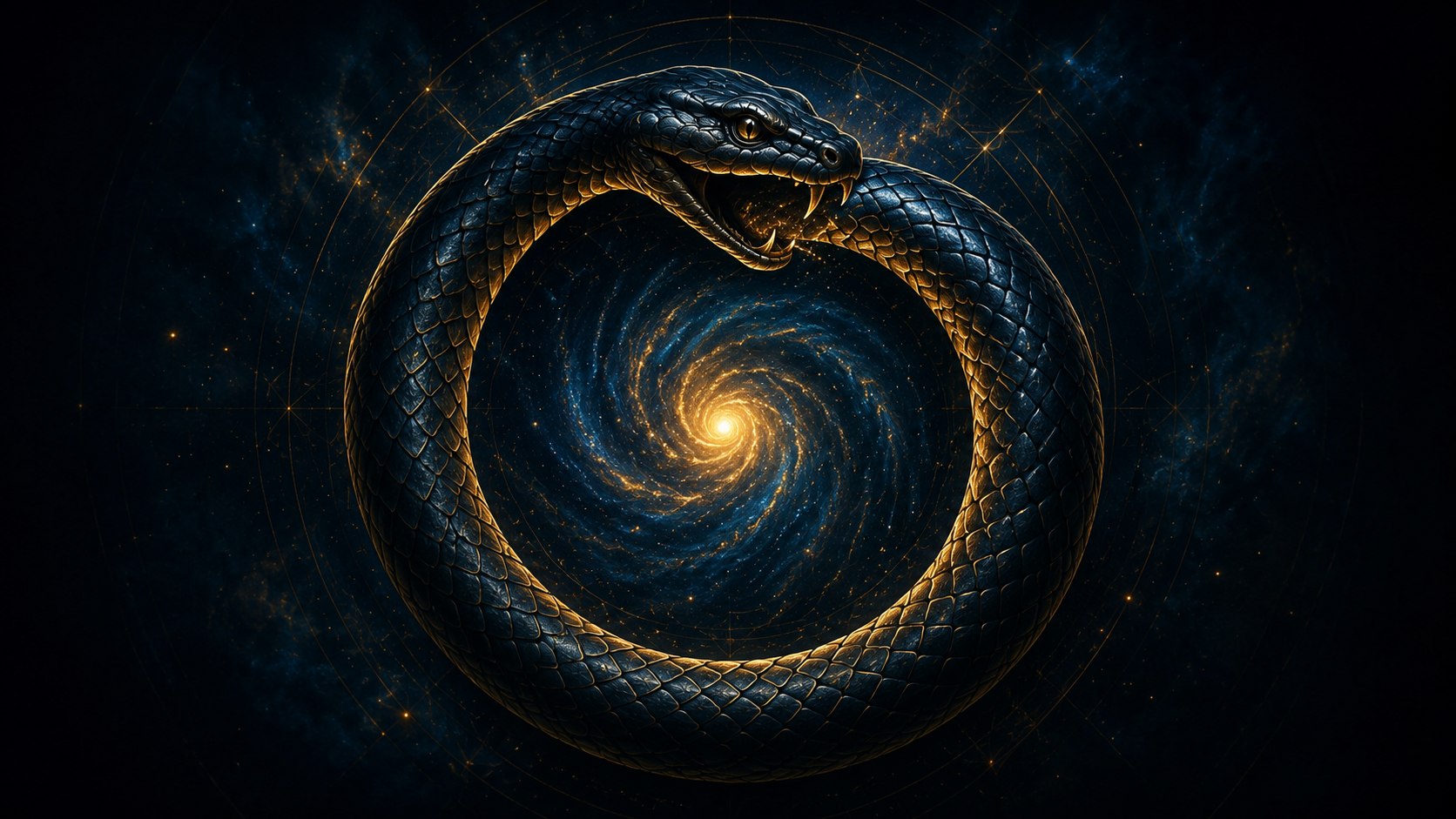
The loop that devours itself
Ouroboros is usually depicted as a serpent curving into a circle and biting its own tail.
That single image opens several paths of interpretation: ending and beginning, renewal and depletion, recurrence, and the strange condition of a system that sustains itself while slowly consuming its own substance.
Ouroboros is therefore often associated with the cycle of life: birth, growth, decay, and return in another form.
Seen only as a peaceful circle, however, the symbol loses its sharper edge. The serpent is not simply forming a closed shape. Its teeth are pressed into its own body.
An image across many traditions
Ouroboros appears in several ancient traditions, often connected with cycles, return, and the self-sustaining nature of life. Each tradition placed the image within a different symbolic setting.
In ancient Egyptian imagery, the serpent forming a closed loop was associated with the sun, darkness, protection, and renewal. Its body could surround a passage through which an old state entered darkness before emerging into another rhythm of existence.
In Greek and Hermetic traditions, Ouroboros became connected with the idea of “The One is All.” The closed circle evoked a reality containing itself, where opposing forces remained part of the same continuous process.
In alchemy, Ouroboros represented transformation. Matter was heated, separated, refined, recombined, and carried through successive stages of change. Each turn of the cycle brought the old state through dissolution and rearrangement before another state could emerge.
Across these interpretations, Ouroboros touches a familiar intuition: life rarely moves in a straight line. Some things return. Some endings prepare the ground for another beginning. Certain loops become visible only after we have travelled through them several times.
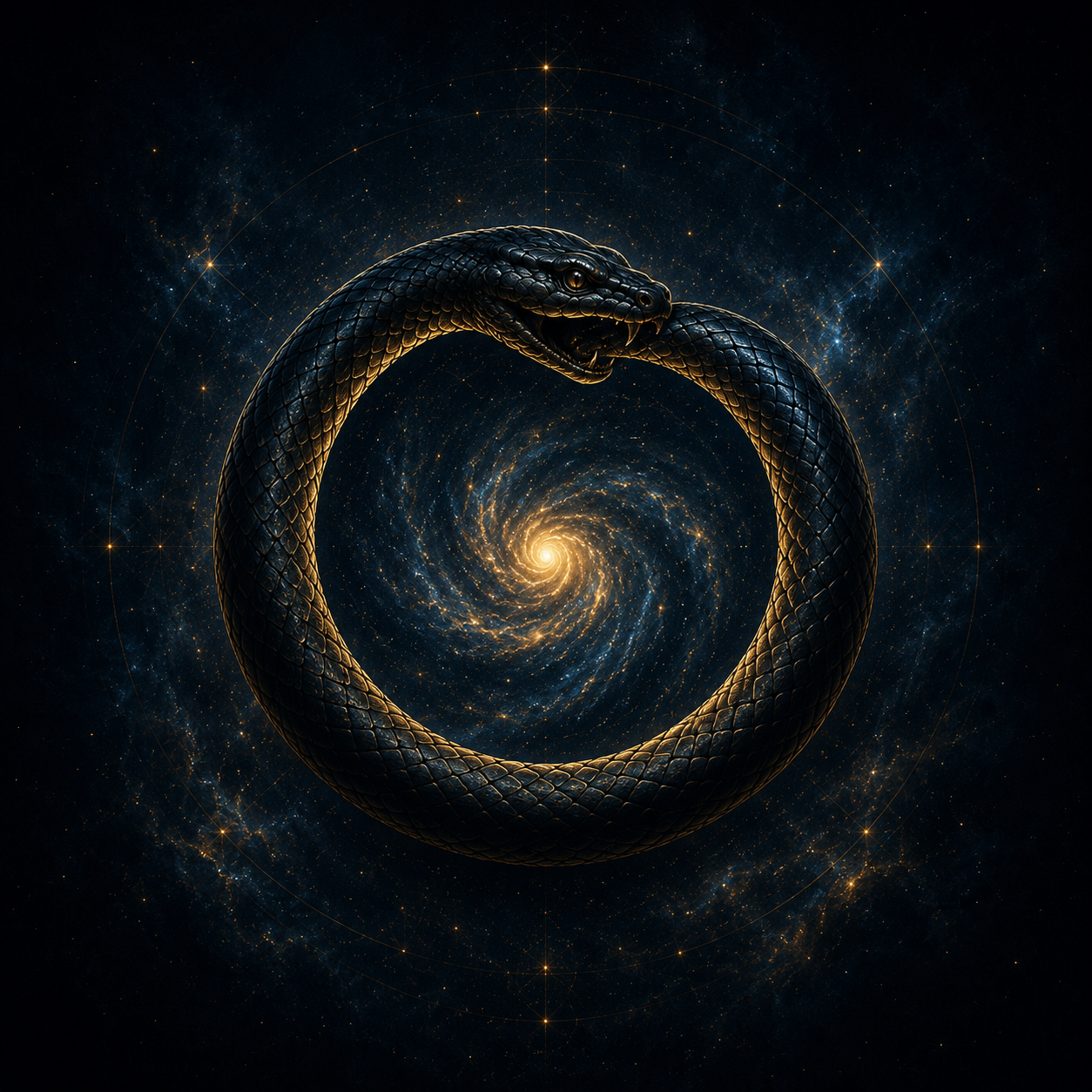
The circle and the bite
The first shape we notice is the circle.
It suggests continuity without an absolute beginning or end. Any point along its curve can become the starting place, depending on where the eye chooses to enter.
The bite changes the meaning.
For the serpent to continue, it must turn back toward itself. The same body that sustains the cycle also becomes the material being consumed.
The circle speaks of return. The bite introduces the cost of continuation.
Every enduring system draws from what already exists: memory, experience, matter, energy, belief, old wounds, and familiar habits. Some of that material becomes nourishment for new life. Some is chewed over repeatedly until the system continues moving without truly changing.
Ouroboros therefore holds two movements within the same image: recurrence and consumption.
Not every return leads forward.
Renewal and entrapment
Ouroboros carries two possibilities at once.
One is renewal. Something ends, breaks down, and becomes material for what follows. Fallen leaves become soil. One phase of life closes so that another can take shape. Earlier versions of the self may also dissolve, allowing what remains alive to be rearranged.
Some endings protect a living system from becoming rigid.
The same cycle can also become a trap.
A pattern may support us for a time, then gradually close around us. We return to the same kind of relationship, react through the same fear, repeat the same story about ourselves, or carry an old wound into new situations under a different name.
Some loops help us grow because each return reveals something we could not see before.
Others wear us down because every turn leads back to the same place.
Ouroboros asks us to look beyond the fact that something has returned. Has this return opened a path toward transformation, or has it simply extended a cycle of self-consumption?
Alchemy and the loop of transformation
In alchemy, Ouroboros often appears as an image of a closed process in which matter passes through dissolution, refinement, and recombination.
The famous image of turning base metal into gold belongs to a wider language of transformation. Old material is heated, broken apart, filtered, and rearranged before it can enter another state.
An alchemical cycle does not restore matter to its original condition. Every return carries the marks of what was dissolved, removed, or joined during the previous passage.
This distinction separates repetition from transformation.
Repetition brings us back to a familiar point while the inner structure remains largely unchanged.
Transformation may also return us to a familiar situation, emotion, or conflict, yet we meet it with a different perspective, response, or degree of awareness.
From the outside, both movements can look remarkably similar. The difference appears in what has genuinely changed within us after each return.
Ouroboros stands at that boundary: the same loop may become a furnace of transformation or a trap capable of maintaining itself indefinitely.
Feedback loops in everyday life
Modern language offers another way to approach Ouroboros through the idea of feedback loops.
An action produces a result. That result returns and influences the next action. As the process continues, a system may regulate itself, reinforce itself, or gradually amplify its own distortions.
Living bodies depend on feedback to maintain balance. Societies move through cycles of production, consumption, crisis, and adjustment. The human psyche also develops its own loops: thought shapes emotion, emotion influences behaviour, and behaviour produces experiences that appear to confirm the original thought.
A healthy feedback loop helps a system learn and adapt.
A distorted one keeps reproducing the same error.
A person who expects abandonment may interpret every silence as evidence that someone is pulling away. They may respond by clinging, doubting, testing the relationship, or withdrawing first. Those reactions create tension, and the resulting distance strengthens the original belief.
That too is an Ouroboros: a loop feeding itself in everyday life.
A TWOR reading
TWOR reads Ouroboros as an image of cycles that can sustain themselves.
Some cycles are essential. Human life depends on rhythm: sleeping and waking, breathing in and out, leaving and returning, learning and forgetting, breaking apart and arranging again. Without repetition, experience would scatter into disconnected fragments.
Other cycles demand closer attention.
Fear can prolong itself by searching everywhere for proof. An old wound can survive by repeatedly leading us toward situations in which it will be reopened. Identity can preserve itself by telling the same story again and again, long after that story has stopped helping us live.
No cycle is harmful merely because it repeats. Danger enters when the repetition becomes invisible to the person living inside it.
While caught within a loop, we may call it fate. Once its pattern becomes visible, another response becomes possible.
Ouroboros does not demand the destruction of every cycle. Some rhythms hold life together. Some repetitions allow the body to recover. Some returns help us understand what we once passed over too quickly.
The symbol instead draws attention to the effect of continuation.
Is this loop helping us grow, or slowly wearing us away?
The serpent biting its tail carries both survival and consumption in the same gesture. A loop may keep life moving. It may also feed upon the very life it preserves.
Ouroboros eventually turns our attention back toward the cycles already shaping us:
Are we living within a cycle that helps us transform, or within a loop that has learned to sustain itself through old wounds?
_______
🐍 Back