Dreamcatcher

Dreamcatcher — the web beside sleep
Today, dreamcatchers turn up almost everywhere: bedrooms, windows, cafés, rear-view mirrors and bohemian shops. Some are large enough to serve mainly as wall décor.
Their earlier form was far more modest. In ethnologist Frances Densmore’s records of the Ojibwe, the objects she called “spider webs” were small wooden hoops, about 9 cm across, woven with a web of thread and suspended from the bow of an infant’s cradleboard. The thread was once made from nettle fibre before other materials became common.
From a small hoop above a child’s cradleboard, the dreamcatcher eventually became an image recognised around the world.
Why a spider web?
The web follows the logic of a spider’s web: whatever touches it can be caught.
Densmore described these objects as “spider webs”. They were believed to catch harmful influences in the air, much as a spider’s web catches whatever comes into contact with it. The Smithsonian Institution still holds an Ojibwe cradleboard with two spider-web charms hanging from the bow above the infant’s head.
Ojibwe vocabulary preserves the link between spiders and webs as well. Ojibwe.net notes that asab relates to a net, while asabikeshiinh, the Ojibwe word for spider, carries the sense of a “little net maker”.
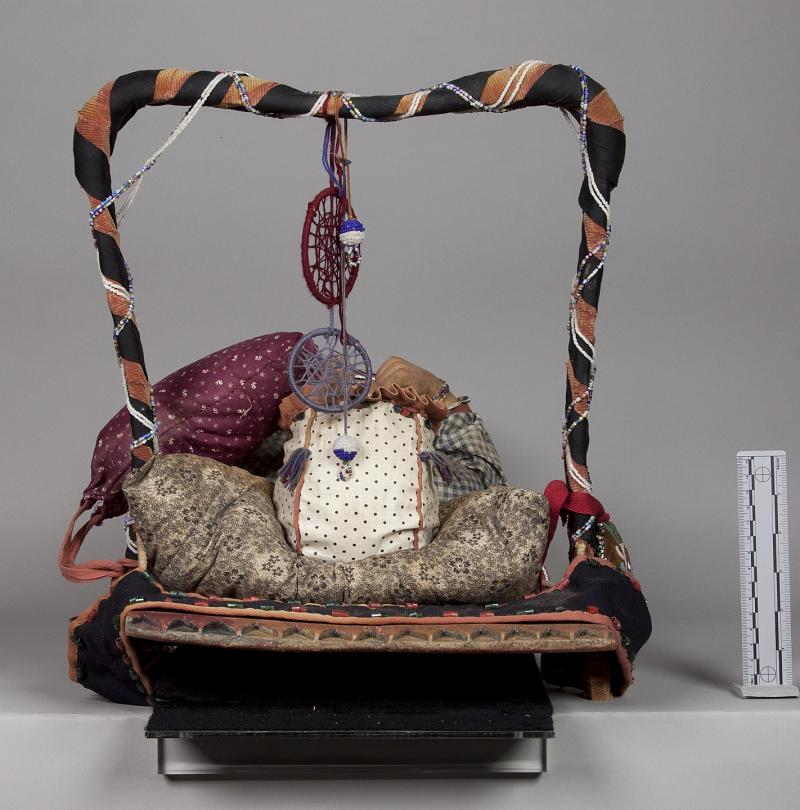
An Ojibwe cradleboard with two spider-web charms hanging above the infant’s head.
Image: Smithsonian Institution.
From protection to dreams
The name dreamcatcher makes it easy to assume that the object has always been concerned mainly with dreams. Early records describe a broader protective role around children, while other objects associated with dreaming could also be attached to cradleboards for their own purposes.
Densmore’s account does not describe the familiar formula in which bad dreams become trapped while good dreams pass through. The web had a wider protective function around the child. Its close association with dream filtering became more prominent as the older protective form was revived and reshaped during the twentieth century.
In A. Irving Hallowell’s studies of the Ojibwe, dreams could carry guidance, protection or encounters that mattered to the dreamer. Dream experience could remain connected with waking life, personal choices and responsibilities. The dreamcatcher’s later association with dreams fits naturally into that cultural setting.
Today, dreamcatchers are commonly associated with the idea that bad dreams become caught in the web while good dreams pass through to the sleeper. The Minnesota Historical Society still presents this meaning in its educational material on Ojibwe culture.
Modern retellings also connect the web with Asibikaashi, often called Spider Woman. One account published by Anishinabek News describes Asibikaashi visiting cradleboards and weaving protective webs for children. Oral traditions have many versions, so details involving the central opening, beads, feathers and the way dreams are caught or allowed through vary from one telling to another.
Dreamcatcher traditions come in several versions, with no single ancient instruction manual behind them.
From the cradleboard to the mass market
There is a gap between the early cradleboard charms and the modern dreamcatcher. Cath Oberholtzer, a researcher of material culture, noted that netted charms for children became rare or disappeared from regular use in some areas before the dreamcatcher returned as a revived tradition. From Ojibwe communities, the form spread quickly among other Indigenous communities; within a pan-Indian context, it also took on meanings connected with identity and wider Indigenous solidarity.
Oberholtzer describes how protective charms for children were recreated in many forms, from jewellery to objects hung in cars and homes. Their production and sale provided income for Indigenous makers while also carrying Indigenous imagery and cultural values into a wider market.
Dreamcatchers later entered New Age culture and the mainstream décor market. Smithsonian Libraries records trace their Ojibwe roots, protective role and later adoption within New Age culture.
Some dreamcatchers from the late twentieth and early twenty-first centuries in the National Museum of the American Indian are catalogued as “made-for-sale items and souvenirs”. Their size, materials and decoration can differ greatly from the small hoops once suspended above cradleboards.
When a dreamcatcher becomes décor
A dreamcatcher above a cradleboard and one hanging in the middle of a café may share the same basic shape while serving very different purposes.
In an Ojibwe context, the object carried a protective function connected with children, sleep and ideas about unseen harmful influences. In a modern room, it may simply become a combination of colour, texture and bohemian style.
Early records focus on protection around children and sleep. Claims that a dreamcatcher must never hang near an entrance or in a living room appear much later.
For anyone familiar with its earlier role, the web carries more meaning than an ornament chosen because it matches the curtains.
Dreamcatchers in horror films
Cinema gave the dreamcatcher another job.
The web, feathers, suspended hoop and association with dreams make it almost tailor-made for horror. Place one beside a child’s bed, in a dark room or at the end of an empty corridor and the audience already links it with sleep, nightmares and whatever may appear when conscious control fades.
Horror films use those associations with sleep, dreaming and protection to create unease. An object once meant to protect the sleeper can become a visual warning that the sleeper is about to have a very bad night.
From protective charm to global symbol
A small wooden hoop modelled on a spider’s web once hung close to an infant’s cradleboard. Over the twentieth century, cultural exchange, revival and commerce carried the dreamcatcher into many forms: protective charm, dream symbol, handicraft, New Age object, décor accessory and even horror prop.
Modern dreamcatchers can look very different from the small hoops described in early records. Today the form is recognised worldwide, far beyond its Ojibwe origins.
Sources
- Frances Densmore — Chippewa Customs (1929), Bureau of American Ethnology Bulletin 86
- Smithsonian National Museum of Natural History — Figure of Infant in Cradle-Board
- Library of Congress — Dreamcatchers
- Minnesota Historical Society — Mille Lacs Indian Museum and Trading Post
- Ojibwe.net — Asabikeshiihn (The Itsy Bitsy Spider)
- Anishinabek News — March 2008
- Cath Oberholtzer — The Re-Invention of Tradition and the Marketing of Cultural Values (1995)
- Cath Oberholtzer — Dream Catchers: Legend, Lore and Artifacts (2012), Smithsonian Libraries record
- National Museum of the American Indian — Dreamcatcher, collection record
- A. Irving Hallowell — The Role of Dreams in Ojibwa Culture