The maps inside the body
How the body became a map
Humans have drawn many kinds of maps onto the body. Some mark centers, others follow channels, flows, or vital points. Chakra, nadi, marma, dantian, meridians, tsa-lung, and lataif emerged from very different historical settings and systems of thought.
At first glance, they seem to return to familiar regions of the body: the chest, abdomen, head, throat, or central axis. These overlaps may reflect historical contact and exchange, areas of the body that are especially noticeable in lived experience, or different ways cultures organize inner experience. Over time, especially under the reshaping force of New Age culture and the internet, once-separate systems were increasingly pressed into a single framework.
The maps inside the body traces the history and original logic of each system before placing them side by side. We will look at what each map was actually describing, where they overlap, where they diverge, and what happens when ancient traditions are forced into marriage on the modern operating table.
At first glance, they seem to return to familiar regions of the body: the chest, abdomen, head, throat, or central axis. These overlaps may reflect historical contact and exchange, areas of the body that are especially noticeable in lived experience, or different ways cultures organize inner experience. Over time, especially under the reshaping force of New Age culture and the internet, once-separate systems were increasingly pressed into a single framework.
The maps inside the body traces the history and original logic of each system before placing them side by side. We will look at what each map was actually describing, where they overlap, where they diverge, and what happens when ancient traditions are forced into marriage on the modern operating table.
Tantra & Yoga
Search for “chakra” online and one image appears again and again: a human body with seven rainbow-colored circles running along the spine. Many diagrams also pair each chakra with an endocrine gland, making the two systems look as though they have always belonged together.
Go back to earlier Tantric and Yogic sources, and the picture changes considerably. The number of chakras was not fixed at seven, and their positions and arrangements varied between systems. Chakras could appear alongside mantra, deities, geometry, prāṇa, nāḍī, visualization, and techniques involving breath.
The familiar seven-chakra system is one point in a much longer history. To understand how it reached its present form, we first need to look at the elements that once made up the subtle body in Tantra and Yoga.
Common elements
Each tradition arranges and uses these elements in its own way. Still, several concepts appear repeatedly and have become familiar terms in discussions of the subtle body.
- Cakra / chakra: centers used in meditation, visualization, and other practices. Their number, location, and associated meanings vary across texts and traditions.
- Nāḍī: channels within the subtle body. Many systems give particular importance to a central channel running along the body’s axis.
- Prāṇa / vāyu: concepts related to breath, vital force, or forms of “wind” within Yogic systems. Their divisions and functions vary between sources.
- Bindu: a word that can mean “point” or “drop.” In some early Haṭha Yoga traditions, bindu was associated with reproductive essence and practices intended to preserve it within the body.
- Granthi: “knots” encountered along the path of practice in some systems. Their number and location are not fixed across traditions.
- Kuṇḍalinī: in systems that use this concept, texts describe a power located in the lower body that can be raised through the central channel by Yogic practice.
These concepts belong to a body shaped by practice, visualization, and religious thought. Chakras and nāḍīs carried their own historical meanings without needing to correspond point for point with endocrine glands, nerves, or blood vessels. An exhibition on the history of Yoga organized by the Smithsonian and presented at the Asian Art Museum likewise explored the subtle body through chakras and nāḍīs alongside many other ways the Yogic body has been represented in art.
A body used in practice
Across different sources and traditions, these points and channels appear together with specific techniques. Practice may involve:
- regulating and holding the breath;
- mantra and visualization;
- mudrā and bandha;
- concentrating on particular points in the body;
- directing prāṇa or vāyu into the central channel;
- in Kuṇḍalinī systems, raising this power through centers or knots.
The British Museum describes Tantric Yoga as involving breath control, postures, muscular contractions, and visualizations of Kuṇḍalinī and the chakras. The details vary considerably between traditions, each combining these elements according to its own system.
Knots along the way
Granthi offers a particularly clear example of how an idea described in texts could also be located within the body.
A painting from Nurpur, dated around 1690–1700, shows Raja Mandhata seated in Yogic practice. The Cleveland Museum of Art describes the king as directing his breath upward through three granthi: one at the base of the spine, one at the heart, and one between the eyebrows. In the system depicted by the painting, these three points are associated respectively with Brahma, Vishnu, and Rudra.
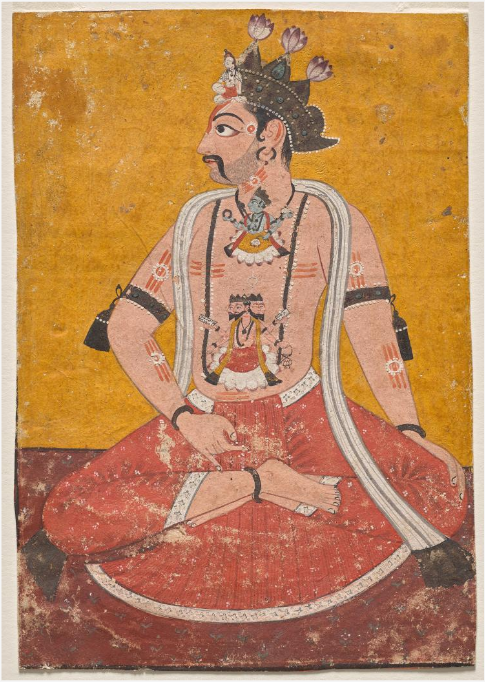
Three granthi at the base, heart, and between the eyebrows.
Bindu and Kuṇḍalinī meet in Haṭha Yoga
Early Haṭha Yoga developed along several lines. Some texts centered on bindu, with practices aimed at preserving this essence and drawing it upward rather than allowing it to be lost. Other texts developed techniques for raising Kuṇḍalinī through the central channel.
Drawing on the work of James Mallinson and the Haṭha Yoga Project, Mark Singleton distinguishes these as a “bindu model” and a “Kuṇḍalinī model.” Later texts began to combine them. The fifteenth-century Haṭhapradīpikā, for example, preserves traces of both: a technique may appear in one context concerned with controlling bindu and elsewhere in connection with raising Kuṇḍalinī.
This history helps explain why later Haṭha Yoga could contain breath practices, mudrā, bandha, nāḍī, chakra, bindu, and Kuṇḍalinī within the same broad tradition. These elements came through different historical lines and gradually met through transmission and synthesis.
From six chakras to the familiar seven
The Kubjikāmata, an influential Tantric text, uses a system of six chakras. Singleton notes that this six-center model later spread through Yoga compilations; when sahasrāra, positioned above the head, is added, the arrangement is often counted as the familiar seven.
The dominance of seven chakras today can easily obscure earlier alternatives. Different traditions arranged their centers differently, while individual chakras could be associated with deities, mantras, Sanskrit syllables, geometric forms, or their own programs of visualization. The neat image of seven circles aligned along a body preserves only one part of a much larger history.
When Yoga later entered Western esotericism, Theosophy, and twentieth-century spiritual movements, the chakra system continued to change. The final section of The Maps Inside the Body will return to that part of the story.
Sources
- James Mallinson & Mark Singleton — Roots of Yoga
- Mark Singleton — “Early Haṭha Yoga”, Routledge Handbook of Yoga and Meditation Studies
- Geoffrey Samuel — The Origins of Yoga and Tantra, Cambridge University Press
- Asian Art Museum / Smithsonian Institution — The Art of Transformation
- British Museum — “What is Tantra?”
- Cleveland Museum of Art — Man Dhata in Yogi Position (image source, Open Access)
Ayurveda / marma
In modern spas, “Marma therapy” is often promoted as a practice of pressing or massaging energy points for relaxation and healing. Many sources today refer to 108 points, while the classical system described in the Suśrutasaṃhitā records 107 marma.
Go back to the Suśrutasaṃhitā, a classical Ayurvedic work known for its discussions of anatomy and surgery, and marma appears in a very different setting. Its early history leads toward battlefields, injuries, and parts of the body that demanded particular caution from anyone using a surgical blade.
In Suśruta’s system, marma are regions where injury can have serious consequences. A wound to a marma may cause severe pain, loss of function, or death. Knowing the marma therefore meant knowing where to avoid cutting during surgery and how to judge the likely outcome of an injury.
Marma are often described where several structures of the body meet:
- māṃsa — muscle or flesh;
- sirā — vessels;
- snāyu — tendons and ligaments;
- asthi — bone;
- sandhi — joints.
Not every marma contains all five components. This classification reflects a way of observing the body closely tied to injury and surgery, while Ayurveda also associates these regions with prāṇa, the vital force within its own system of thought.
107 vital regions
The Suśrutasaṃhitā classifies marma by location, structure, and the consequences of injury. When grouped by prognosis, the 107 marma are divided into:
- 19 regions where injury may cause rapid death;
- 33 where death may follow after some time;
- 3 where removing an embedded object can be especially dangerous;
- 44 where injury may cause disability or loss of function;
- 8 primarily associated with severe pain.
These categories belong to the way classical Ayurveda assessed the consequences of wounds. They do not correspond directly to modern medical classifications of trauma.
Suśruta’s system records 107 marma. The number 108, now common in modern diagrams and Marma therapy, comes from later ways of presenting the system and should not be substituted for the number given in the classical source.
Marma in injury and surgery
Marma holds a prominent place in the Suśrutasaṃhitā, a work that devotes considerable attention to anatomy and surgery. Recognizing these regions helped healers identify places that required particular care during intervention and assess how dangerous a wound might be.
Historical studies of marma also point to links with battlefield experience in South Asia. Regions where a single strike could cause death, disability, or intense pain would clearly matter to both healers and fighters.
In this setting, classical marma looks closer to a system of vital regions to recognize and protect than to a list of points intended for massage or pressure.
Marma and prāṇa
Ayurveda does not limit marma to physical structures. Classical sources also connect these regions with prāṇa, the concept of vital force within Ayurvedic thought.
Marma therefore carries several dimensions at once:
- it relates to muscles, vessels, tendons, bones, and joints;
- it is associated with prāṇa and the activity of life;
- injury to a marma is understood through both its physical consequences and its place within the wider Ayurvedic view of the body.
This connection with prāṇa makes it easy for marma to be reduced today to “energy points.” The phrase preserves one part of the older system while leaving out the strong emphasis on injury, prognosis, and surgery.
Where does Marma therapy enter the story?
Today, marma often appears alongside marma chikitsa: massage, pressure, or other forms of stimulation applied to particular points on the body. This use needs to be distinguished from the classical descriptions in the Suśrutasaṃhitā.
Historical research notes that marma in early Ayurveda appears mainly in relation to injury, prognosis, and surgery. Its use as a therapeutic system became more explicit in later traditions. In Kerala and other parts of South India, marmmam / varmam also intersected with local medicine and martial arts.
A modern diagram of “108 marma points for healing” therefore cannot stand in for the way Suśruta originally described the system.
Is it similar to Chinese acupuncture points?
Marma and acupuncture points are often placed side by side because both mark particular locations on the body. Some lie in similar areas, yet the two systems differ in number, classification, and the theories behind them.
Classical marma is strongly tied to vital regions, bodily structures, and the consequences of injury. Acupuncture points developed within a different meridian system, together with the concepts and practices of Chinese medicine.
Where the two systems actually meet will make more sense when the maps are placed beside one another later. For now, marma keeps its Ayurvedic address.
Another way of marking the body
While chakra systems often draw attention toward the central axis, marma spreads across the head, neck, torso, arms, legs, and joints. The contrast already reveals how the same human body can be divided into important regions according to very different logics.
Some marma locations will later fall close to points emphasized by other traditions. When we reach the comparison section, we can ask where that proximity comes from and whether the systems are really describing the same thing.
Sources
- Roman Sieler — Lethal Spots, Vital Secrets: Medicine and Martial Arts in South India, Oxford University Press
History of marman, marmmam, and varmam; useful for the links between marma, warfare, surgery, and later practices. - M. R. Raghava Varier — A Brief History of Āyurveda, Oxford University Press
Background on the Suśrutasaṃhitā and the role of surgery in classical Ayurveda. - “A comparative study on marma and acupoints” — Journal of Ayurveda and Integrative Medicine
Used for comparison between marma and acupuncture points in Chinese medicine.
China: dantian, meridians, circulation
Look at a modern Chinese “energy body” diagram and you will often see dantian, meridians, acupuncture points, and a circulation loop around the body appearing all at once. Seen this way, they can easily look like parts of a single complete system that has existed from the beginning.
The history is messier. Meridians (jingluo) developed within Chinese medicine and became closely tied to acupuncture, while dantian took on important roles in Daoist meditation and internal alchemy. The Microcosmic Orbit (xiao zhoutian) belongs to internal-alchemy practices and describes a circulation route through the body.
These three elements sometimes appear together on the same diagram. Separating them makes their differences easier to see.
Meridians and the body’s network of pathways
In Chinese medicine, jingluo refers to the channel network commonly translated into English as meridians. It describes pathways linking different regions of the body, together with acupuncture points and the movement of qi. Jingluo became a foundational part of acupuncture and moxibustion theory.
Modern diagrams commonly include:
- jing — the main pathways;
- luo — branches or connecting pathways;
- acupuncture points located along particular routes;
- qi — described as moving through this network and relating to many bodily functions.
The word “meridian” can easily make a modern reader imagine an anatomical structure similar to blood vessels or nerves. The translation history of jingluo is more complicated. Modern scholarship on the history of Chinese medicine has documented repeated attempts to match meridians with nerves, blood vessels, or other biological structures, but jingluo does not correspond directly to any one anatomical system.
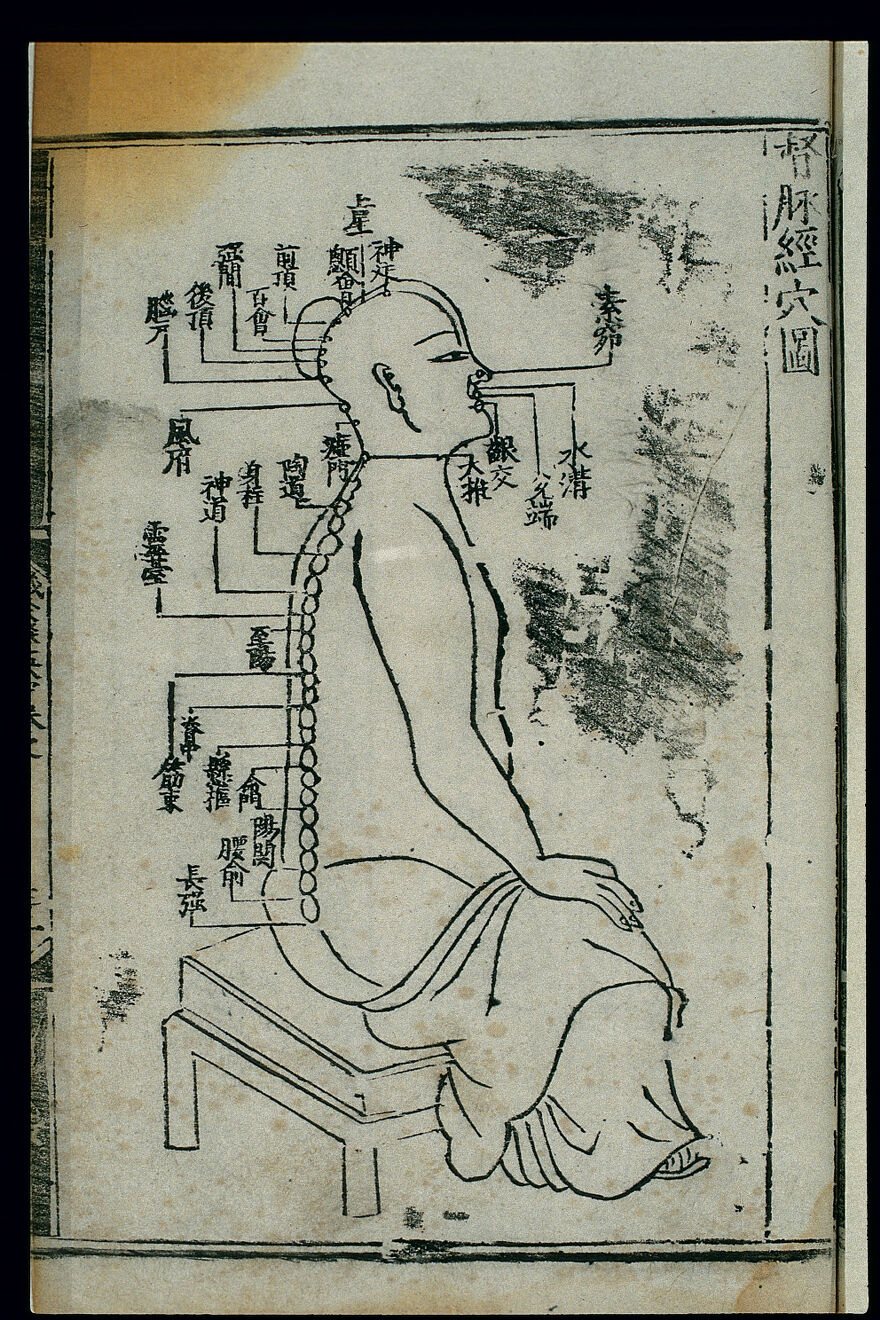
Dumai (Governor Vessel) and acupuncture points along the channel, 1537. Wellcome Collection
Three dantian within the body
Dantian means something close to “cinnabar field.” In Daoist traditions, three regions are commonly described:
- lower dantian — the lower abdomen, associated with jing (essence);
- middle dantian — the heart/chest region, associated with qi;
- upper dantian — the head, associated with shen (spirit).
The three dantian do not correspond to three specific anatomical organs. Their roles in meditation and internal alchemy vary across Daoist systems, and their locations can also shift between sources.
The lower dantian later became important in many practices involving the body and breath. Modern internet sources often call it an “energy center,” while in internal alchemy it is tied to the cultivation of jing – qi – shen. Neidan also uses images of furnaces, cauldrons, medicines, and elixirs to describe this process.
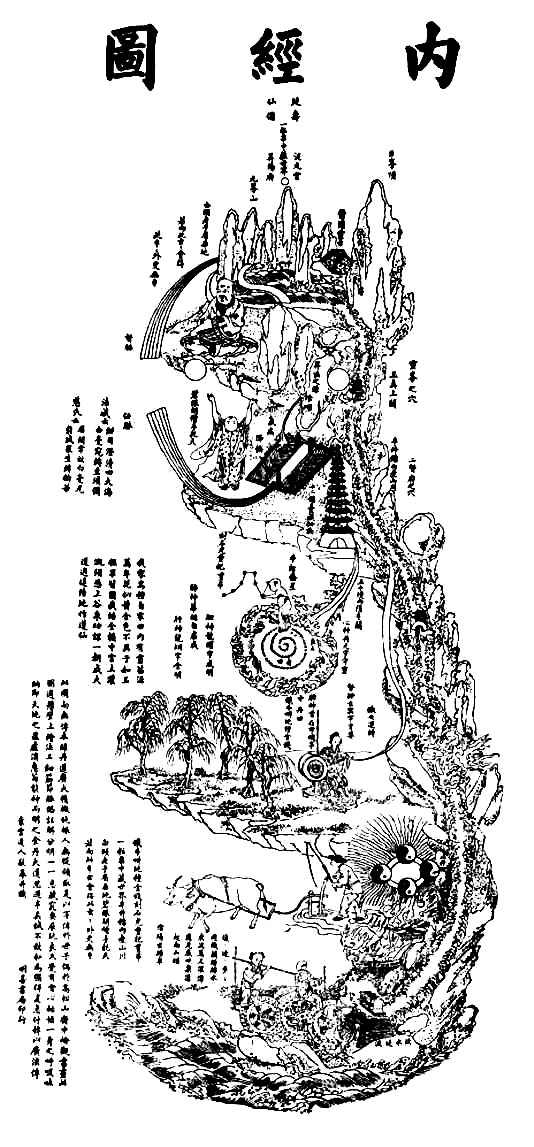
Neijing Tu, 1886 — the body represented as a Daoist inner-alchemical landscape
When the body becomes a circulation loop
In some systems of internal alchemy, the Microcosmic Orbit links the Dumai (Governor Vessel) along the back of the body with the Renmai (Conception Vessel) along the front.
The route is commonly described as:
- rising along the back of the body;
- passing through the Three Gates / sanguan;
- reaching the upper dantian;
- descending along the front of the body;
- returning to the lower dantian.
In Neidan sources, the Microcosmic Orbit forms part of a wider alchemical process. It appears alongside concepts such as jing, qi, shen, “fire timing,” the three dantian, and different stages of internal cultivation.
One circle, many versions
Today, the Microcosmic Orbit often appears in qigong as a fairly simple route: up the back, over the head, and down the front of the body. The diagram is easy to follow, while its meaning and practice vary across lineages and historical periods.
Within internal alchemy, the name Microcosmic Orbit can refer to different parts of the process depending on the source. Some use it for a specific stage, while others place it within a larger system that includes both the Lesser and Greater Celestial Circuits.
When the three elements overlap
If all three are placed on a single body and labeled together as a “Chinese energy system,” much of the distinction between them disappears:
- a medical network of pathways;
- central regions used in meditation and internal alchemy;
- a circulation process within internal-alchemy practice.
Modern diagrams become especially easy to misread at these points of overlap. The lower abdomen, for example, is the lower dantian in many Neidan systems. Channels in Chinese medicine also pass through or near this region, while in the Microcosmic Orbit it commonly serves as a point of departure and return. The locations may sit close together, but each system gives them its own function and meaning.
Sources
1. Stanford Encyclopedia of Philosophy — “Religious Daoism”
Used for the three dantian, jing–qi–shen, and their roles in meditation and internal alchemy.
2. Fabrizio Pregadio — “Cinnabar Fields (Dantian)”, Golden Elixir
A specialist source on Daoist internal alchemy and the three dantian.
Used for the three dantian, jing–qi–shen, and their roles in meditation and internal alchemy.
2. Fabrizio Pregadio — “Cinnabar Fields (Dantian)”, Golden Elixir
A specialist source on Daoist internal alchemy and the three dantian.
3. Fabrizio Pregadio — “Xiao zhoutian 小周天 — Lesser Celestial Circuit”, Neidan Dictionary
Used for the Microcosmic Orbit, Dumai, Renmai, and circulation in internal alchemy.
Used for the Microcosmic Orbit, Dumai, Renmai, and circulation in internal alchemy.
4. Wang Mu — Foundations of Internal Alchemy
Used for the Three Gates, stages of the Microcosmic Orbit, and the wider Neidan framework.
Used for the Three Gates, stages of the Microcosmic Orbit, and the wider Neidan framework.
5. National Library of Medicine — MeSH: Meridians / Jingluo
Background definition of jingluo in Chinese medicine and acupuncture.
Background definition of jingluo in Chinese medicine and acupuncture.
6. Lan A. Li — Body Maps: Improvising Meridians and Nerves in Global Chinese Medicine, Johns Hopkins University Press
History of how meridians were visualized and translated, especially attempts to connect jingluo with nerves and modern anatomy.
History of how meridians were visualized and translated, especially attempts to connect jingluo with nerves and modern anatomy.
Tibetan subtle body
Mention “Tibetan chakras” online and the familiar seven rainbow-colored circles are often carried straight into the Himalayas with a few terms renamed. Tibetan Vajrayana does not use a single seven-center diagram. Kalachakra, for example, describes six chakras along the body, while other lineages arrange their centers differently.
Tibetan Vajrayana traditions inherited many ideas from Indian Buddhist Tantra and developed them in their own directions. Alongside khorlo (chakra), sources on the Tibetan subtle body frequently refer to tsa, lung, and thigle — channels, winds, and “drops” or essences.
Tsa, lung and thigle
In Vajrayana practices involving the subtle body, tsa, lung, and thigle play different roles:
.- tsa (rtsa) — channels running through the subtle body;
- lung (rlung) — “winds” moving through the channels;
- thigle (thig le) — “drops” or essences whose meanings vary across systems and practices.
Thigle carries different meanings depending on the source. It may refer to red and white essences, “drops” used in tantric practice, or more abstract meanings. Equating thigle with a single type of bodily fluid narrows the term considerably.
Three main channels and the wheels
In many Tibetan Vajrayana practices, the subtle body includes a central channel running along the body, accompanied by two channels on either side. Smaller branches extend from them, while multiple channels meet at the khorlo.
The number and position of khorlo vary by tantra and lineage. A Kalachakra diagram annotated by the Rubin Museum, for example, uses six centers:
- crown of the head;
- forehead;
- throat;
- heart;
- navel;
- genital region.
Some of these locations overlap with or lie close to familiar centers in Indian chakra systems. Their organization, meanings, and associated practices depend on the particular Vajrayana tantra.
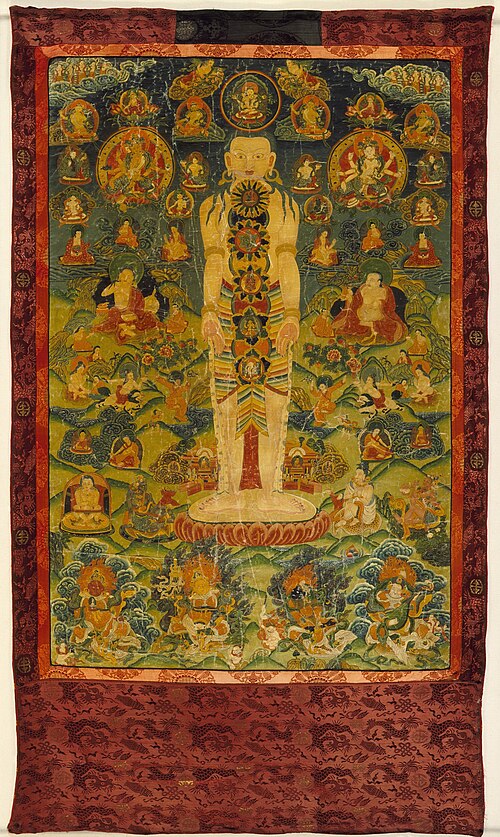
Cosmic Man with Diagrams of Newar Yogic Six Chakra Transformation, Tibet, c. 19th century. Los Angeles County Museum of Art (LACMA)
Winds and mind
In tantric sources, lung is a “wind” connected with breath, bodily activity, and mind. Many Vajrayana practices also place the movement of lung in a close relationship with mental activity.
Practitioners combine breath, posture, and visualization of the channels to influence how lung moves. This process accompanies meditation and changes in the mind.
Techniques may combine:
- breathing and breath retention;
- posture or bodily movement;
- visualization of channels and centers;
- directing lung into the central channel;
- working with thigle in some systems;
- mantra and accompanying meditation techniques.
Tummo: when the map begins to move
Tummo (gtum mo), commonly translated as “inner heat,” uses tsa, lung, thigle, and khorlo within the same process of practice. In some Vajrayana lineages, practitioners combine breath, posture, and visualization to direct the winds into the central channel.
Traditional descriptions also refer to heat around the navel and changes involving thigle during this process. Experiences of heat, bliss, and deep meditation also appear within the wider Vajrayana path of practice.
Chakras vary across tantras
When modern posters compress Vajrayana diagrams into a fixed row of chakras, many differences between tantras disappear. Kalachakra has its own arrangement, while other tantras and lineages use different numbers of centers, positions, channel configurations, and techniques.
The phrase “Tibetan chakras” can easily group several different systems under one name. To understand what a diagram is describing, we need to know which tantra and lineage it belongs to and how it is used in practice.
A figure with three channels running through the body and circles placed at the head, throat, heart, or navel can look very similar to the familiar chakra system. The tantra, lineage, and practices surrounding the diagram reveal which system it actually belongs to.
When the body becomes an inner mandala
Some Vajrayana practices organize the body according to the logic of a mandala: channels, winds, essences, centers, deities, and stages of meditation form a single structure. Other traditions also connect this inner structure with cosmology, time, death, the intermediate state, and rebirth.
Kalachakra places the human body alongside the structure of the cosmos. It links regions within the body to elements of the outer world, while the khorlo also form part of this “inner universe.”
Reducing this whole structure to a few “energy centers” leaves out many of the relationships between channels, winds, thigle, khorlo, and the techniques used in practice.
Sources
- Naomi Worth — The Enlightenment of the Body: The Theory and Practice of Winds and Channels Yoga at Namdroling Monastery and Nunnery in South India, University of Virginia
Research on rtsa, rlung, thigle, the subtle body, and inner-heat practice in a contemporary Vajrayana lineage. - Naomi Worth — “One’s Own Body of Pure Channels and Elements”, Religions
Research on tsa-lung-tummo and the relationship between bodily practice and Tibetan Buddhist thought. - University of Virginia — Mandala Collections, “The Varieties of Tibetan Buddhist Meditation”
Background on inner-body practices, channels, winds, and the Vajrayana subtle body. - Rubin Museum of Himalayan Art — Kalachakra Cosmology Illustration
Reference for Kalachakra cosmology, the inner body, channels, and six chakras. - David B. Gray — The Buddhist Tantras: A Guide, Oxford University Press
Historical background on Indian Buddhist Tantra and its development within Tibetan Buddhism. - Image source — Cosmic Man with Diagrams of Newar Yogic Six Chakra Transformation, LACMA (Public Domain)
Sufi lataif + Kabbalah
Search online for “Sufi chakras” or “Jewish chakras” and you will quickly find diagrams placing colored points across the chest, head, or body and linking them to chakra. At a glance, it is easy to assume that Sufi traditions and Kabbalah simply have their own versions of the same system of energy centers.
Older sources point in a different direction. Lataif and sefirot emerged from very different conceptual systems. Jewish mysticism and the Sufi world did have areas of historical contact, but that did not make these two structures versions of the same system. Modern diagrams often bring them closer together, especially when both are placed on the human figure and compared with chakra.
Lataif: subtle points of inner life
Latifa roughly means “the subtle”; its plural is lataif. Across the history of Sufi traditions, the term developed into different systems with varying numbers, names, colors, and locations.
One influential early example comes from ʿAlāʾ al-Dawla Simnani (1261–1336). He developed a system of seven lataif associated with spiritual levels, colors, and prophetic figures. This system belonged to the Kubrawi tradition and differed from the later Naqshbandi-Mujaddidi arrangement that became more familiar.
In Naqshbandi-Mujaddidi traditions, lataif continued to take new forms. One influential arrangement includes:
- qalb — “heart”;
- ruh — “spirit”;
- sirr — “secret”;
- khafi — “hidden”;
- akhfa — “most hidden”;
- nafs — the “self” or ego.
In some modern Mujaddidi lineages, the first five lataif are placed around the chest, while nafs is associated with the area between the eyebrows. Each latifa may also correspond to a color and a prophetic figure. This arrangement developed through several historical stages; earlier sources record different configurations.
From “points” to practice
In these traditions, lataif are used alongside muraqaba (meditative contemplation), dhikr (remembrance of God), and other stages of spiritual practice. Practitioners direct attention toward individual lataif in a particular sequence as part of spiritual cultivation and transformation within the Sufi tradition.
Because some lataif are placed on the chest and are associated with colors and a sequence of practice, modern diagrams can easily make them look similar to chakra. A study of contemporary Naqshbandi-Mujaddidi practice also notes that Western audiences may associate lataif with chakra, even though practitioners within the tradition emphasize that the two systems are different.
The number of lataif varies across lineages and periods. Shah Wali Allah of Delhi (1703–1762), for example, developed a system of as many as fifteen lataif, while many other Mujaddidi traditions use ten-part structures or shorter variations.
Kabbalah: from sefirot to the human figure
Kabbalah follows a different path. The sefirot are ten emanations or aspects through which the infinite divine, Ein Sof, relates to the world. They hold a central place in Kabbalah and are often arranged in the structure commonly known as the Tree of Life.
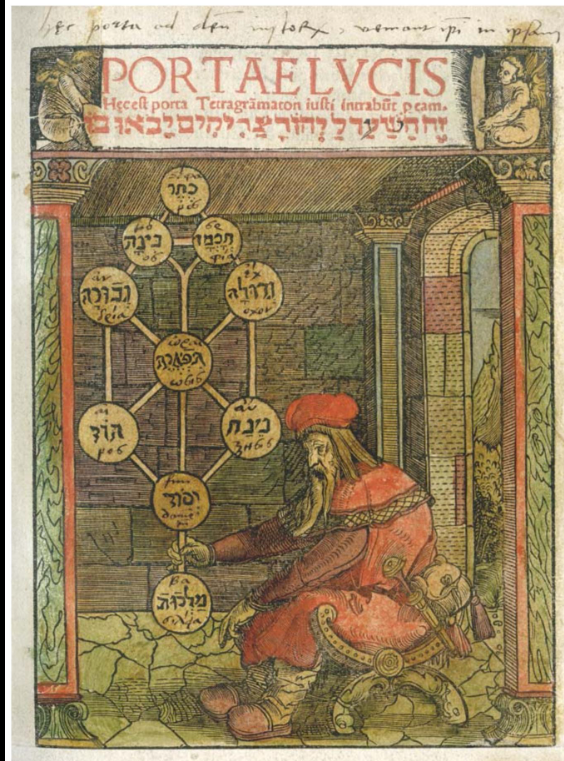
Portae Lucis (1516) — a diagram of the ten sefirot on the title page of an early printed Kabbalistic work
Portae Lucis (1516) — a diagram of the sefirot in an early modern Kabbalistic print.
The ten sefirot are:
- Keter — Crown;
- Chokhmah — Wisdom;
- Binah — Understanding;
- Chesed — Loving-kindness;
- Gevurah — Strength / Judgment;
- Tiferet — Beauty;
- Netzach — Endurance;
- Hod — Splendor;
- Yesod — Foundation;
- Malkhut — Kingdom.
When the sefirot are arranged on a human figure, positions around the head, sides of the body, center, and lower regions can easily look like “points on the body” to modern eyes. Within Kabbalah, however, this arrangement concerns relationships among divine powers and the structure of the cosmos.
Adam Kadmon: the human figure as a form of the cosmos
With Adam Kadmon, the human figure takes on another role in Kabbalah. The concept appears in Kabbalah from the thirteenth century onward and later assumes a particularly important place in the sixteenth-century system of Isaac Luria. Adam Kadmon represents the totality of divine powers expressed in human form; in Lurianic Kabbalah, it is also the first emanation after the process of tzimtzum.
The head, torso, and limbs of Adam Kadmon belong to the cosmological and theological language of Kabbalah. The human body serves here as a framework for describing the structure of divinity and the worlds, with a function entirely different from that of a therapeutic map of the physical body.
Ilan Ha-Kabbalah (1691) — a diagram of Adam Kadmon in the Lurianic Kabbalistic tradition.
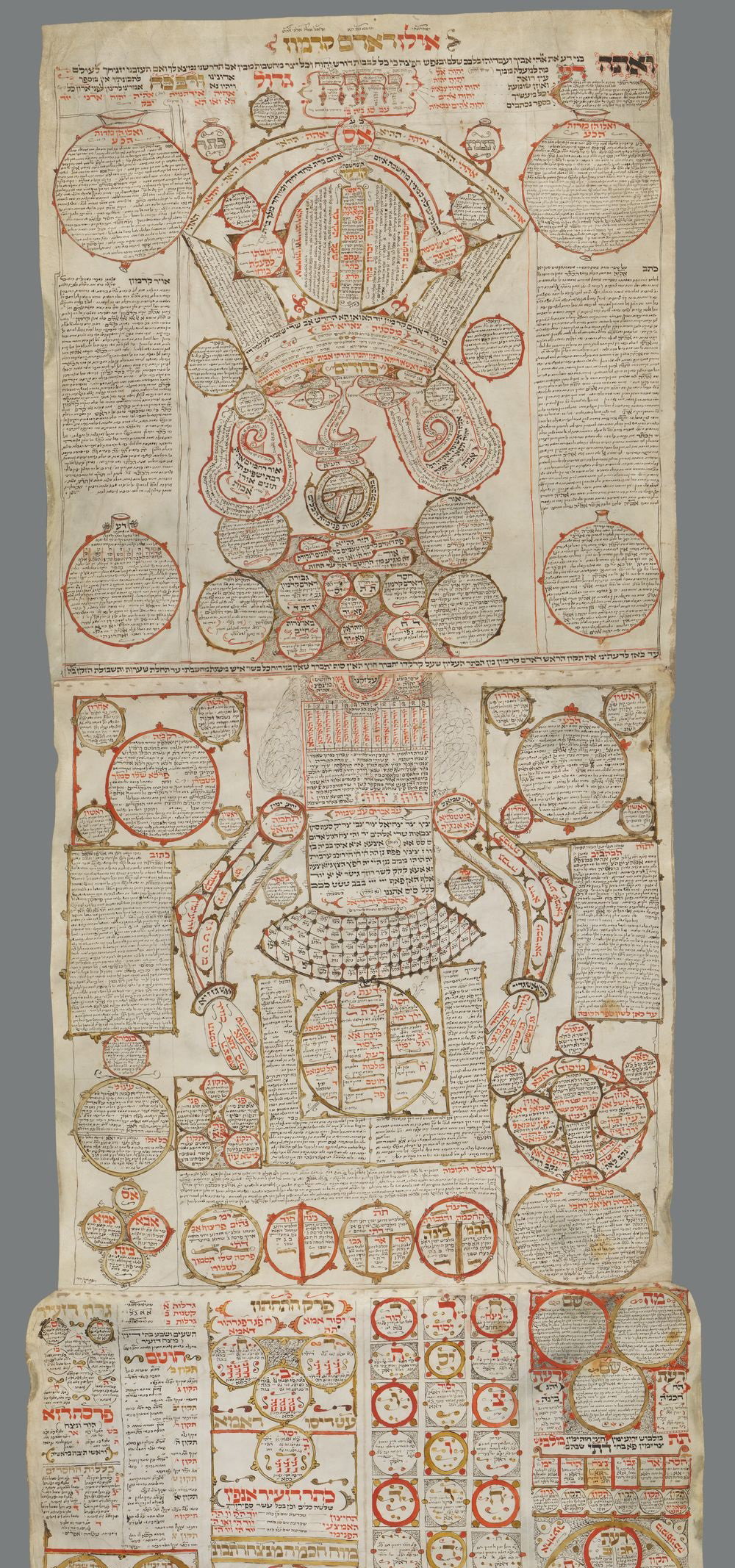
Ilan Ha-Kabbalah (late 17th century) — Adam Kadmon represented within a Lurianic Kabbalistic diagram
When two traditions are pulled toward chakra
Lataif and sefirot can both appear on the human figure, but each uses that figure according to a different logic:
- lataif — subtle components of the human being in some Sufi lineages, connected with spiritual practice and inner transformation;
- sefirot — the structure of divine emanations in Kabbalah, sometimes arranged in human form;
- Adam Kadmon — the primordial human figure used to express a cosmological and theological structure.
Their visual similarities make them easy to rename as “Sufi chakras” or “Jewish chakras.” Once those modern labels are set aside, each system uses the human figure to address a different set of concerns.
Sources
- Marcia K. Hermansen — “Shāh Walī Allāh’s Theory of the Subtle Spiritual Centers (Laṭāʾif): A Sufi Model of Personhood and Self-Transformation”, Journal of Near Eastern Studies
- Marcia K. Hermansen — “Shah Wali Allah’s Arrangement of the Subtle Spiritual Centers”, Loyola University Chicago
- Encyclopaedia Iranica — “ʿAlāʾ-al-Dawla Semnānī”
- Michael E. Asbury — “Naqshbandi Mujaddidi Mysticism in the West: The Case of Azad Rasool and His Heirs”, Religions
- My Jewish Learning — “What Are the Sefirot?”
- Cambridge University Press — “Adam Kadmon”, Joseph Dan
- My Jewish Learning — “Isaac Luria and Kabbalah in Safed”
- Portae Lucis, 1516 — image source
- Ilan Ha-Kabbalah, late 17th century — Bayerische Staatsbibliothek, Cod.hebr. 450 — image source
When the maps overlap
We have now moved through many ways humans have marked the body: chakra and nadi in Tantra, marma in Ayurveda, dantian and meridians in China, tsa–lung–thigle in Tibetan traditions, lataif in Sufism, and finally sefirot and the human figure in Kabbalah. Some systems focus on centers, others on pathways, flows, or regions given particular significance. Each tradition builds its own structure through its own language, purpose, and history.
Place these maps side by side and certain regions of the body keep appearing. The head and forehead, throat, chest, abdomen, pelvis, and central axis return again and again even as their names and functions change. In this section, we will look at where the maps genuinely meet, where they merely share a location, and why traditions that developed far apart so often chose some of the same regions of the body.
Regions that keep appearing
The head and the area between the eyebrows appear across several traditions. Tantra and Yoga include chakra around the head or forehead; some Mujaddidi lineages place nafs between the eyebrows; the upper dantian of Chinese internal alchemy is associated with the head. Some Tibetan systems also give an important role to centers at the crown or forehead.
The chest appears repeatedly as well. The heart chakra in many Tantric systems, the middle dantian of Chinese internal alchemy, and the lataif around the chest in some Mujaddidi lineages all place emphasis on this region. Kabbalah may also arrange sefirot on the human figure, with several positions running through the torso, although their function belongs to a very different theological and cosmological structure.
The abdomen and navel recur across several systems. The lower dantian holds an important place in many Chinese practices, while Tantric and Vajrayana systems often include a center around the navel or lower abdomen. Tummo, for example, commonly situates the practice of inner heat around the navel region.
The lower body is also frequently marked. Some Tantric and Tibetan systems place centers around the pelvis or genitals, while Chinese internal alchemy often treats the lower dantian as a major point of concentration in the lower torso. Marma extends much more widely across the body, from the head, neck, and torso to the limbs, so it cannot simply be fitted onto the same vertical axis as chakra or dantian.
Similar location, different function
A point on the chest can carry very different meanings. In a Tantric system, it may be a chakra associated with mantra, deities, geometry, and visualization practice. In a Sufi lineage, a latifa in the chest belongs to a process of spiritual cultivation and inner transformation. The middle dantian in Chinese internal alchemy belongs to another conceptual framework involving jing, qi, and shen.
The same applies to the head, abdomen, or pelvis. A location on the body tells us where a tradition directs attention. Its function depends on the larger system it belongs to: medicine, meditation, internal alchemy, theology, cosmology, or ritual practice.
Two diagrams can place points close together while referring to very different things.
Body region | System / tradition | Term | Role in its original context |
|---|---|---|---|
Head / forehead | Tantra / Yoga | Ajna, Sahasrara | Centers within the subtle body and meditative practice |
Chinese internal alchemy | Upper dantian | Region associated with shen and internal alchemical practice | |
Sufi Mujaddidi | Nafs | In some lineages, associated with the area between the eyebrows | |
Tibetan Vajrayana | Khorlo at the head / forehead | A center in some tantric systems and subtle-body practices | |
Chest | Tantra / Yoga | Anahata | Chakra associated with mantra, deities, geometry, and practice |
Chinese internal alchemy | Middle dantian | Region associated with qi in the transformation of jing–qi–shen | |
Sufi Mujaddidi | Qalb, ruh, sirr, khafi, akhfa | Lataif involved in spiritual practice and inner transformation | |
Abdomen / navel | Chinese internal alchemy | Lower dantian | Important region in bodily cultivation and internal alchemy |
Tantra / Yoga | Navel chakra | A center in some subtle-body systems | |
Tibetan Vajrayana | Khorlo at the navel | Important in some tantric systems and tummo practice | |
Pelvis / lower body | Tantra / Yoga | Root / genital-region chakra | Centers found in some Tantric systems |
Tibetan Vajrayana | Khorlo in the genital region | Appears in some tantric systems, including Kalachakra | |
Central axis / vertical pathway | Tantra / Yoga | Sushumna nadi | Central channel in many subtle-body practices |
Tibetan Vajrayana | Avadhuti / central tsa | Central channel associated with lung, thigle, and meditation | |
Front–back circuit | Chinese internal alchemy | Renmai–Dumai / Microcosmic Orbit | Circulatory route rising along the back and descending along the front of the body |
When history creates overlap
Some similarities developed through historical contact. Tibetan Vajrayana absorbed many elements from Indian Tantra and later developed systems of tsa, lung, thigle, and khorlo within its own lineages. Ayurveda and Tantra also developed within the broader South Asian environment, although marma and chakra served different purposes.
Sufi traditions and Jewish mysticism likewise developed in environments where Jewish and Muslim communities exchanged ideas and participated in overlapping cultural worlds. Such contact created opportunities for concepts, language, and practices to cross communal boundaries, although the direct relationship between lataif and sefirot is far too limited to treat one as a copy of the other.
In cases like these, similarities may reflect exchange, inheritance, or development within a shared cultural environment. Tracing the degree of influence requires attention to texts, chronology, and the historical transmission of each tradition.
Regions of the body we readily feel
Some similarities may also have developed independently. People in different cultures still inhabit bodies with broadly similar structures. Breathing moves the chest and abdomen; the heartbeat produces clear sensations in the chest; hunger, stress, and fear often register in the abdomen; the voice draws attention to the throat; vision and the felt presence of the head can make the face and forehead especially salient regions.
Traditions therefore often bring these regions into meditation, ritual, medicine, or symbolic language. Two traditions may choose the same part of the body even without direct borrowing.
These locations continue to appear in modern diagrams because the body already provides sensory landmarks that people can readily recognize and use as points of reference.
The central axis and the pull of a straight line
Many modern illustrations feature a vertical axis running from the head down through the body. Tantric diagrams often arrange nadi and chakra around a central channel, while some Tibetan systems also use a central channel alongside lateral ones. The Microcosmic Orbit of Chinese internal alchemy follows a different pattern, rising along the back and descending along the front of the body.
On a flat page, these structures can easily be collapsed into a single “energy line.” Yet the central axis of Tantra, the central channel in some Tibetan systems, and the circulation of the Microcosmic Orbit belong to three different logics. Drawing them on the same upright human figure can make the traditions look much closer than their actual histories suggest.
When maps look more alike after being redrawn
The feeling that “all these systems are basically the same” also comes from the way they are presented today. A front-facing human figure, colored circles, a line running down the center of the body, and labels placed alongside it have become familiar elements of Internet graphics.
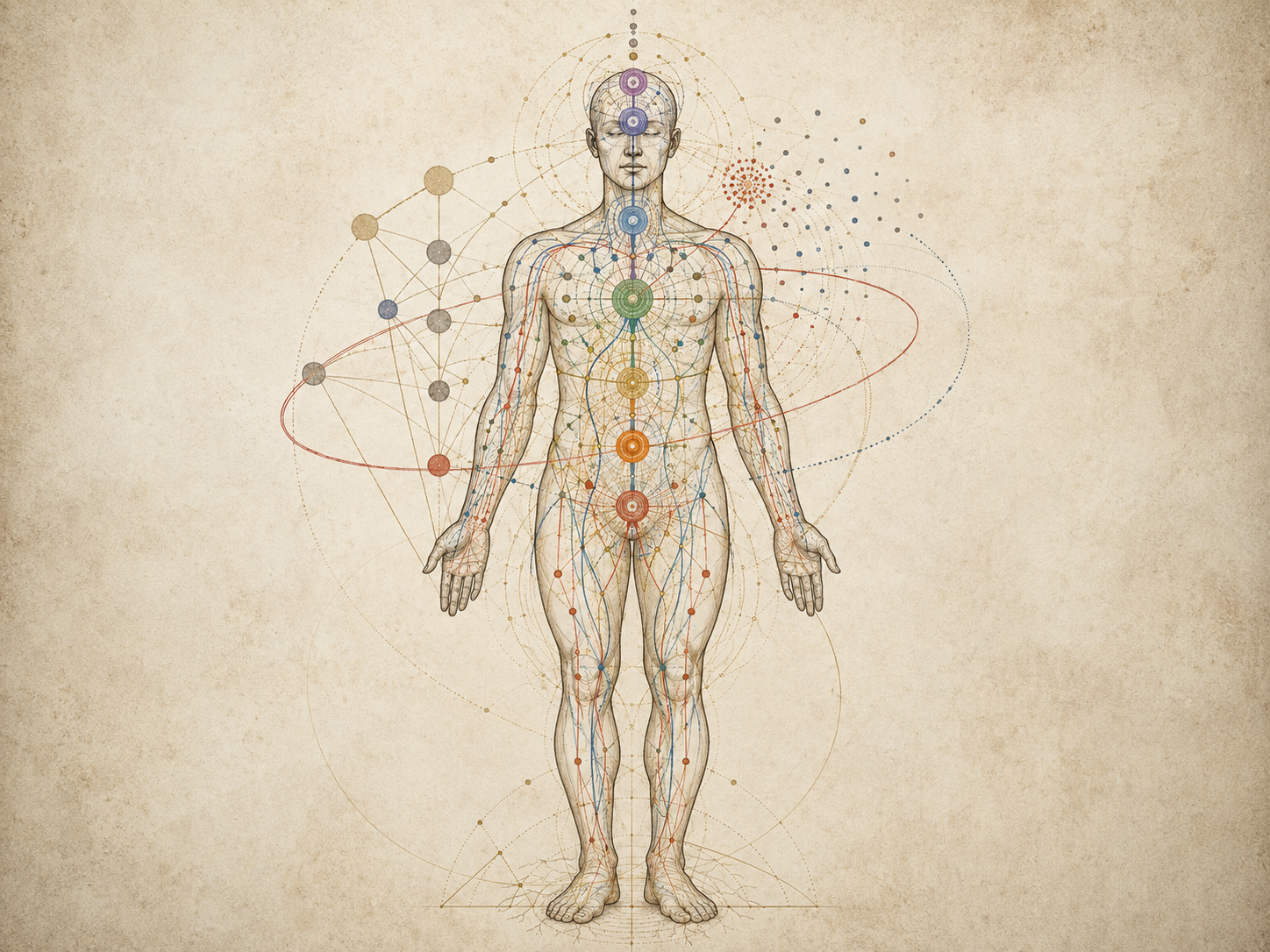
A modern composite diagram of body centers and pathways
When a tradition that originally used texts, mandalas, internal-alchemical landscapes, or medical diagrams is transferred onto the same human-body template, the visual distance between systems naturally shrinks. The design itself begins to create a sense of similarity.
The boundary between comparison and fusion can easily blur at this stage. Chakra, dantian, lataif, marma, meridians, and sefirot may all appear on a single body diagram, then a few steps later become different names for one supposedly universal “energy system.”
How far do the maps overlap?
Some regions of the body recur. Some lines of historical influence can be traced. Other similarities may arise from the human body itself and from the ways we experience it.
The challenge is to keep these possibilities separate long enough to examine each case clearly. A shared location does not automatically turn two concepts into one, and a similar-looking diagram does not tell the whole history behind it.
Placed side by side, the maps still reveal how different traditions used the same human body to build very different structures of life, mind, spiritual practice, and the cosmos.
The modern human energy system
Across the previous sections, chakra, marma, dantian, meridians, tsa–lung–thigle, lataif, and sefirot each emerged with their own histories and functions. During the nineteenth and twentieth centuries, Asian and European traditions increasingly entered the same worlds of publishing, esotericism, and comparative study, gradually shifting some of those boundaries. Elements that once belonged to different systems began to be assembled into a new image: the human body marked by centers, pathways, colors, and psychological or spiritual functions.
The most familiar version of this image revolves around seven chakra running along the body. Each chakra has a rainbow color and a bodily region, sometimes accompanied by an endocrine gland, nerve plexus, emotion, psychological quality, element, sound, or spiritual function. The structure is now so familiar that it can easily seem ancient and complete from the beginning.
Its history, however, involved many stages of assembly.
From Tantra to the Western seven-chakra system
Indian Tantric traditions used many different chakra arrangements. Some systems described six centers together with sahasrara at the crown, while others used different numbers, locations, and functions. The familiar seven-chakra model is one branch within a much broader history of the Indian subtle body.
By the late nineteenth century, Theosophy had become an important bridge bringing chakra into Western esotericism. Helena Blavatsky and later Theosophical writers placed Indian terminology within a new framework of subtle bodies, spiritual evolution, and planes of existence. In the early twentieth century, Annie Besant, C. W. Leadbeater, Alice Bailey, and others continued to expand this framework.
Another route came through the study and translation of Tantra. The Serpent Power by Arthur Avalon (Sir John Woodroffe), published in the early twentieth century, introduced English-language readers to two Sanskrit texts on chakra and Kundalini with extensive commentary. The book strongly influenced how Western readers pictured a chakra system running through the body.
Ideas moved continuously between scholars, esoteric groups, modern Yoga, and spiritual communities during this period.
Where did the rainbow colors come from?
Chakra in Tantric texts have colors, geometry, deities, mantra, and many other attributes. The familiar red–orange–yellow–green–blue–indigo–violet sequence belongs to the modern Western history of chakra.
From around the 1930s, some Western writers and color therapists began arranging chakra according to the visible spectrum. By the 1970s, the color sequence was being combined with psychological themes such as survival, sexuality, power, love, communication, intuition, and spiritual life. By 1977, Western chakra models were combining rainbow colors with a relatively developed set of psychological associations.
Anodea Judith’s Wheels of Life, published in 1987, further popularized the pairing of chakra, rainbow colors, and psychological themes within New Age culture.
The familiar structure developed gradually through Western esotericism, color therapy, the human potential movement, New Age culture, and other modern practices.
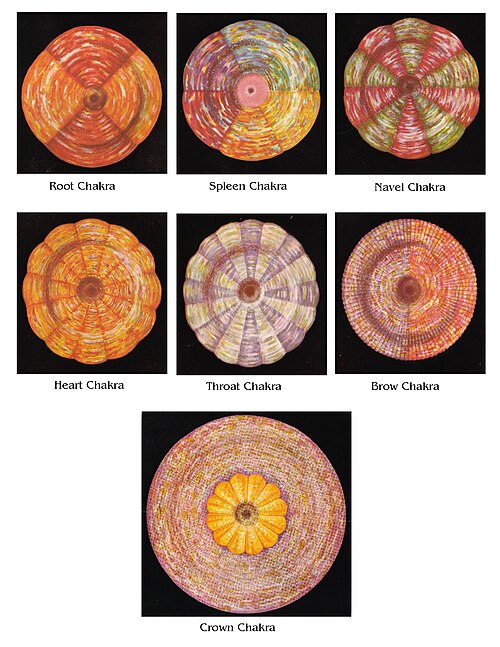 The chakras according to C. W. Leadbeater, from The Chakras (1927)
From esoteric centers to a psychological map
During the twentieth century, writers increasingly attached psychological qualities to chakra. The centers came to be associated with themes such as survival, sexuality, personal power, love, communication, intuition, and spiritual life. Popular psychology, the human potential movement, New Age culture, and healing traditions helped carry these associations into mainstream spiritual culture.
A modern diagram might link Muladhara with safety, Anahata with love, Vishuddha with communication, or Ajna with intuition. These labels are now common within wellness culture, but they emerged much later than the Tantric chakra systems themselves.
Across the twentieth century, psychological language became increasingly common in descriptions of chakra.
Chakra and the endocrine glands
One of the most familiar modern pairings places the seven chakra alongside the endocrine glands. A common version links Muladhara with the adrenal glands, Svadhisthana with the gonads, Manipura with the pancreas, Anahata with the thymus, Vishuddha with the thyroid, Ajna with the pituitary gland, and Sahasrara with the pineal gland.
Modern authors, however, have never agreed completely on these correspondences. Muladhara has been paired with either the adrenal glands or the gonads, while Ajna and Sahasrara have sometimes traded places between the pituitary and pineal glands. Correspondence charts already appeared in several variations during the early decades of the twentieth century.
In 1928, Cajzoran Ali brought chakra and the endocrine glands together in a single model in Divine Posture Influence upon Endocrine Glands. Later authors continued to alter the pairings before such charts became a familiar feature of modern chakra diagrams.
Tantric texts predate modern endocrinology and describe chakra through a very different vocabulary. The two structures can be placed beside one another to build a symbolic or practical model. Physical proximity alone does not make a chakra an endocrine gland in anatomical terms.
When other maps join the system
Chakra became the most familiar framework, and the process of synthesis continued beyond India. Chinese dantian and meridians, Ayurvedic marma, Tibetan tsa, Sufi lataif, Kabbalistic sefirot, and many other terms began appearing together in books, courses, healing practices, and diagrams of the “energy body.”
A modern diagram may place chakra along the central axis, meridians across the body, an aura around it, dantian in the abdomen, and lataif around the chest. Each element keeps its original name, yet the finished image can make them look as though they always belonged to a single structure.
The Internet accelerated this process. Images are copied, simplified, and redrawn, while their sources can disappear after only a few rounds of reposting. Terms that once belonged to separate traditions gradually become part of a shared vocabulary for a global “energy body.”
A new system assembled from many inheritances
The modern “human energy system” has a history of its own. It developed through translation, Theosophy, Western esotericism, modern Yoga, New Age culture, popular psychology, alternative healing practices, and Internet culture. Many of its components have ancient roots, while their assembly into a single system is much more recent.
Modern practices can still carry meaning for the people who use them. History helps distinguish older inheritances from elements added later. A modern synthesis also has its own history worth studying.
Looking back across all the maps in this series, the human body is their clearest point of contact. Across many periods, people have marked it with important points, pathways, flows, and ideas about the life within it. These maps also record how different eras understood the human being, life, and the world around them.
Image source: Wikimedia Commons — C. W. Leadbeater, The Chakras (1927), Public Domain.