Part IV
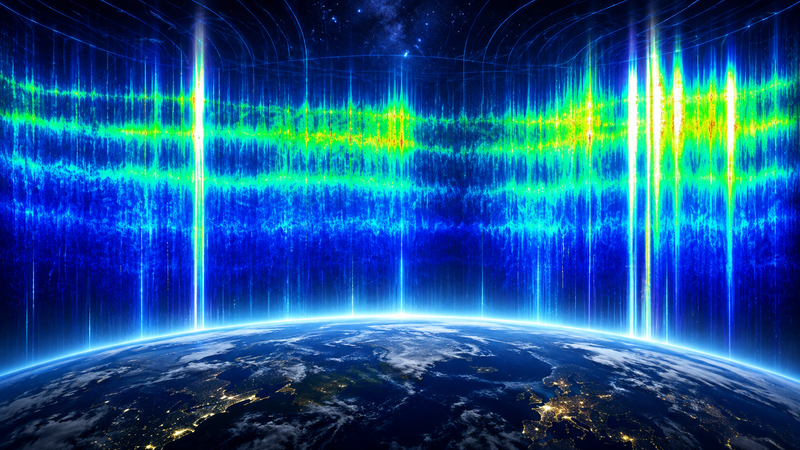
Schumann resonance and the pull of “frequency”
The word “frequency” has a peculiar attraction. It belongs to the language of measurement and physics, yet its meaning is broad enough for people to attach all sorts of ideas to it.
The attraction becomes even stronger when the brain enters the picture. Neurons produce electrical activity, EEG records oscillations at different rates, and the environment around us is full of electromagnetic waves. Place Earth beside those facts and the idea of the human brain resonating with the planet appears almost immediately.
Schumann resonance is a real physical phenomenon. Between Earth’s surface and the ionosphere lies a natural electromagnetic cavity, where extremely low-frequency waves generated by lightning around the planet can form resonant modes. The lowest mode is usually around 7.8 Hz, followed by others near 14, 20, 26 and 33 Hz. These values shift slightly with ionospheric conditions, time of day and atmospheric activity.
The number 7.83 Hz, in particular, later became the star of the story.
Human EEG also contains oscillatory bands measured in hertz. Theta occupies the lower frequencies, alpha sits roughly around 8–12 Hz, while beta and gamma lie higher. Put the two sets of numbers side by side and their proximity makes it easy to wonder whether the brain is somehow “falling into step” with Earth.
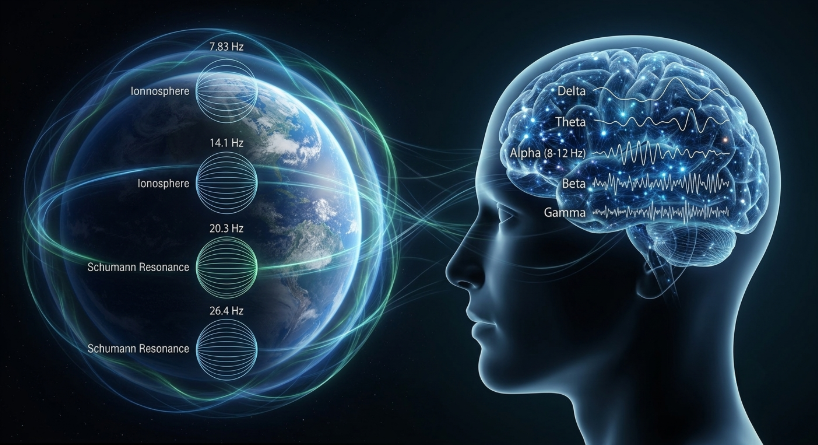 Schumann and EEG: nearby frequency bands.Similar numbers still do not tell us that two systems are resonating with one another.
A musical instrument and a bridge can share matching frequencies on paper. To know whether they actually interact, we also need to understand signal strength, how energy could pass from one system to the other, and whether the receiving system responds.
Schumann resonance adds another complication: the signal is extremely weak. Its magnetic component is typically in the picotesla range (pT), meaning around one trillionth of a tesla, or 10⁻¹² T. Finding a brain oscillation and a Schumann mode in a similar frequency range establishes numerical similarity; biological resonance would also require a plausible mechanism linking the two systems.
Science has looked for that link in several ways.
In 2005, Mitsutake and colleagues followed 56 people for seven days and compared blood pressure and heart rate across days with different levels of Schumann activity. A QEEG study published in 2016, involving 184 participants, also reported spectral peaks near several Schumann modes, around 7–8, 13–14 and 19–20 Hz, although the pattern did not appear consistently across everyone.
Results like these remain correlational or based on spectral similarity. A causal mechanism showing that Schumann resonance directly regulates human brain activity or physiology has not been established.
Recent reviews still treat extremely low-frequency electromagnetic fields and biological systems as an open area of research. Proposed mechanisms involve ions, cellular bioelectricity, circadian regulation and neural activity, but current evidence remains unsettled on both mechanism and specific health effects.
The trouble begins when the word “resonance” leaves the laboratory.
Online, 7.83 Hz is often described as:
- “the heartbeat of the Earth”;
- “the natural frequency of the human body”;
- a frequency for healing or restoring balance;
- a marker of “raising frequency” or awakening consciousness.
Another branch of the story comes from the colourful images of Schumann spectrograms. These plots show signal intensity across time and frequency, usually through different colour bands. Bright or white areas are often shared online as evidence that “Earth’s frequency has just increased”.
A bright region on a spectrogram means that stronger signal intensity was recorded in that part of the plot. If a receiver reaches its display limit, encounters local interference or picks up strong broadband activity, white regions can also appear.
A brighter patch may indicate stronger recorded intensity; it does not mean that the Schumann modes have shifted to a new frequency.
Schumann resonance also contains several modes rather than revolving around 7.83 Hz alone. Their frequencies fluctuate around familiar ranges, while amplitude can vary considerably with lightning, ionospheric conditions and other atmospheric factors. Saying that “Earth has jumped from 7.83 Hz to 20 Hz” because a spectrogram turns white mixes two different quantities: frequency and amplitude.
The idea of resonance remains powerful because it fits human intuition so easily.
Two instruments can vibrate together. Two people can fall into the same tempo. A room can feel completely different when everyone begins to sing. Experiences like these make the idea of the brain “tuning in” to an electromagnetic field around the planet sound both elegant and plausible.
Physics asks for more than intuitive resemblance. Signal strength, energy transfer and the response of the receiving system all have to be examined.
At the moment, three separate facts stand on their own:
- the brain produces measurable electrical activity and oscillatory bands;
- Earth has Schumann resonances;
- some frequency ranges in the two systems sit fairly close together.
What remains unresolved is the causal link between them. Science has not established that Schumann resonance directly regulates, heals or raises human consciousness.
The word “frequency” is compelling because it appears in physics, sound, engineering and everyday language at the same time. From there, the step into metaphysical language is surprisingly short.
The final part leaves resonance behind and returns to consciousness itself: how far can science currently explain it, and what still remains open?
Part V: When science reaches the edge of the consciousness question
References
- Besser, B. P. (2007). Synopsis of the historical development of Schumann resonances
- Nickolaenko 1997 — Modern aspects of Schumann resonance studies
- Mitsutake et al. 2005 — Does Schumann resonance affect our blood pressure?
- Nelson 2025 — Exploring the influence of Schumann resonance and electromagnetic fields on bioelectricity and human health
- Saroka et al. 2016 — Schumann resonance and EEG spectral similarities