Part II
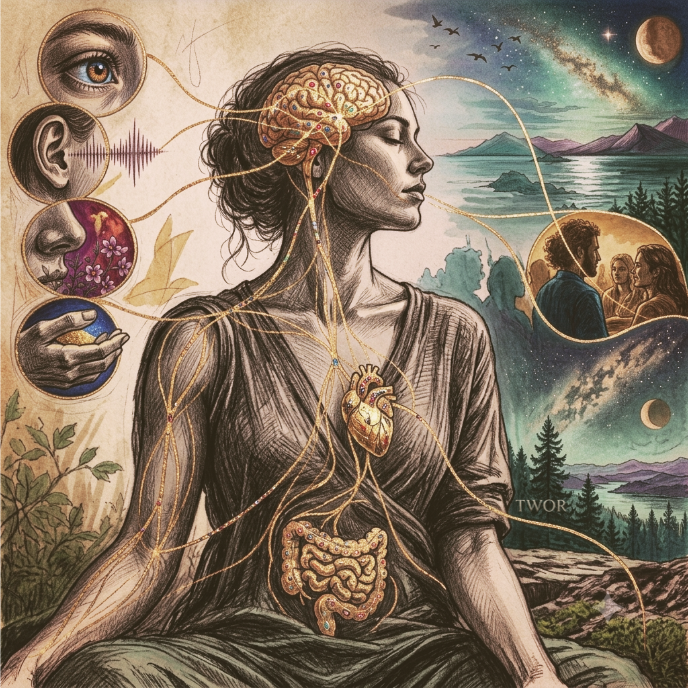
The brain is not alone
The body is always part of what we feel
The same situation can feel completely ordinary one day and strangely difficult the next. After a bad night’s sleep, an unsettled stomach, a slightly faster heartbeat and a body already tense, even a small problem can send the mind spinning for much longer than usual. The outside world may not have changed very much, but the state inside the body has.
The brain is constantly receiving information from the heart, lungs, blood vessels, gut, hormones and many other organs. Most of this exchange happens outside conscious awareness, yet these internal signals still contribute to sensations such as:
- hunger or fullness;
- tension or relaxation;
- tiredness or alertness;
- nausea, heat, cold or physical discomfort;
- safety, stress or unease.
The ability to sense the internal state of the body is known as interoception. The brain tracks mechanical, chemical and hormonal signals and combines them with the situation around us.
A faster heartbeat can accompany many different states: fear, excitement, nervousness or anticipation. The heart may race when we face danger, when we are about to step onto a stage or when we finally see someone we have been waiting to meet. Bodily signals contribute to emotion, while memory, experience and context help the brain make sense of what is happening.
From interoception, cognitive science opens into a broader idea: embodied cognition. Thought, emotion and decision-making always take place in a body that is breathing, moving, sensing and responding to its surroundings.
The gut is part of the communication network
The gut usually demands our attention when we are hungry, uncomfortable or have eaten a little too much. Behind digestion, however, sits a large nervous system and several two-way communication routes connecting the gut and the brain.
The gut–brain axis includes the vagus nerve, hormones, the immune system and substances produced by the gut microbiome. Signals travel in both directions: conditions in the gut can influence the nervous system, while stress and brain activity can also affect movement, secretion and sensation in the digestive tract.
Serotonin often comes up in discussions of this topic because most of the body’s serotonin is produced in the gastrointestinal tract. Peripheral serotonin does not freely cross the blood–brain barrier (BBB) to directly control serotonin in the brain. The two systems work differently, while gut–brain communication travels through several pathways at once.
An unsettled stomach can colour an entire morning differently. The cause may come from many directions; mental experience still unfolds inside a real body that is digesting, breathing, contracting muscles, regulating temperature and keeping dozens of systems running at the same time.
 The gut–brain axis and two-way communication
Other people also enter our nervous system
Our own body is one source of signals; other people also continually affect the state of the nervous system.
You can walk into a room and quickly sense tension before anyone has said a word. Someone who speaks slowly, with an even voice and a relaxed expression, can soften the atmosphere; another person arriving in a rush, moving sharply and speaking with tension can put the whole group more on edge.
Beyond the words themselves, the brain also reads:
- facial expression;
- tone and speed of speech;
- body posture;
- interpersonal distance;
- pauses;
- movement and the reactions of people nearby.
In psychology and social neuroscience, emotional contagion describes part of this process. One person’s emotional state can influence another person’s emotion, behaviour and physiological response, and the effect can appear quickly enough that we may notice only after our own mood has already shifted.
Research on physiological and neural synchrony has also found that, in some forms of interaction, breathing, heart rate or neural activity between participants may become synchronised to some degree. The extent of this varies with the task, the setting and the relationship between the people involved; it cannot be used as a simple measure of how well two people “match”, nor does it prove that two brains are directly exchanging information.
Another concept that appears in research on human interaction is co-regulation. Our nervous system can settle or become more activated while we are with someone else. Children show this clearly when they rely on a caregiver to regain stability, but adults also continue to influence one another’s state.
The boundary between “my mood” and what is happening around me can be less distinct than we imagine. A tense room may make the body more alert, while the calm presence of another person can sometimes help us settle. These responses reflect how sensitive the nervous system remains to the state of others, especially during close and sustained interaction.
The room also takes part
Light, sound, temperature and the way a space is organised all continue to act on the nervous system.
Light has a direct route into the body’s circadian system. The retina contains light-sensitive cells with melanopsin that help send information about light to the systems regulating day–night rhythms. Intensity, timing, wavelength and duration of exposure can all affect alertness, sleepiness and melatonin rhythms.
Artificial light in the evening can extend daytime signals later into the night, shifting the biological clock away from the natural light–dark cycle. A bright screen close to bedtime, strong indoor lighting or streetlight entering through a window all become part of the environment the nervous system has to process.
Noise enters in its own way. A sudden sound can pull attention immediately, while prolonged noise keeps the brain sorting what deserves attention from what can be ignored. Temperature, crowding and whether a space feels open or confined can also affect comfort, alertness and concentration.
Walk into a room that is bright, hot and noisy and the body will respond differently from when you sit somewhere cool, quiet and softly lit. The brain keeps receiving signals from heart rate, breathing, muscle tension and body temperature while also responding to light, sound and the presence of other people.
A line of thought in philosophy of mind pushes the boundary further beyond the body. The extended mind hypothesis, proposed by Andy Clark and David Chalmers, asks whether certain external tools can become part of a cognitive system when they are used consistently and are deeply integrated into how a person thinks or remembers.
A notebook used for appointments, a phone that stores every address or a map we constantly rely on are familiar examples. The hypothesis redraws the boundary between cognitive activity and the external tools people use every day.
The brain sits among many streams of signals
Looking only inside the skull leaves out many of the influences shaping thought and emotion.
The brain is in constant exchange with the heart, gut, hormones, muscles and other organs. At the same time, it receives light, sound, temperature, spatial cues and social signals from the people around us. Conscious experience takes shape amid many streams of information arriving together.
What we call “mood”, “thought” or “how I feel” often already carries the influence of several sources at once.
Among the signals coming from the environment, light also connects to a small organ near the centre of the brain. Biology has mapped much of what this organ does, while centuries of philosophy, spiritual traditions and occult thought have layered many other meanings onto it: a site associated with the soul, an inner eye, a centre of intuition and a bridge to unusual states of consciousness.
Part III: The pineal gland and the inner eye
References
- Craig, A. D. (2009). How do you feel—now? The anterior insula and human awareness. Nature Reviews Neuroscience.
- Cryan, J. F. et al. (2019). The microbiota-gut-brain axis. Physiological Reviews.
- Feldman, R. (2017). The neurobiology of human attachments. Trends in Cognitive Sciences.
- Clark, A. & Chalmers, D. (1998). The extended mind. Analysis, 58(1), 7–19.
- Berson, D. M., Dunn, F. A. & Takao, M. (2002). Phototransduction by retinal ganglion cells that set the circadian clock. Science.