Part I
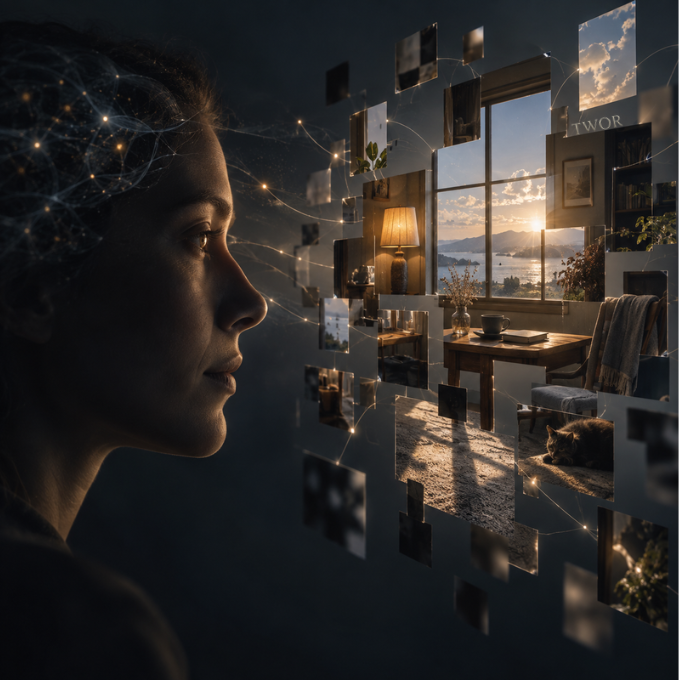
A gap your eyes never warn you about
We often trust our eyes as if they were faithful cameras, recording the world almost exactly as it is. What appears in front of us feels so continuous that it is easy to assume we are seeing reality more or less directly.
Yet there is already a patch on the retina that records no image at all.
Where the optic nerve leaves the eye, there are no photoreceptors. Technically, this creates a genuine blind spot. You almost never notice a hole in your visual field because the visual system uses surrounding information, together with input from both eyes, to complete the missing part.
The brain does this kind of “patching” in ordinary life all the time. The information it receives is often incomplete:
- only part of a face may be visible;
- an object may be mostly hidden;
- several syllables may disappear into background noise;
- a familiar scene may be missing a few details.
And yet you still recognise the face, guess the hidden object, understand the sentence and know the place. The brain draws on previous experience to fill in what is missing, then adjusts when new information no longer fits the first guess.
In neuroscience, a family of theories studies this broader mechanism under the name predictive processing. Put simply, the brain carries expectations shaped by previous experience, compares them with incoming signals and keeps updating when the two do not match.
Some models describe this process in Bayesian terms. Earlier experience provides a starting point, while new evidence raises or lowers confidence in the initial guess. The greater the mismatch, the more the system has to revise. Predictive processing has become an influential framework in neuroscience, although many parts of it are still debated.
The dress that once split the internet into two camps is a famous example. Some people saw blue and black; others were certain it was white and gold. The image itself stayed the same, but different brains could make different assumptions about the light falling on the dress and compensate for that light differently. Two people could look at the same picture and genuinely experience different colours.
Neuroscientist Anil Seth has used the phrase “controlled hallucination” to describe perception in this sense. The brain is constantly building a version of the world, while sensory signals keep that version tied to what is happening outside. When the two match well enough, the result feels seamless and we rarely notice how much work happened behind the scenes.
The past has to be rebuilt too
Memory often feels more reliable than perception. It is easy to imagine the mind as a film archive, with old events already stored away and ready to be replayed when needed.
The brain is much messier than that.
Each time we remember something, the memory is rebuilt from what remains. Clear details can stay in place, while faded parts may pick up colour from present emotion, later knowledge or information heard from someone else.
Two people can witness the same event and remember it differently. Years later, the same person may retell an old experience with added or missing details while still feeling completely certain about what happened.
Research on memory reconsolidation suggests that some memories can become temporarily more open to change after being recalled, before they stabilise again. During that period, new information may become mixed with the older memory. The effect does not occur in the same way for every kind of memory, and the conditions that trigger it in humans are still being studied.
Elizabeth Loftus’s work on false memory has also shown how the wording of a question, information received after an event or repeated suggestions can alter what someone remembers. A detail that never happened can still carry a powerful sense of certainty.
The past in our heads is therefore never a perfectly preserved recording waiting to be opened. Each act of remembering rebuilds it from what is still available in the present.
If memory can change while being recalled, what holds together the feeling that our personal past forms one continuous line?
When the brain builds a scene during sleep
The machinery that creates experience keeps working when we sleep.
In dreams, the brain can produce rooms, streets, faces and entire situations with nothing directly matching them in front of the eyes. Someone who has died may return and speak. A place that has never existed may still have roads, light, distance and an oddly familiar atmosphere.
Inside the darkness of the skull, the brain is not looking at the sky with eyes turned upwards. Yet a dream can still contain wind, depth, faces, fear, joy and a very clear feeling of “I am here”.
Dreams have puzzled neuroscience for a long time partly because of this ability. During sleep, input from the outside world drops sharply, yet inner experience can remain rich enough to feel like a temporary reality. Dreams occur across several stages of sleep, although REM dreams are often especially vivid, image-rich and easier to remember.
A dream already reveals something remarkable about the brain’s ability to generate experience. Even with far less sensory input from the outside world, it can still build scenes, create characters, sustain emotion and give a sleeping person the sense of living inside that world.
A soft organ weighing a little over a kilogram can produce an experience convincing enough to leave you waking with your heart still racing.
Who is the person looking at this world?
There is one more thing being rebuilt continuously: the self.
The feeling that “I am still me” across decades seems completely natural. Yet the body changes, memories fade, beliefs shift, emotions move and social roles change. The brain still links those stages into a line continuous enough for someone at forty or sixty to look at a childhood photograph and say, “that was me”.
When researchers study the sense of self, the default mode network — DMN — appears again and again. This network is active during many inward-facing states: thinking about ourselves, remembering the past, imagining the future, thinking about other people or letting the mind wander.
After more than two decades of research, scientists have found strong links between the DMN and self-referential thought, autobiographical memory, social cognition and internally generated thought. Some studies also suggest that it helps connect memory, meaning and personal experience into a relatively continuous stream.
Our sense of self depends on many systems working together; the DMN is one part of that larger arrangement. Memory, the body, emotion and the social environment all contribute to keeping today’s “me” connected with the person who existed years ago.
The self sounds like something fixed. Look closer, and it begins to resemble an ongoing process of updating.
From soft tissue to a “sanctuary of the universe”
By this point, the name “Sanctuary of the universe” begins to sound a little less extravagant.
Even if we leave aside the image of the brain as an antenna receiving signals from space, the brain remains strange enough on its own. A soft biological organ can turn signals into colour, complete missing parts of the world, rebuild memory, generate dreams and maintain a sense of “I am still me” across decades.
The world we experience passes through sensory systems, previous experience, memory, prediction and the state of the body. After all of that work, we are left with the feeling that we are simply seeing, remembering and living inside a continuous reality.
This brain does not live in a world of its own. It is tied to the heartbeat, hormones, the gut, muscles, emotion, the surrounding environment and other people.
Part II: The brain does not live in a world of its own
References:
- Seth, A. K. & Bayne, T. (2022). Theories of consciousness. Nature Reviews Neuroscience.
- Elsey, J. W. B., Van Ast, V. A. & Kindt, M. (2018). Human memory reconsolidation: A guiding framework and critical review of the evidence. Psychological Bulletin.
- Schwabe, L., Nader, K. & Pruessner, J. C. (2014). Reconsolidation of human memory: brain mechanisms and clinical relevance. Biological Psychiatry.
- Loftus, E. F. & Polage, D. C. (1999). Repressed memories. When are they real? How are they false? Psychiatric Clinics of North America.
- Laney, C. & Loftus, E. F. (2005). Traumatic memories are not necessarily accurate memories. Canadian Journal of Psychiatry.
- Nir, Y. & Tononi, G. (2010).Dreaming and the brain: from phenomenology to neurophysiology. Trends in Cognitive Sciences.
- Menon, V. (2023). 20 years of the default mode network: A review and synthesis. Neuron.