P7 | Self-aware cells
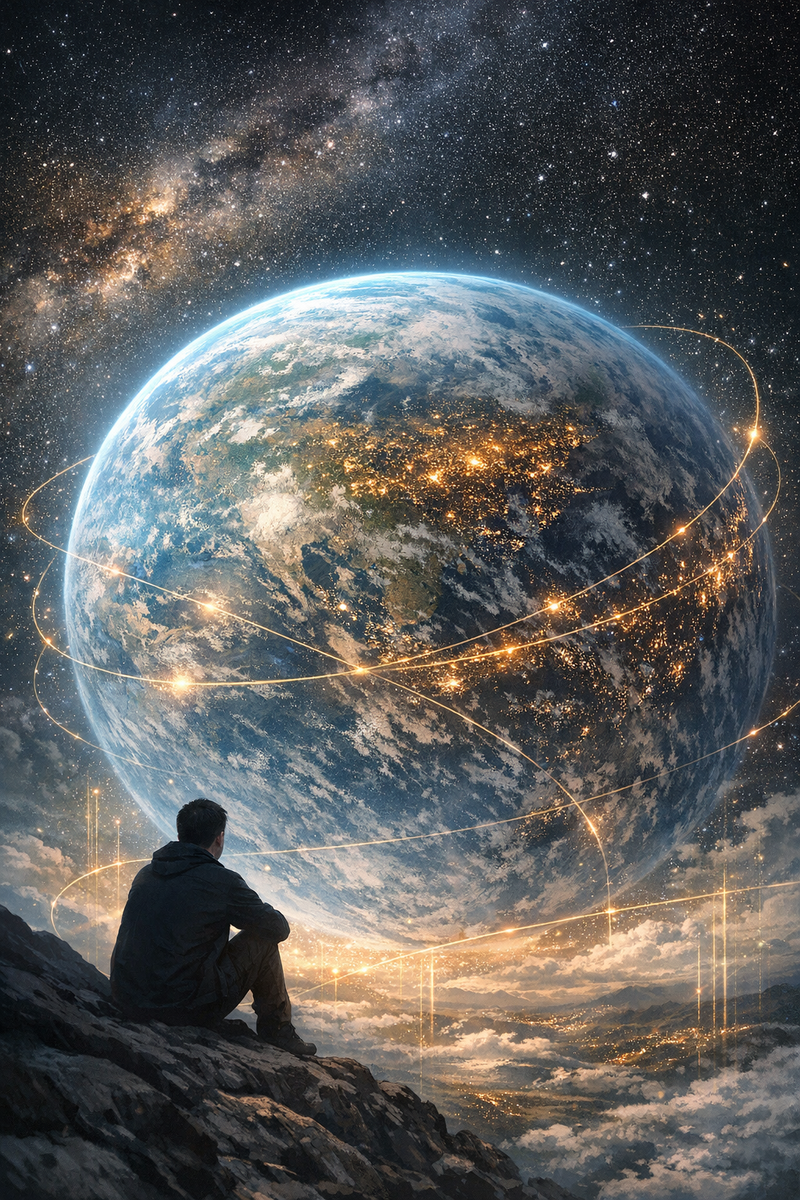
For most of human history, we knew Earth from the ground. The world expanded through travel, maps, and observation, yet the planet as a whole remained beyond the view of any single person.
Then humans traveled far enough from the surface to turn a camera back toward where they had come from.
In 1972, the crew of Apollo 17 took the photograph later known as Blue Marble, one of the most iconic images of Earth from space. Continents, oceans, and bands of cloud appeared together on a single sphere suspended against the darkness. A planet once experienced one region and one horizon at a time could now appear almost whole within a single frame.
In Living Earth, this moment opens the final role of humanity: a very small part of life on Earth had begun to observe the larger whole it belonged to.
When Earth comes fully into view
A photograph captures only one moment. Satellites, sensors, monitoring stations, and other observing systems later extended that view into a continuous process.
Humans can now track ocean temperatures, ice, clouds, the atmosphere, forests, soil moisture, wildfires, water movement, and many other changes on a global scale. Data gathered across different places and times can be combined into increasingly detailed models of how Earth’s systems interact.
The planet appears in many forms at once. A forest is vegetation seen from orbit, while also taking part in the carbon and water cycles. The ocean is a visible surface and a vast store of heat that influences climate. The atmosphere surrounds the planet while transporting matter and linking distant regions.
At this point, the heart, brain, nervous system, auxiliary brain, green lifeline, and skeleton explored across the previous six parts return as pieces of the same whole.
Observing from within
Humans can map Earth, but our point of observation has never truly been outside it.
Cities visible from orbit, nighttime lights, shrinking forests, reservoirs, roads, farmland, and changes in atmospheric composition all carry traces of the activity of the species doing the observing. The same tools used to monitor the planet also record changes to which humans contribute.
We gather information about the system while living through its water, soil, air, and other forms of life. Decisions about energy, food, transport, resource extraction, and land use continue to affect the same cycles we measure.
Any picture of Earth also contains the observer.
At the individual scale, most of life still revolves around nearby concerns: work, family, food, money, a passing storm, or an unusually hot season. Placed beside global observations, billions of such experiences begin to narrow the distance between everyday life and the Earth system. Water from the tap, the temperature outside the window, food prices, and air quality all connect back to larger systems.
From observation to response
Seeing change gives humans more information to respond to it.
Satellite data can help track wildfires, identify flooded areas after storms, monitor drought, and support forecasting and disaster response. Detecting change early can influence decisions about evacuation, water management, forest restoration, or land-use planning.
Observation records spanning decades can reveal trends that are difficult to notice within a single human lifetime. A retreating coastline, ice lost across many seasons, an expanding city, or changing forest cover becomes a process that can be tracked rather than a collection of scattered memories.
Information does not decide what humans will do. It gives us more ability to see consequences, compare choices, and change direction. The same data may lead to action, debate, delay, or simply be ignored; the human response then becomes another part of a system that continues to change.
The image of “self-aware cells” rests on this ability to look back at the larger whole. Humans can build models of the planet they live on, place themselves within those models, and ask what their own actions are contributing to.
We are made from the material of Earth, live through its cycles, and eventually developed tools capable of observing those same cycles. After billions of years of planetary history, one part of the biosphere can photograph its entire home from space, measure changes across it, and preserve those records across generations.
Seeing Earth as a whole is only the first step toward understanding where we stand within it.
Source notes
- NASA Science — History of the Blue Marble
https://science.nasa.gov/earth/earth-observatory/history-of-the-blue-marble/ - NASA Science — The Blue Marble
https://science.nasa.gov/resource/the-blue-marble/ - NASA Science — Earth Science Missions
https://science.nasa.gov/earth-science/missions/ - NASA Earthdata — Your Gateway to NASA Earth Observation Data
https://www.earthdata.nasa.gov/ - NASA Science — Terra
https://science.nasa.gov/mission/terra/ - NASA Applied Sciences — Disasters Practitioner Resources
https://disasters.nasa.gov/what-we-do/disasters/practitioner-resources