P6 | The planetary skeleton
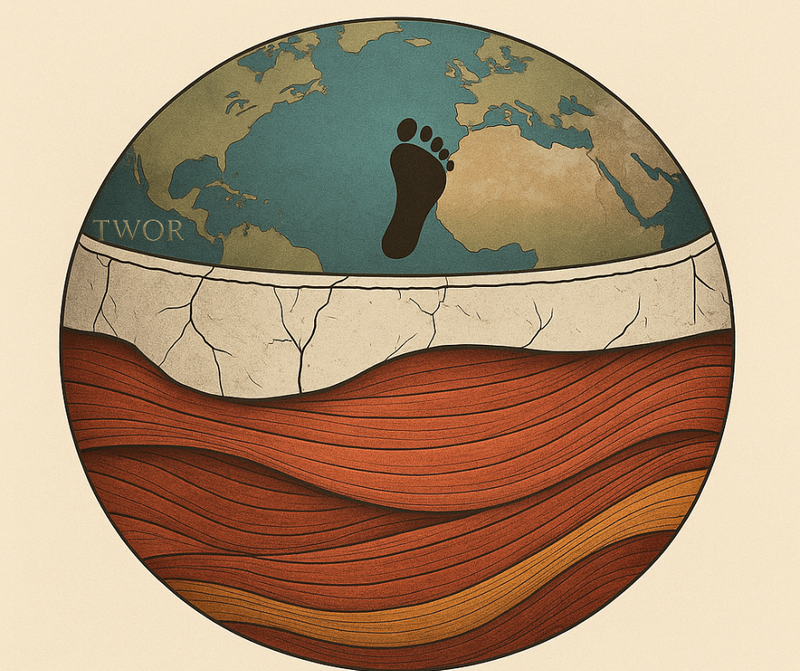
Beneath forests, plains, cities, and the ocean floor lies a physical foundation with a history far older than life at the surface. Earth’s rigid outer shell is divided into large tectonic plates that continue to move, even though their speed is measured in only a few centimeters per year.
Within the planetary-body imagery of Living Earth, this rocky foundation comes closest to a skeleton. It forms continents, ocean floors, and the terrain that water, climate, and life continue to shape over millions of years. This framework also keeps changing rather than holding one fixed form.
The framework changes over time
Tectonic plates can move apart, collide, or slide past one another along their boundaries. Over long periods, these slow movements build mid-ocean ridges, deep trenches, mountain ranges, and many of the large structures visible across Earth’s surface.
Earthquakes often occur around plate boundaries and faults, where stress can accumulate until the rock suddenly slips. In some converging regions, one plate sinks beneath another; elsewhere, continental masses press together and raise the land. The planetary skeleton carries the marks of forces that have acted on it over immense spans of time.
Even mountain ranges, symbols of permanence to human eyes, are continually worn down by rain, wind, ice, and rivers. Rock breaks apart, moves elsewhere, and eventually settles in a new place. Material once high in the mountains may become sediment on a plain or the ocean floor much later.
The framework is continually reshaped by forces from both within and above the surface.
A living layer over rock
Above the rocky foundation lies a thin but remarkable layer: soil.
Soil develops as mineral material from rock combines over time with water, air, organic matter, and biological activity. A single handful may contain mineral grains, roots, fungi, bacteria, water, air, and decomposing material. Geology and biology meet here directly.
Soil anchors roots, stores and distributes water, cycles nutrients, provides habitat for countless organisms, and supports most terrestrial ecosystems. Rainwater may soak in, remain within pore spaces, or continue deeper underground; the properties of the soil also influence how much water infiltrates and how much moves across the surface. Carbon, nitrogen, phosphorus, and many other elements are continually stored and transformed within it.
If the rocky framework gives the surface its broad physical form, soil allows life to take hold on that structure.
When support begins to weaken
Loss of vegetation can leave soil more vulnerable to erosion in many environments. Compacted or sealed surfaces change the way water enters the ground. Mining alters soil and rock structures, while excessive groundwater extraction can compress sediment layers and cause the land surface to sink.
Land subsidence, erosion, landslides, and soil degradation arise through different mechanisms, but they all connect to a very physical reality: the ability of the surface to support what lies above depends on the structure of soil and rock, water, vegetation, and the interactions among them.
As those conditions change, life at the surface changes with them. Roots may find it harder to anchor, water may leave the surface more quickly or remain in different places, soils can lose organic matter, and habitats gradually shift.
A layer of soil only a few dozen centimeters thick may take hundreds or thousands of years to develop. Beneath it lies rock carrying the record of processes that have unfolded over millions of years. Those two timescales meet directly beneath our feet.
Within the image of a planetary skeleton, its significance comes from more than simple rigidity. Earth has a physical foundation durable enough to support life, yet that same foundation is continually compressed, uplifted, eroded, fractured, and reshaped.
Every forest, field, and city occupies only a tiny part of that immense framework.
Source notes
- U.S. Geological Survey — Understanding Plate Motions
https://pubs.usgs.gov/gip/dynamic/understanding.html - U.S. Geological Survey — The Science of Earthquakes
https://www.usgs.gov/programs/earthquake-hazards/science-earthquakes - USDA Natural Resources Conservation Service — What is Soil?
https://www.nrcs.usda.gov/resources/education-and-teaching-materials/what-is-soil - USDA Natural Resources Conservation Service — Soil Health
https://www.nrcs.usda.gov/conservation-basics/soil/soil-health - U.S. Geological Survey — Land Subsidence
https://www.usgs.gov/mission-areas/water-resources/science/land-subsidence