P5 | The green lifeline
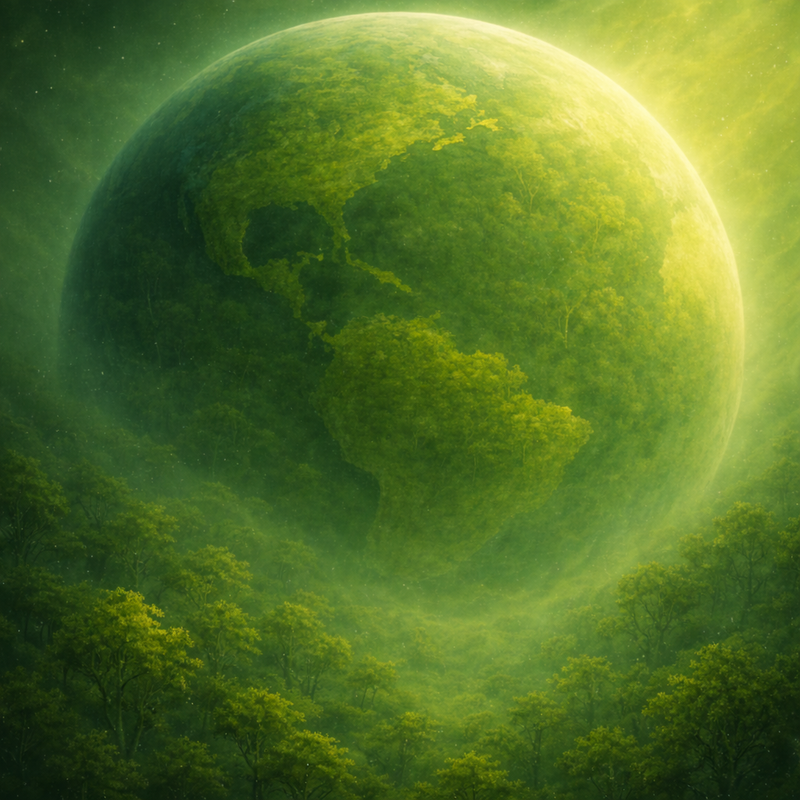
Forests are among the places where living matter circulates most actively across Earth’s surface. Water moves from soil into roots and returns to the atmosphere through leaves. Carbon passes from the air into trunks, branches, roots, and soil. Minerals, organic matter, and countless organisms keep material moving through overlapping cycles of exchange.
In the Living Earth series, forests fit the image of a green lifeline because of this constant circulation. A healthy forest holds water, cools the surface, stores carbon, protects soil, and provides habitat for countless species. Life here depends on connections far denser than anything visible above the ground.
Connections beneath the ground
Beneath every forest lies a world of roots, microorganisms, and fungi in constant activity. Many plants live in partnership with mycorrhizal fungi: plants provide carbon produced through photosynthesis, while fungi extend their access to water and certain nutrients in the soil.
Fungal threads can sometimes connect the roots of multiple plants, forming what scientists call common mycorrhizal networks. This gave rise to the popular name “Wood Wide Web,” often described as an underground version of the Internet.
The name is memorable, but the reality is more complicated than the popular story. Carbon, water, and nutrients can move through some fungal–root networks, although the scale and ecological role of these transfers vary across species, environments, and conditions. Stories about “mother trees” deliberately feeding seedlings or entire forests warning one another have gone beyond what the evidence currently supports.
The forest remains deeply interconnected without adding that layer of personification. Trees compete for light and water, fungi exchange resources with roots, insects carry pollen, and microorganisms break down dead material and return nutrients to the soil. A single tree is only one participant in a much larger flow of exchange.
How water moves through a forest
Forests play a major role in the water cycle. Trees draw water from the soil and release part of it back into the atmosphere through transpiration. Water also evaporates from the ground and canopy, enters the air, and later becomes part of cloud formation and rainfall.
Across large tropical forests, enough water returns to the atmosphere to influence regional rainfall and temperature. Evaporation and transpiration also remove heat from the surface, helping forests remain cooler than many areas converted to bare ground, pasture, or cropland.
This is where the idea of a “green lifeline” becomes easiest to see. Water enters the tree, travels through trunk and leaves, then returns to the air. Atmospheric circulation carries that moisture elsewhere, where it may eventually return to the ground as rain. Forests participate in a continuous exchange linking soil, water, air, and living organisms.
Carbon follows its own route through another cycle. Trees take CO₂ from the atmosphere through photosynthesis, store carbon in living tissue, and send part of it below ground through roots, fallen leaves, and organic matter. When trees die, burn, or decompose, some carbon returns to the atmosphere while some remains stored in the soil.
Forests are places where life proliferates and matter continuously changes hands between atmosphere, soil, and living bodies.
An environment that shapes life
Organisms living in forests are also shaped by the environments forests create. Tree canopies alter light and temperature, forest soils retain moisture, and vegetation provides shelter and food. Changes in forest structure therefore change the conditions experienced by the entire ecosystem.
Humans respond to green environments as well. Many studies have found associations between exposure to green space, lower stress, psychological relaxation, and several benefits to mental health. These effects do not require a hidden “resonance” between the human nervous system and the planet. The body is responding to light, temperature, sound, air, movement, and the sensory experience of the surrounding environment.
Forests affect the organisms within them, and those organisms continue to affect the forest in return. These ongoing exchanges help ecosystems persist and change over time.
When the green lifeline breaks
Deforestation disrupts several flows at once. Carbon stored in vegetation can return to the atmosphere when plants are burned or decay. Less water is returned to the air through trees. The surface can become hotter and drier, soil loses protection, habitats become fragmented, and species that once depended on the forest must adapt, move elsewhere, or disappear from the area.
At a large enough scale, forest loss can affect rainfall as well. Vast forests such as the Amazon return enormous amounts of water to the atmosphere, and winds carry that moisture onward. Large-scale deforestation can therefore alter regional water cycles and climate rather than leaving behind only an empty patch where trees once stood.
The ability to recover also changes with the severity of the damage. A forest may regenerate after a natural fire if soil, seed sources, water, and ecological connections remain intact. When forests are repeatedly fragmented, soils are degraded, or local climate shifts too far, the path back becomes much harder.
The “green lifeline” is more than a count of standing trees. It exists in the movement of water, carbon, nutrients, and living organisms between one another, linking soil with atmosphere and individual species with the environments that sustain them.
From a distance, a forest may look like a simple green band on a map. Inside it, water continues through leaves, carbon moves between air and living matter, fungi thread their way among roots, organisms consume and become food, and old material breaks down before entering another cycle of life.
The green lifeline exists in those movements.
Source notes
- NASA Earth Observatory — Tropical Deforestation
https://science.nasa.gov/earth/earth-observatory/tropical-deforestation/ - NASA Earth Observatory — The Carbon Cycle
https://earthobservatory.nasa.gov/features/CarbonCycle - Karst, Jones & Hoeksema, Nature Ecology & Evolution — Positive citation bias and overinterpreted results lead to misinformation on common mycorrhizal networks in forests
https://www.nature.com/articles/s41559-023-01986-1 - World Health Organization — Green and blue spaces and mental health: new evidence and perspectives for action
https://www.who.int/europe/publications/i/item/9789289055666 - World Health Organization — Urban green spaces and health
https://www.who.int/europe/publications/i/item/WHO-EURO-2016-3352-43111-60341