P3 | The peripheral nervous system
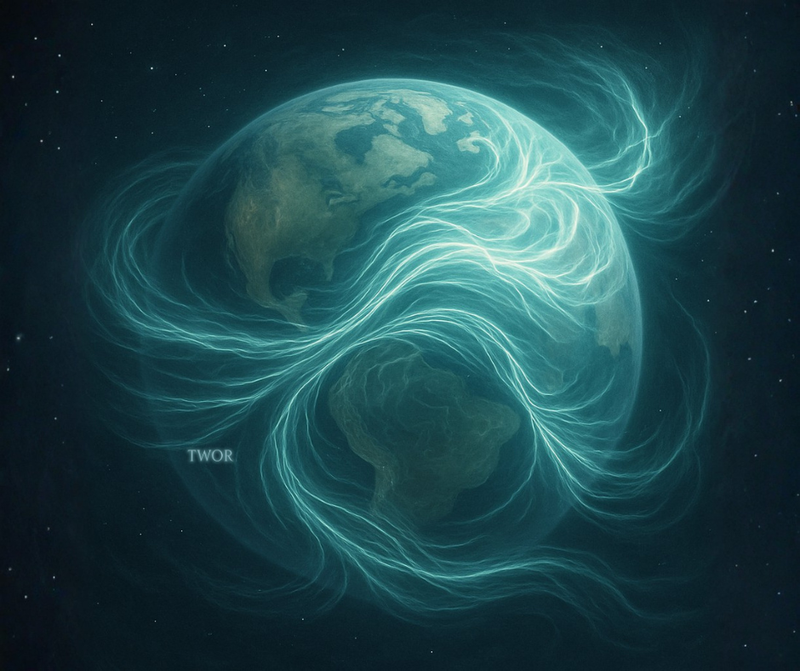
Earth is wrapped in a layer of air that is constantly in motion. Heat from land and ocean, water vapor, and differences in air pressure continuously reshape the atmosphere, while Earth’s rotation bends the paths of moving air. Winds emerge from these conditions and carry heat, moisture, and material from one region to another.
In Living Earth and New Age imagery, the atmosphere readily resembles a peripheral nervous system. It stretches across the entire surface, touching ocean, land, ice, and living systems while carrying influences between regions separated by great distances. Wind is the most immediate part of this network we can see and feel.
The planet’s sensory layer
The atmosphere responds continuously to conditions below. A warmer ocean changes the amount of heat and moisture entering the air; continents heat and cool at different rates from the sea; mountains redirect airflow; forests, deserts, and cities each leave their own traces in the air above them.
Wind carries those traces far beyond their source. Water vapor travels with moving air before returning elsewhere as cloud and rain. Saharan dust can cross the Atlantic; smoke from major wildfires can travel across several countries; sea salt, pollen, spores, and other small particles are also transported through the atmosphere. A place leaves something of itself in the air, and wind carries that material elsewhere.
The planet’s “sensory layer” extends through the blanket of air surrounding Earth. The atmosphere comes into contact with many different environments and carries their traces onward.
High-altitude pathways
High above the surface, jet streams form powerful bands of wind that curve around the planet and shift with the seasons and changing atmospheric conditions. Their position influences the paths of many weather systems, with effects on temperature and rainfall in the regions below.
Large-scale bends known as Rossby waves also develop along these high-altitude flows. They create broad curves in the circulation, allowing warm air to move toward the poles while colder air reaches farther into lower latitudes.
The atmosphere resembles a peripheral nervous system most strongly in its ability to carry effects across thousands of kilometers. A change in one region can contribute to a chain of effects farther away, while the air and energy within the disturbance continue to change along the way. These pathways shift with the atmosphere itself rather than forming a fixed network of lines.
When effects travel far
Large-scale atmospheric connections also appear as long-distance climate links known as teleconnections. A persistent change in one region can be associated with shifts in pressure, temperature, wind, or rainfall far away. El Niño is a familiar example: changes in the coupled ocean–atmosphere system of the tropical Pacific can influence weather patterns across large parts of the world.
Rossby waves are one of the ways these effects travel across long distances, linking regions thousands of kilometers apart through large-scale atmospheric disturbances.
Within Living Earth, the atmosphere fits the role of a “peripheral nervous system” through its contact with nearly the entire surface, its ability to transport matter and energy over great distances, and the way atmospheric flows and waves carry disturbances from one region to another. What begins in one place can continue to leave effects elsewhere, sometimes thousands of kilometers from its point of origin.
Wind is the part we feel directly against the skin. Behind that moving air lies a much larger system stretching around the planet, continuously connecting regions that may seem far apart.
Source notes
NASA — How to See the Atmosphere
https://www.nasa.gov/image-article/how-see-atmosphere/NASA / JPL — In a First, Scientists Map Particle-Laden Rivers in the Sky
https://www.jpl.nasa.gov/news/in-a-first-scientists-map-particle-laden-rivers-in-the-sky/NOAA NESDIS — What Is the Jet Stream?
https://www.nesdis.noaa.gov/about/k-12-education/atmosphere/what-the-jet-streamNOAA Ocean Service — What is a Rossby wave?
https://oceanservice.noaa.gov/facts/rossby-wave.htmlNOAA Climate.gov — What are teleconnections? Connecting Earth's climate patterns via global information superhighways
https://www.climate.gov/news-features/blogs/enso/what-are-teleconnections-connecting-earths-climate-patterns-globalWirth et al., Monthly Weather Review — Rossby Wave Packets on the Midlatitude Waveguide—A Review
https://journals.ametsoc.org/view/journals/mwre/146/7/mwr-d-16-0483.1.xml