Earth – a living being awakening
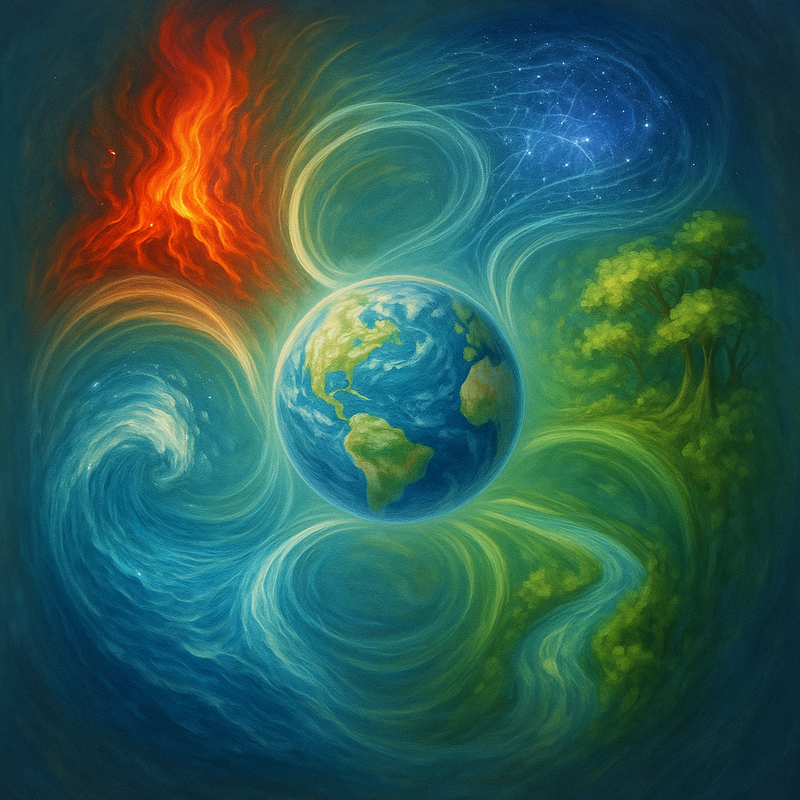
About every 26 seconds, a small seismic pulse emerges from the Gulf of Guinea and travels far enough to be recorded by seismic stations in distant parts of the world. The phenomenon has been known since the 1960s. Its steady rhythm has often been compared to a kind of “heartbeat” of the Earth.
A heartbeat? A repeating interaction between ocean and crust? Or simply a seismic signal that we are still trying to understand?
That 26-second pulse became the starting point for She, the Living Earth: placing Earth beside a living body and following the similarities between the systems that keep a planet in motion.
Earth science studies the planet as a connected system made up of the atmosphere, hydrosphere, biosphere, cryosphere, and geosphere, all continually exchanging matter and energy. A change in one part can affect others through feedback loops unfolding across very different timescales.
In this series, Earth’s systems are placed alongside familiar functions of a living body:
- Heat and deep movement beneath the surface resemble an internal source of energy.
- The oceans store and redistribute enormous amounts of heat.
- Wind and the atmosphere transport heat, moisture, and matter across vast distances.
- Forests sustain biological networks across the continents.
- Soil and the geological crust provide the foundation for most life on land.
- The Internet adds an artificial information network around the planet.
- Humans become points of observation capable of looking back at the whole.
The idea of a “body” can extend beyond Earth as well. The universe is constantly moving and expanding; stars are born and die, while new structures continue to form from the matter they leave behind. Nebulae, cosmic networks, and other celestial formations sometimes resemble cells, vessels, eyes, or other parts of a body. Similar patterns appearing across very different scales remain an intriguing area to observe.
Humans have also added a new layer to the planetary system: satellites, sensors, maps, data, and the Internet.
A species living on Earth can now observe storms from orbit, measure ocean temperatures, track changes in forests, record movements in the crust, and transmit those observations around the world almost instantly.
Through humans and technology, Earth increasingly appears as a whole that can be observed.
Is Earth truly a living being?
Or does looking at the planet this way reveal connections we usually overlook?
Source notes
Bruland et al. (2023) – Gliding tremors associated with the 26 second microseism in the Gulf of Guinea
https://www.nature.com/articles/s43247-023-00837-y
Poli et al. (2026) – Swell-driven bursts of 26 s and 16 s seismic spectral peaks
https://www.nature.com/articles/s41467-026-71541-6
NASA Earth Science – Earth System Science Research
https://science.nasa.gov/earth-science/research/
NASA Goddard – The Earth System Science Spheres
https://svs.gsfc.nasa.gov/31365
NASA – Earth
https://science.nasa.gov/earth/