L13.02.004: The ascent ritual
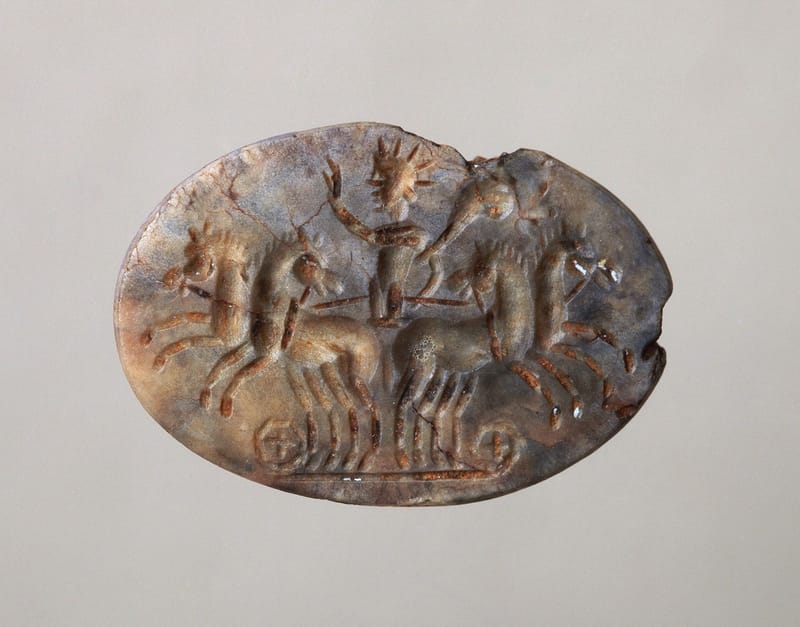
Roman Egypt, c. 4th century CE · PGM IV.475–834 · temporary immortalization · celestial visions · Helios Mithras · modern title introduced in 1903
1. A ritual bearing the name of Mithras
Among the divinatory formulas, invocations, and magical practices preserved in PGM IV is a lengthy passage now commonly known as the Mithras Liturgy. It guides the practitioner through a visionary ascent into the heavens, encounters with divine beings, and an approach to the supreme deity Helios Mithras.
The title entered scholarly use in 1903, when the German scholar Albrecht Dieterich published Eine Mithrasliturgie. He associated the passage with the worship of Mithras in the Roman world, initiating a long-running debate over its origins and religious character.
The ancient text uses the Greek term apathanatismos, usually translated as “immortalization.” The practitioner seeks direct contact with divine beings through an experience described in terms of visions and transformations beyond ordinary human life.
The passage belongs to PGM IV, preserved at the Bibliothèque nationale de France under the shelfmark Supplément grec 574. Although the surviving manuscript dates to approximately the fourth century CE, elements of the ritual may have developed and changed during earlier periods.
2. Preparing for the heavenly ascent
The opening refers to secret knowledge that the writer wishes to transmit to its recipient. The writer appeals for the power of immortality and presents the ritual as a means of entering the heavens and witnessing the order of the cosmos.
The central procedure begins with an invocation directed towards rebirth. The practitioner recites special sequences of sounds, works with the breath, and prepares for the visions described in the following instructions.
One instruction calls for drawing breath from the rays of light three times. The practitioner is then expected to feel lifted upwards, as though suspended in the air. The familiar sounds and surroundings of the human world disappear from perception, giving way to the sight of gods ascending and descending through the heavens.
These passages describe what the practitioner is instructed to see, hear, and experience. The manuscript does not recount an ascent performed by an identifiable individual. It provides ritual actions and the visions anticipated during their performance.
3. Heavenly gates and divine beings
After the ascent begins, the practitioner sees gods approaching. The text explains how to face them through prescribed gestures and ritual names, then leads the practitioner through a sequence of visions:
The first encounter: Divine beings approach, and the practitioner responds with the gestures and words specified in the instructions.
The heavenly gate: The Sun expands, stars appear, and a closed gate comes into view. The practitioner recites an invocation to open it and behold the divine realm beyond.
Celestial beings: A youthful god appears, followed by seven goddesses of fate and seven celestial gods. Each group is accompanied by its own forms of greeting or ritual utterances.
The culminating encounter: A gigantic god emerges amid light and thunder. He has a radiant face, golden hair, white garments, and a golden wreath, and holds the golden shoulder of a calf.
The visions unfold in a prescribed order. The practitioner confronts the beings encountered along the way, recites the appropriate words, and continues towards the divine meeting sought through the ritual.
4. Immortality for a brief time
The term apathanatismos can invite comparisons with beliefs about life after death. Studies of the Mithras Liturgy, however, often emphasize the temporary character of the immortalization described in the ritual.
The practitioner is alive when the ritual begins. During the visionary journey, the practitioner enters a condition beyond ordinary human existence, encounters divine beings, and receives revelation. The ascent takes place within a single ritual performance, with the language of rebirth and transformation describing the experience.
Traditions concerned with the fate of the soul after death generally address what follows the end of earthly life. The Mithras Liturgy instead instructs a living person to seek an encounter with divine beings during the performance of a ritual.
5. Mithras, Helios, and the debate over origins
The presence of Helios Mithras led Dieterich to associate the passage with Mithraism, the worship of Mithras that developed within the Roman Empire. Yet the divine name and solar imagery alone cannot identify the entire ritual as belonging to a particular Mithraic community. Franz Cumont, a major scholar of Mithraism, challenged Dieterich's interpretation.
The debate continued as researchers compared the papyrus with archaeological evidence from Mithraic sanctuaries. The text contains Greco-Egyptian elements, ideas about the cosmos and divine beings, and instructions characteristic of ancient magical traditions. Some scholars identify Mithraic features, while others understand the passage as a composite ritual that incorporated the name and imagery of Mithras.
In 2003, Hans Dieter Betz published a detailed study presenting the Greek text, an English translation, and extensive commentary. His work examines the history of scholarship and possible connections with Egyptian religion, Mithraism, Hermeticism, and other ancient intellectual traditions. Mithras Liturgy has become the conventional scholarly title, although the text's precise origins and relationship to Mithraic ritual remain debated.
6. What was the ascent actually like?
PGM IV gives detailed instructions concerning the prayers, breathing, gestures, divine names, and sequence of visions that the practitioner was expected to experience.
The text also describes changes in perception through the language of visionary experience. Ordinary sounds are expected to disappear, the body seems to rise, and a realm inhabited by immortal beings unfolds before the practitioner's eyes.
These descriptions can be studied through the history of ritual and religious experience. Modern hypotheses have considered ecstatic states, breathing techniques, and the possible use of substances that alter consciousness. Each requires its own evidence, since the manuscript cannot tell us precisely what any particular practitioner experienced.
We know a considerable amount about the heavenly ascent the writer intended the practitioner to undergo. What a person living in Egypt nearly two thousand years ago actually saw while reciting these words remains beyond the testimony of the surviving manuscript.
The next dossier
After the rituals of invocation, divination, and heavenly ascent, PGM IV also preserves numerous formulas addressing everyday concerns: protection, healing, relationships, and other matters that practitioners sought to influence through ritual.
These formulas offer another area of the papyrus collection to examine. Ancient magical knowledge also addressed familiar human needs, from health and personal safety to relationships between people.
References
Hans Dieter Betz, The “Mithras Liturgy”: Text, Translation, and Commentary.
Mohr Siebeck, 2003. A detailed study of PGM IV.475–834, including the Greek text, English translation, and commentary.Matthew Andrews, “The Mithras Liturgy”, Harvard Divinity School, Center for the Study of World Religions, 8 July 2026.
An academic introduction with translated excerpts from the visionary passage PGM IV.539–728.Anders Lisdorf, review of Hans Dieter Betz, The “Mithras Liturgy”: Text, Translation and Commentary, Bryn Mawr Classical Review, 2006.
A discussion of the text, its scholarly reception, and its religious context.Radcliffe G. Edmonds III, “There and Back Again: Temporary Immortality in the Mithras Liturgy”, trong Conversion and Initiation in Antiquity: Shifting Identities – Creating Change.
Edited by Birgitte Bøgh, Peter Lang, 2014, pp. 185–201. An examination of temporary immortalization in the ritualImage source: Princeton University Art Museum.
Late Roman, Gem: Quadriga and Helios (?). Mottled gray agate (burnt jasper?); 2 × 1.3 cm. Gift of Frank Jewett Mather Jr. (y1940-375).
Back