L13.02.003: Magical utterances and divine names
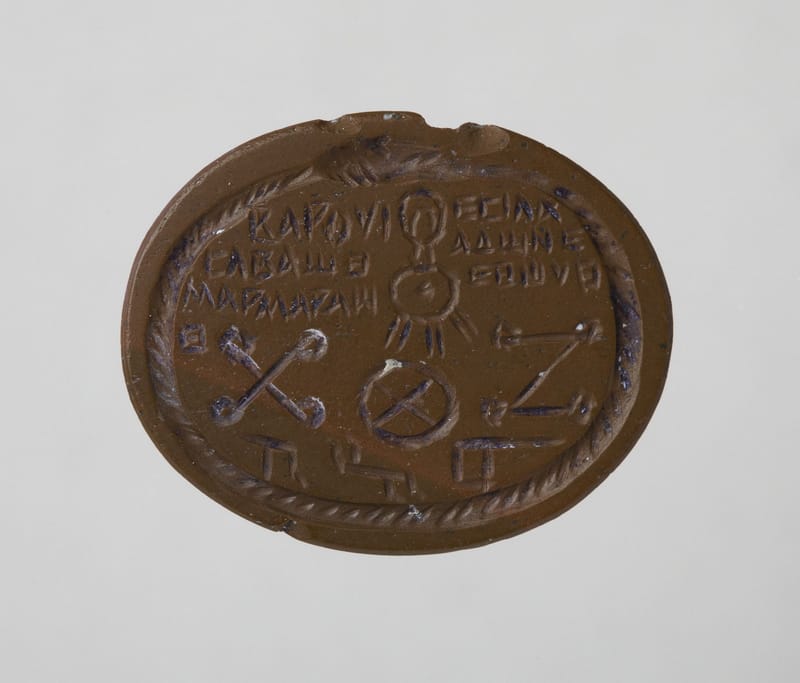
Roman Egypt, c. 3rd–4th century CE · voces magicae · Greco-Egyptian divine names · Typhon's hundred-letter name · PGM IV.154–285, particularly lines 222–260
1. Voces magicae – utterances that resist translation
Among the instructions for sacrifice, invocation, and divination in PGM IV, readers frequently encounter long sequences of sounds, sometimes arranged in several groups of letters. They appear within prayers, interspersed with divine names and passages that can be translated into ordinary language.
Scholars use the term voces magicae for such expressions. Some sequences may contain divine names, traces of other languages, or variants that developed as texts passed between scribes. The origins and meanings of many others remain uncertain.
In PGM IV, these expressions often appear when practitioners summon a being, request its presence, or perform a ritual action. They occupy functional positions in the text, even when their contents remain difficult for modern readers to understand.
Studying them requires attention to both their possible meanings and their positions within a ritual. Some sequences remain untranslated, yet the ways ancient practitioners used them may tell us something about the functions their scribes intended.
2. When divine names crossed languages
Greco-Egyptian magical manuscripts preserve names drawn from several religious traditions. In the direct-vision ritual near the beginning of PGM IV, Osiris, Anubis, and Thoth appear alongside Sabaoth, Michael, and other divine names. Later formulas also contain IAO and numerous sequences whose origins are difficult to determine.
These names travelled through different linguistic and religious settings. Some retained nearly their original forms, while others changed in spelling or appeared in rituals serving purposes different from those of their earlier contexts.
IAO is particularly relevant because of its connection with Jewish tradition and its widespread appearance in Greco-Egyptian magical texts. Its presence in an invocation offers evidence of how divine names circulated, although it cannot establish the religious community to which an individual scribe belonged.
Divine names offer clues to contact between traditions. At the same time, their combination makes it difficult to trace every ritual back to one identifiable source.
3. Typhon's hundred-letter name
In PGM IV.222–256, a divination ritual involving a bowl of water and oil uses a sequence described by the text as Typhon's hundred-letter name. The practitioner recites an invocation, asking a deity or deceased person to appear and respond. The hundred-letter name forms part of that appeal.
The text subsequently identifies it as Typhon's principal name. In the language of the ritual, the earth, the depths of the sea, the underworld, the heavens, the Sun, the Moon, and the stars all tremble before it. When the name is spoken, gods and daimones are commanded to answer the summons.
This is how the ancient author presents the name's authority. The claim extends across the cosmos, assigning to the spoken sequence the power to command supernatural beings.
Why, then, a hundred letters? The text identifies the name by that number. Examining its structure and counting its letters requires a return to the Greek manuscript, with attention to how the sequence is divided and how related versions differ. Modern Latin transliteration cannot preserve every feature of the original writing relevant to that examination, and the number alone cannot establish a particular system of numerology.
4. Spoken, engraved, and worn
The hundred-letter name appears at several points within the same ritual. The text assigns it three uses:
Invocation: The name is spoken when calling upon a deity or deceased person to appear and respond.
Dismissal: After receiving an answer, the practitioner uses the name in the formula that ends the encounter.
Protection: In PGM IV.257–260, the instructions call for the name to be engraved on a silver leaf with a bronze stylus and worn on a cord made from donkey hide. The resulting protective object is a phylactery.
The same sequence of letters can be spoken aloud, included in a dismissal formula, and inscribed on metal. Even as it moves from speech to an object worn on the body, the divine name retains a role in the ritual procedure.
Changing the material and the means of use also brings the name into the making of a protective object. Sound, writing, and material objects all figure in the instructions given to the practitioner.
5. Where did the name's authority come from?
PGM IV presents the authority of Typhon's name through images of supernatural beings and elements of the cosmos submitting to its power.
The invocation draws on the authority attributed to the name by the text. The practitioner recites it to demand the appearance of a being and an answer to a question.
Calling a being by name, knowing a secret name, or possessing a special sequence of sounds appears in many ancient ritual traditions. Each text, however, has its own procedures, and PGM IV must be examined within its Greco-Egyptian setting.
The passage also raises the historical connection between the Greek Typhon and the Egyptian Seth. The two figures were identified with one another in certain ancient contexts, although their attributes and roles varied between texts.
For PGM IV, we can examine how the author uses Typhon's name and the powers assigned to it. The supernatural effects claimed in the invocation belong to the beliefs and worldview of those who used the text; the surviving manuscript contains no evidence by which those effects can be independently verified.
6. When the sounds survive but their meaning remains uncertain
In PGM IV, Typhon's hundred-letter name is accompanied by specific instructions for its use. The practitioner speaks it aloud, employs it in a dismissal formula, and engraves it on metal, while much of the sequence's linguistic meaning remains uncertain.
The scribe also describes the authority attributed to the name. These details allow us to examine its intended ritual functions, although the actual pronunciation and the experiences of those who recited it were never recorded.
Proposals about the Egyptian, Greek, or Semitic origins of individual elements need to be assessed against specific linguistic evidence. Likewise, the idea that magical utterances operated through a particular physical frequency requires independent evidence that the ancient manuscript does not provide.
PGM IV preserves the written sequence, the accompanying actions, and beliefs about its powers. Nearly two thousand years later, we can still read those instructions. The sounds that filled the ritual space, how ancient practitioners heard them, and what they experienced while reciting the divine name remain unknown.
The next dossier
Divine names and magical utterances occur throughout PGM IV. Some rituals use them to summon beings for divination, while others seek experiences beyond ordinary life.
Among these is PGM IV.475–834, commonly known as the Mithras Liturgy. The text describes a heavenly ascent and encounters with divine beings.
The next dossier will examine this ritual, from its sequence of actions to scholarly debates about its name and origins.
References
Hans Dieter Betz (ed.), The Greek Magical Papyri in Translation, Including the Demotic Spells
Volume 1, 2nd edition, University of Chicago Press, 1992. PGM IV.154–285, particularly lines 222–260.Patrícia Cardoso, “The Usage of Voces Magicae in the Greek Magical Papyri”, Romanitas, 2017.
Korshi Dosoo, “Magical Names: Tracing Religious Changes in Egyptian Magic”
A study of divine names and their transmission between religious traditions.Technical Phylactery in Graeco-Egyptian Ritual Practice.
Research concerning protective objects, divine names, and inscribed texts in Greco-Egyptian ritual practice.Image source: Princeton University Art Museum. Roman, Gnostic gem.
Yellow jasper; 1.7 × 2.1 × 0.3 cm. The Collection of Virginia Aldrich Van Vleck, Gift of Joseph Van Vleck Jr., Class of 1923 (y1970-77).
Used as an example of an inscribed ancient gem; no direct connection to PGM IV has been established.