L13.02.002: Direct vision & bowl divination
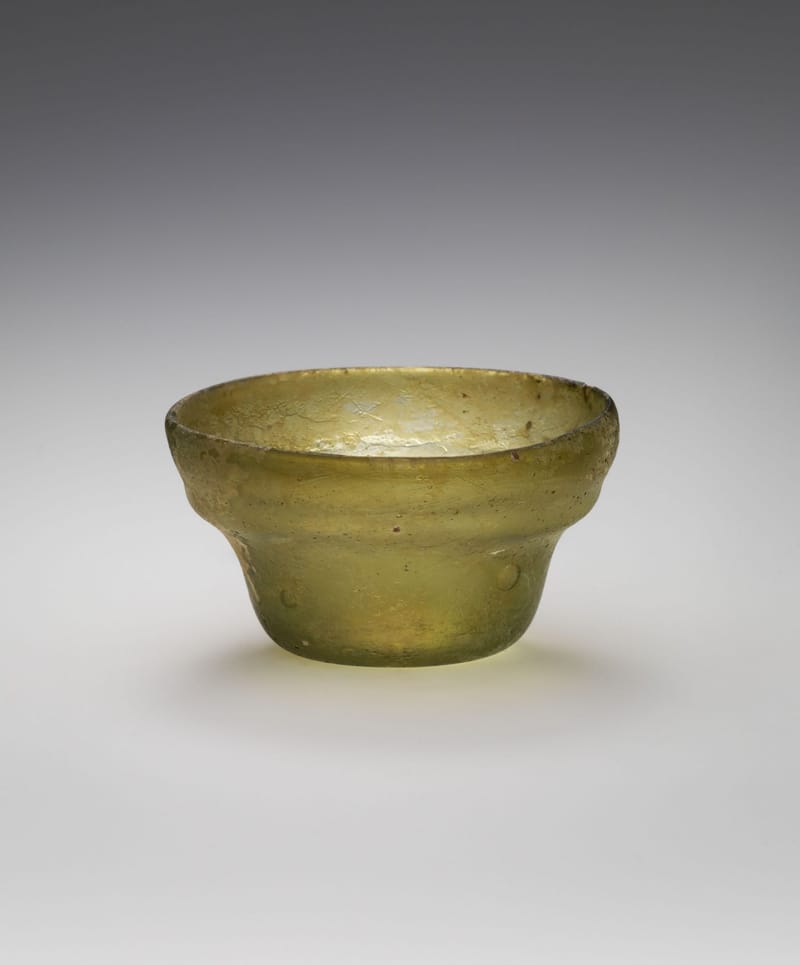
Roman Egypt, c. 3rd–4th century CE · divine apparitions · liquid divination · Greek–Old Coptic · PGM IV.5–51 and PGM IV.154–285
1. Direct vision – preparing the eyes for an encounter
One of the opening recipes in PGM IV, designated PGM IV.5–51, aims to bring about a theophany: the direct appearance of a deity whom the practitioner can encounter and question. The ritual instructions are written in Greek, while the invocation uses Egyptian in an Old Coptic form of writing.
Preparation extends over seven days and requires ritual purity. On the third day of the lunar month, the practitioner goes to land recently uncovered by the receding Nile, lights a fire of olive wood between two bricks, and digs a trench around it. A white rooster is sacrificed. The practitioner then enters the river fully clothed, immerses the entire body, and returns to the bank without turning away from the water. Finally, owl bile is applied to the eyes with an ibis feather. The text describes the state reached after these procedures as having been “initiated.”
Preparing the eyes is part of the ritual itself. Timing, location, the body, and the act of seeing each have a role. Only after these steps does the practitioner recite the magical names and summon the deity.
The invocation brings together figures from several traditions: Osiris, Anubis, and Thoth appear alongside Sabaoth, Michael, and other names or sound sequences whose origins are difficult to trace to a single source. It concludes by calling upon these beings to appear and answer the practitioner's questions.
A parallel passage survives in the Demotic Magical Papyrus of London and Leiden. Some lines closely resemble those in PGM IV, although particular names and beings have changed. Where PGM IV invokes Sabaoth, for example, the corresponding Demotic passage refers to “the light.” Such differences suggest that the formula circulated and underwent adaptation before entering the surviving codex.
2. Bowl divination – visions through water and oil
A little over a hundred lines later, PGM IV reaches the section PGM IV.154–285, commonly known as Nephotes to Psammetichos, a letter concerning bowl divination. The instructions involving water, oil, and the vessel itself are concentrated in PGM IV.222–256.
The writer identifies himself as Nephotes and addresses his secret knowledge to Psammetichos, the “immortal king of Egypt.” This opening places the ritual knowledge under the authority of an ancient royal figure. Attributing magical texts to prominent figures of the past was common in Graeco-Egyptian traditions, lending the transmitted material an impression of antiquity and authority.
The central practice is bowl divination, or lecanomancy. The practitioner uses a bronze bowl or dish, fills it with water and green olive oil, and gazes into the liquid while reciting an invocation. A deity or deceased person is summoned to answer the practitioner's questions.
The water source depends on whom the practitioner wishes to summon:
Rainwater for celestial gods.
Seawater for the gods of the earth.
River water when invoking Osiris or Sarapis.
Spring water when calling upon the dead.
Using seawater for the “gods of the earth” may sound unusual to modern readers, but this is how the text classifies the water sources. The wording follows the recipe rather than replacing these beings with “marine gods.”
The practitioner places the vessel on the knees, adds olive oil, and looks down into the liquid while reciting the invocation. Once an answer has been received, another formula dismisses the summoned presence.
The bowl, the chosen water, the oil, and the spoken words establish the setting for divination. Every element serves a specific action: gazing into the liquid while awaiting an appearance and a response.
3. Two ways of seeking a vision
Both direct vision and bowl divination seek answers from divine beings, although their preparations differ considerably.
In direct vision, preparation centres on the person who will see. Ritual purity, the lunar date, newly exposed Nile soil, immersion in the river, sacrifice, and an eye preparation all lead towards the encounter.
In bowl divination, preparation centres on the place where the encounter is expected to occur. A vessel, the appropriate water source, olive oil, and an invocation create a surface into which the practitioner gazes.
Other recipes in the PGM involve lamps and light, mediums, or sleep. The desire to question the unknown remains consistent, while the means of receiving an answer vary from one ritual to another.
4. Water, oil, eyes, and the act of seeing
In bowl divination, each water source corresponds to a different group of beings. Rain, sea, river, and spring water each have a distinct ritual function.
Olive oil adds another element. PGM IV.222–256 instructs the practitioner to pour green olive oil into the vessel after selecting the appropriate water. The practitioner gazes into the mixture while reciting the invocation.
Direct vision treats the eyes more directly. The preparation involving owl bile and an ibis feather follows purification and sacrifice, before the practitioner proceeds to summon the deity. Within the recipe's ritual logic, the ability to “see” requires preparation.
Three elements recur throughout these procedures: the eyes, the liquid, and the invocation. The eyes receive the image, the liquid supplies a surface for observation, and the spoken words direct the encounter towards a particular being.
5. Who was summoned?
Names drawn from several religious traditions appear together quite naturally in these two recipes.
Direct vision invokes Osiris, Anubis, and Thoth alongside Sabaoth, Michael, and other magical names whose origins remain uncertain. The scribe offers no explanation for their presence within the same ritual.
Bowl divination allows the practitioner to summon both deities and the dead. The water source changes according to the intended recipient, the invocation leaves room for a name to be inserted, and the instructions anticipate an encounter involving questions and answers.
The text of Nephotes to Psammetichos also includes the “hundred-letter name” of Typhon. It plays a role in both the invocation and the formula used to dismiss the summoned presence.
The instructions for a phylactery also mention a version of the hundred-letter name, engraved on a silver leaf with a bronze stylus and worn on a cord made from donkey hide as a protective object during the ritual. Here, sound, writing, and the physical object carrying the inscription become parts of the same procedure.
A name could be spoken aloud, engraved on metal, and carried on the body. Its “meaning” extended into its sound, its written form, and the ways it was used in ritual practice.
6. What did they actually “see”?
In PGM IV, deities appear and respond; practitioners see and hear.
The manuscript does not preserve accounts of what individual practitioners experienced when attempting these recipes. Nor can we determine whether any particular performance involved an external apparition, an inner vision, trance, imagery arising in an altered state of consciousness, reflections in the liquid, or an experience that does not fit neatly into modern categories.
What survives most clearly is the preparation for the encounter. Timing, the body, materials, water, oil, divine names, spoken formulas, and protective objects each have a designated role. For those who used the codex, a vision could be sought through a prescribed procedure.
The papyrus records the preparations, the beings to be summoned, and where the practitioner was supposed to look. What they actually experienced while gazing into the water remains undocumented.
The next dossier
Bowl divination brings us to the hundred-letter name of Typhon.
In PGM IV.154–285, this name appears in several places: the invocation, the dismissal formula, and the instructions for a phylactery engraved on silver. A long sequence of sounds, difficult to translate into ordinary language, nevertheless performs specific functions within the ritual.
The next dossier turns to voces magicae, divine names, and the hundred-letter name.
References:
University of Würzburg, Coptic Magical Papyri – The Bilingual Direct-Vision of PGM IV (2019).
Hans Dieter Betz (ed.), The Greek Magical Papyri in Translation, Including the Demotic Spells, Vol. 1, 2nd ed., University of Chicago Press, 1992.
See PGM IV.154–285, particularly lines 222–256.University of Würzburg, Coptic Magical Papyri – Old Coptic Magic II: The Bilingual Divination of PGM IV (2019).
A comparative study of PGM IV.52–87, distinct from the bowl-divination section at PGM IV.154–285.Image source: Princeton University Art Museum
Roman Imperial to Late Antiquity (ca. 476–700 CE), Eastern Mediterranean, or Cypriote, probably 3rd century CE, Bowl. Transparent olive-green glass; 4.8 × 7.9 cm. Gift of Howard Crosby Butler, Class of 1892 (y1930-352).