L13.02.001: Overview
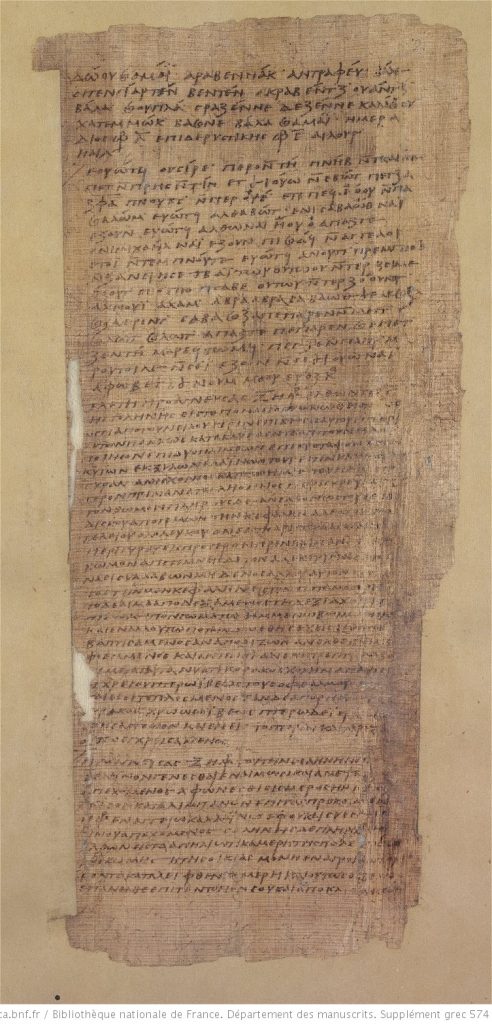
At a glance
Roman Egypt, c. 3rd–4th century CE · Greco-Egyptian magical codex · ritual handbook · held at the Bibliothèque nationale de France, Paris
1. Manuscript profile
PGM IV, commonly known as the Great Magical Papyrus of Paris, is one of the largest surviving manuscripts in the Greco-Roman magical corpus. Preserved under the shelfmark BnF Supplément grec 574, it consists of 72 pages, 66 of which contain writing, comprising a total of 3,274 lines.
The manuscript is not a continuous work with a single author or a unified structure. It belongs to the category of magical formularies: collections of formulas, invocations, ritual instructions, and practical techniques gathered within a single codex. PGM IV therefore resembles an extensive practitioner's handbook more than a sacred book in the conventional sense.
2. Structure & contents
PGM IV brings together a striking variety of rituals and instructions. One passage may instruct the practitioner on invoking a deity to obtain knowledge, while the next turns to love spells, divination through water, ritual plant gathering, or preparations for a visionary experience.
Its contents can be grouped into several broad areas according to their functions.
- Contact with deities and the reception of omens
Invocations to Osiris, rituals of apparition, solar divination, bowl divination, and other forms of visionary practice appear relatively early in the codex. - Altered states and celestial ascent
Among its best-known passages is the section commonly called the Mithras Liturgy, in which the practitioner seeks an experience of ascending to the heavens and encountering divine beings. The designation was introduced much later and remains a subject of scholarly debate. - Intervention in everyday life
Love spells, protective rites, exorcisms, healing practices, and numerous other ritual recipes appear alongside one another within the same collection. - Ritual techniques and materials
The codex also contains instructions for gathering plants, preparing materials, performing consecrations, and carrying out ritual procedures involving particular times, objects, and sequences of actions.
PGM IV was evidently concerned with practical application. It resembles a practitioner's working collection: densely layered, occasionally fragmented, and organized around actions to be performed rather than a single continuous exposition.
3. Languages, scripts & magical utterances
Greek is the principal language of PGM IV, although some recipes also incorporate Old Coptic or Egyptian written using Greek letters, producing distinctly bilingual passages. Within these recipes, the two languages may perform different functions in the same ritual.
The codex also contains voces magicae — sequences of sounds, divine names, and combinations of syllables that resist ordinary translation. Names such as IAO, SABAOTH, and ABRASAX, alongside many other magical utterances, appear as functional elements of ritual practice.
These sequences form part of the rituals themselves. Their roles may have involved sound, patterns of recitation, divine names, or conventions understood by practitioners of the period. The concept of a physical “frequency” belongs to modern terminology, and there is no sound basis for projecting it onto PGM IV.
4. Symbols & worldview
PGM IV emerged within a complex environment of religious exchange. Across the wider corpus, figures and divine names such as Osiris, Isis, Helios, Hekate, Sabaoth, and Adonai appear alongside one another, without necessarily following the rigid religious boundaries familiar to modern readers.
Across Greco-Egyptian magical handbooks, knowledge passed between communities and traditions, with texts preserved, adapted, and combined along the way. The University of Chicago's Transmission of Magical Knowledge project continues to investigate these processes through approximately one hundred magical formularies.
PGM IV is strongly oriented toward practical procedures. Its rituals commonly involve selecting a particular time, preparing materials, reciting utterances, arranging a space, and following prescribed sequences.
The result is something close to ritual technology, built around materials, prescribed actions, and specific sequences.
5. Textual parallels & transmission
PGM IV shares numerous parallels with other Demotic, Greek, and Coptic ritual texts. Many formulas, motifs, and ritual structures have close counterparts elsewhere in the corpus. Comparing these parallel traditions can reveal how a recipe changed its divine names, language, procedures, or intended function over time.
Recent research has been reassessing the origins, structure, and compilation histories of magical handbooks. Rather than assuming that all such texts derive from a single source, scholars increasingly examine palaeography, codicology, layers of textual revision, and the individual histories of surviving manuscripts.
PGM IV carries the marks of this history: knowledge passing between hands, languages, and traditions, changing as it travelled.
6. Open questions & scholarly debates
Is the “Mithras Liturgy” really Mithraic?
The passage PGM IV.539–728 is commonly known as the Mithras Liturgy. However, the title may encourage readers to associate it directly with established Mithraic religious ceremonies.
Recent scholarship generally does not treat it as a standard liturgy of Mithraism. Instead, it is examined as a ritual of immortalization and visionary ascent within the broader context of the magical papyri.
In what sense do voces magicae carry meaning?
Some sequences may preserve divine names or traces of other languages, while others remain extremely difficult to trace.
Whether they functioned primarily as names, ritual utterances, secret designations, or forms of ritual speech acts remains an open area of investigation.
Who used this codex?
PGM IV is commonly studied as a handbook intended for ritual practice. Yet identifying its precise owners, compilers, scribes, and successive stages of revision remains difficult.
Ongoing research continues to re-examine the manuscript's physical structure and compilation history.
The next dossier
If PGM IV is a collection of ritual practices, one promising place to begin a closer examination is with the recipes concerning direct vision and divinatory questioning.
Near the beginning of the codex, a direct-vision ritual instructs the practitioner to prepare the body, choose the appropriate time, and attend to the eyes in preparation for an encounter with a divine presence.
Another procedure, bowl divination, uses water and oil as a medium through which the practitioner seeks to see and ask questions.
One procedure prepares the person who will see. The other prepares the surface through which the vision is sought.
The next dossier examines both rituals in their original textual setting.
References:
- University of Würzburg, Coptic Magical Papyri – The Bilingual Direct-Vision of PGM IV. Coptic Magical Papyri
- Kyprianos Database of Ancient Ritual Texts, entry PGM IV / GEMF 57 / BnF Suppl. gr. 574. Coptic Magical Papyri
- Institute for the Study of Ancient Cultures, University of Chicago, Transmission of Magical Knowledge. UChicago ISAC
- Harvard Center for the Study of World Religions, The Mithras Liturgy. Center for the Study of World Religions
- University of Chicago ISAC, The Mechanics of Ancient Egyptian Magical Practice. UChicago ISAC
- Image source: Page from PGM IV (BnF Supplément grec 574). The Bilingual Direct-Vision of PGM IV