The Labyrinth
The architecture of inner loops
Gate I began with sensory signals. Gate II examined the frame of observation. Gate III followed thoughts and emotions as they appeared. Across different situations, another pattern becomes visible: reactions often return along familiar routes.
A stretch of silence can stir an old anxiety. A remark can revive an earlier sense of inadequacy. Very different relationships may still lead someone back to the same responses: trying to please, watching for signs of abandonment, taking control, or withdrawing.
Memory, belief, and ways of protecting oneself gradually shape these routes.
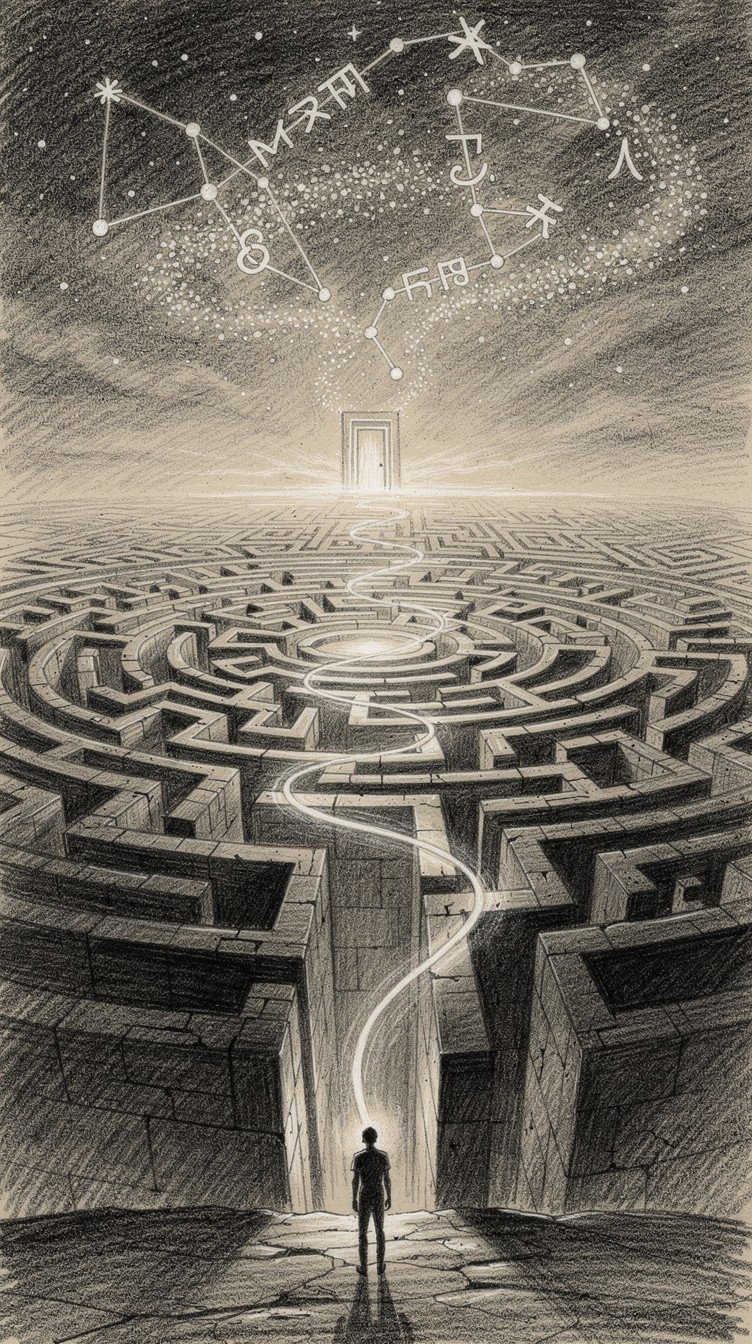
This is the labyrinth of consciousness.
Daedalus and the structure he built
In Greek mythology, the Minotaur, a creature with the body of a man and the head of a bull, was imprisoned in the labyrinth on Crete. Theseus entered to confront it. Ariadne gave him a thread so he could mark the way and find his route back out after killing the Minotaur.
The story brings together four figures that have remained alive in Western culture:
- Daedalus, the builder of the labyrinth.
- The Minotaur, the creature hidden at its center.
- Theseus, the one who enters.
- Ariadne, the one who provides the thread.
Ancient myth did not construct these four figures as a psychological model. In this article, they take on four positions within an inner map.
Daedalus represents the mind’s capacity to build structure. Familiar inner routes take shape through experience, language, relationships, and forms of adaptation that once served a purpose.
The Minotaur takes the form of experience that has been difficult to integrate: anger, fear, need, memory, or instinct pushed out of view. Theseus represents the part willing to enter regions usually avoided. Ariadne preserves the link to the way back.
The labyrinth contains both what has been hidden and the routes formed around it.
Labyrinth and maze
In English, labyrinth and maze have often been used interchangeably. A common modern convention distinguishes them by the structure of their paths.
A maze contains branches, choices, and dead ends. The person inside must repeatedly decide which direction might lead onward.
A labyrinth, in a more specialized modern classification, has a single continuous path. It winds toward the center and then leads outward again, usually along the same route. This distinction developed relatively late in the history of the terms, so it should not be projected backward as an absolute rule for every ancient labyrinth.
The two forms create different experiences.
A maze resembles the state of facing too many possibilities: every direction may be wrong, and every turn creates another decision.
A labyrinth does not confront the traveler with a series of choices. Its difficulty comes from repeatedly passing places that seem familiar. At times the path comes very close to the center before moving outward again. From inside, the overall shape is difficult to see.
Inner life can contain both experiences. We may be caught between too many options, or keep returning to the same theme without realizing that its route was formed long ago.
How familiar routes take shape
The nervous system continually learns from experience. Repeated experiences can influence what people come to expect from their surroundings, how they detect threat, and which responses once helped them move through earlier situations.
A child who is repeatedly punished harshly for mistakes may become highly sensitive to criticism. Someone who has experienced inconsistency in relationships may pay more attention to distance, silence, or changes in how others respond. A person who has lived for a long time in an unpredictable environment may remain highly alert even after circumstances become more stable.
These responses develop in relation to particular conditions. They may once have helped anticipate danger, reduce surprise, or preserve some sense of control when options were limited.
Difficulty begins when an old route continues to guide new situations.
A delayed reply can stir fear of being left behind. A piece of feedback can be received as a judgment on one’s entire worth. A minor disagreement can trigger an urge to win, withdraw, or shut down communication.
The present brings new signals, while older experience can make some signals easier to notice and easier to understand through familiar expectations.
The wall that looks obvious
A wall in the inner labyrinth rarely appears with a sign saying, “this is an old belief.” More often, it speaks in the voice of something too familiar to question:
“I can only rely on myself.”
“If people see my weakness, they will use it against me.”
“Everything eventually slips out of my hands.”
“If I want to be valued, I have to do everything well.”
A belief that has existed for a long time can blend into the way a person sees the world. Once a belief is established, information that fits it may receive more attention and remain more memorable, while conflicting experience may carry less weight.
Someone who believes that nobody can be trusted may remember broken promises vividly while overlooking people who have remained consistently present. Someone who expects to be left may notice signs of distance sooner than signs of connection.
Repeated over time, this can make the world appear increasingly consistent with the belief itself.
A wall built from history gradually begins to look like part of the landscape.
Defense mechanisms and locked areas
A labyrinth also contains places the traveler learns to avoid.
Psychology uses the term defense mechanisms for processes that operate largely outside deliberate control and help people manage emotional conflict and stress. Modern research distinguishes many forms of defense with different degrees of adaptiveness. Having defenses is part of ordinary psychological functioning; flexibility, context, and their effects on everyday life matter more than their mere presence.
A person may deny, rationalize, redirect emotion, create distance, or tightly control a situation. Under certain conditions, these responses help preserve the ability to function.
Someone facing a major loss may temporarily set emotion aside to deal with urgent tasks. A child living in an unpredictable environment may learn to watch adults’ expressions closely in order to detect shifts early.
The problem begins when a response that once helped becomes almost automatic.
Someone accustomed to withdrawal may disappear from every conflict even when conversation is still possible. A person who once relied on perfection to reduce criticism may continue controlling every detail even as the cost keeps rising. Someone who processes everything through analysis may understand emotion very well in theory while rarely making direct contact with it.
A locked door usually has a history. Understanding that history can reveal why the door once needed to exist and whether it still needs to remain closed in the present.
The loop of rumination
The mind can return to the same material many times. Repetition sometimes brings new information; in other cases, thought continues to circle within a closed route.
Rumination usually refers to repetitive negative thinking centered on distress, its causes, or its consequences. Research has linked rumination with increased negative thinking, poorer problem solving, and difficulty moving into action across a range of situations. Research also distinguishes rumination from more constructive forms of self-reflection.
Someone may spend hours returning to the same questions:
“Why did I let that happen?”
“Why do I always ruin everything?”
“What if I had said something different that day?”
Each round revives the emotion while producing very little new information.
Reflection may begin with the same experience but move differently: noticing another factor, revising an interpretation, identifying what remains within one’s influence, or finding a concrete next step.
Rumination tends to return to the same content and conclusion. Reflection has more chance to open additional information or action.
Both look backward. The difference appears in whether thinking expands the map or keeps wearing the same path deeper.
When familiar routes return in relationships
Old routes also appear in how people respond to closeness, disagreement, and insecurity within relationships.
Research on adult attachment often discusses two broad tendencies: attachment anxiety and attachment avoidance. Attachment anxiety is commonly associated with greater sensitivity to signs of distance or possible loss of connection. Attachment avoidance is more often associated with creating distance and expressing fewer needs when a relationship becomes stressful. These tendencies vary across people, partners, and circumstances.
Fear of abandonment may make someone highly sensitive to distance, more likely to seek reassurance, or more reactive to ambiguous signals. Someone who avoids conflict may yield for longer than they want and speak up only after tension has accumulated. A person who ties self-worth to usefulness may repeatedly accept roles in which they are expected to keep meeting other people’s needs.
Every situation also includes other people, circumstances, and responsibilities. The behavior of others, external events, and factors beyond personal control remain real parts of the story.
An inner map focuses on the part that can be observed within oneself: which signals trigger vigilance, what feels strangely familiar, where boundaries are placed, and which responses tend to lead back toward the same route.
Recognizing the familiar route creates more room for choice when it appears again.
The Minotaur at the center
In the myth, Theseus reaches the center to kill the Minotaur. Within the inner map of this article, the Minotaur takes on a different symbolic role.
It may take the form of anger that was once forbidden, a need for care that was treated as weakness, an instinctive part of the self that does not fit an accepted identity, or a memory bound to shame and fear.
These parts can still affect present reactions even when they are rarely named. A particular subject can make anger rise very quickly. A need may be denied again and again. A certain kind of situation can produce an urge to withdraw before the person has fully identified what just happened.
“Meeting the Minotaur” means bringing what has long been avoided into a position where it can be observed and dealt with. Some things need fuller understanding, some reactions need boundaries, some memories need to be seen from the conditions of the present, and some experiences call for support beyond what self-observation can provide.
A reaction also rarely has a single cause. Temperament, life experience, bodily state, current surroundings, relationships, and established habits can all contribute to the way it appears.
The center of the labyrinth may offer one piece of understanding rather than a final answer.
Ariadne and the thread
Theseus may be able to face the Minotaur, but he still needs the thread to find his way out. In the story, Ariadne gives him the means to remain connected to the entrance. The Met preserves an image of Ariadne handing the thread to Theseus at the entrance to the labyrinth.
Within an inner map, the thread can take the form of anything that keeps the traveler connected to the present:
- facts that distinguish what is happening now from what is being remembered;
- awareness of the body and the surrounding environment;
- a trusted person who can offer another perspective;
- values or boundaries that help guide action;
- professional support when reactions exceed the person’s ability to regulate them alone.
The thread does not make the labyrinth disappear. It preserves orientation when the whole structure cannot yet be seen.
Inner exploration also has limits. When a memory or emotion becomes overwhelmingly intense, continuing to force deeper exploration can reduce the ability to observe clearly. Returning attention to the present, shifting toward the immediate environment, or stopping the exploration altogether can be reasonable choices.
Knowing when to stop is also part of keeping one’s direction.
The route back continues through ordinary life. The same silence may appear again, the body may still react, and the old story may still speak. This time, the traveler may recognize it sooner and have a chance to respond differently.
The labyrinth changes through these returns.
The labyrinth in philosophy
The labyrinth has also been used to describe places where reason runs into difficulties within its own concepts.
Leibniz called the problem of human freedom and the structure of the continuum two “famous labyrinths” in which reason often loses its way. For him, the labyrinth was not a psychological image of emotion but a way of describing philosophical problems that repeatedly generate further difficulties.
One solution may open another problem. A definition may clarify one part while creating a new question elsewhere. The deeper the argument goes, the more carefully the assumptions that produced it must be examined.
The labyrinth also suits the limits of thought itself: thinking can expand understanding while generating routes that circle back into further complexity.
Sometimes more analysis brings new information. At other times, it is more useful to return to what can be observed, act on the information already available, or accept that part of the question remains open.
When the loop changes shape
An old theme can return many times.
A fear that once appeared in one relationship may surface again in another. A reaction that seemed to have passed can return when the body is exhausted or circumstances become unstable. Its return can easily create the impression that earlier change has disappeared.
Two encounters with the same theme can still be different.
The first time, the traveler may only feel the pain. Another time, they recognize what triggered it. Later, they may notice the urge before acting. At another point, the old emotion still appears while the choice that follows has changed.
Transformation can happen through shifts this small. Familiar content returns, but the relationship between the person and that content has moved.
The theme may be old, while each return begins from a different position.
The loop begins to take the shape of a spiral.
The labyrinth becomes a spiral.
Source notes
- The Metropolitan Museum of Art — Theseus, Hero of Athens / Marble sarcophagus with garlands and the myth of Theseus and Ariadne
https://www.metmuseum.org/essays/theseus-hero-of-athens
https://www.metmuseum.org/art/collection/search/245585
The Met presents the story of Theseus, the Minotaur, and Ariadne; the sarcophagus shows Ariadne giving Theseus the thread at the entrance to the labyrinth. - The Labyrinth Society — Labyrinth Typology / Labyrinths Overview
https://labyrinthsociety.org/historical-overview/labyrinth-typology/
https://labyrinthsociety.org/labyrinths-overview/
These sources explain the modern distinction between a unicursal labyrinth and a multicursal maze while noting that the two words have often been used interchangeably in English. - Di Giuseppe et al. — Recent Empirical Research and Methodologies in Defense Mechanisms: Defenses as Fundamental Contributors to Adaptation
https://pmc.ncbi.nlm.nih.gov/articles/PMC8678405/
A review of modern research on defense mechanisms and their role in psychological adaptation. - Nolen-Hoeksema, Wisco & Lyubomirsky — Rethinking Rumination
https://pubmed.ncbi.nlm.nih.gov/26158958/
A review of rumination, its effects on thinking, problem solving, and behavior, and its distinction from more adaptive forms of self-reflection. - Simpson & Rholes — Adult Attachment, Stress, and Romantic Relationships
https://pmc.ncbi.nlm.nih.gov/articles/PMC4845754/
A review of attachment anxiety, attachment avoidance, emotional regulation, and relationship behavior under stress. - Stanford Encyclopedia of Philosophy — Gottfried Wilhelm Leibniz
https://plato.stanford.edu/entries/leibniz/
SEP records Leibniz’s description of human freedom and the continuum as two “famous labyrinths” in which reason often goes astray.