The Inner Cartography
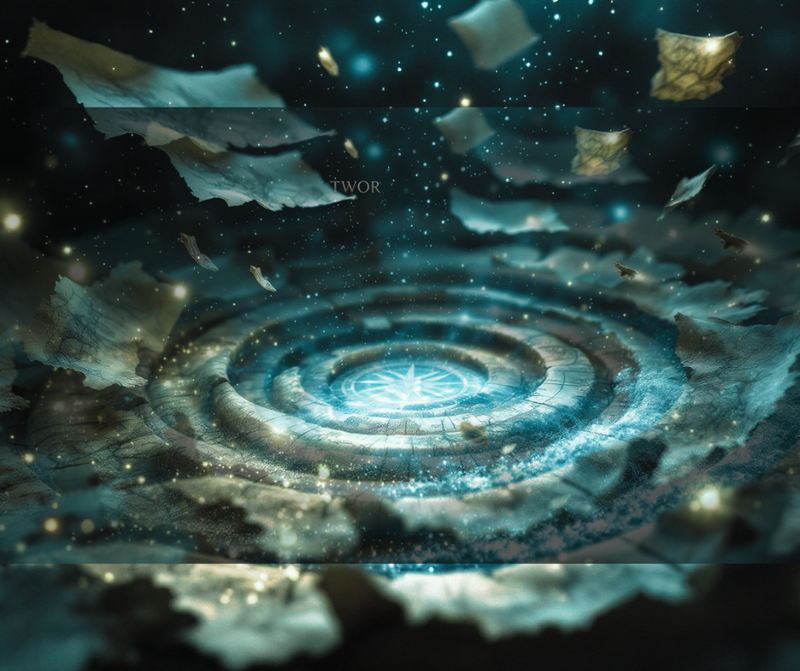
We often feel that when our eyes open, the world simply enters us. An image appears, a sound reaches us, a scent pulls a memory into view. Reality outside seems already complete, waiting to be received.
Perception works through a more complex process. Light, vibration, molecules, and pressure provide signals to the nervous system; the brain combines them with memory, prediction, language, emotion, and the present context. Together, they shape our experience of the world.
Two people can experience the same room very differently. One may feel safe while another feels confined; the same silence may feel peaceful to one person and like absence to another. The room remains where it is, while meaning emerges at the meeting point between the outside world and the inner structure of the person looking.
The Inner Cartography begins at that meeting point. Five symbols in this stage represent five movements of awareness: receiving, selecting, observing, going inward, and transforming.
Gate I — Perception
The senses are the first point of contact between the body and the world. Light, sound, scent, temperature, and pressure enter the nervous system as signals, while our experience is also shaped by attention, memory, and personal history.
Gate I begins with the distance between what exists outside us and what we actually experience. The question “What am I seeing?” then opens into another: what within my body and mind has taken part in the way I see it?
Gate II — The quantum eye
Among the countless signals around us, attention continually selects what comes forward. Expectations, beliefs, and previous experience also take part in that process, which is why the same situation can carry very different meanings for two people.
Gate II turns toward the frame itself. Instead of looking only at what is in front of us, we begin to notice how we ask questions, select information, and form conclusions. The Frame of Observation is where the observer begins to recognize the limits of the perspective they are using.
Gate III — The observer
We can notice a thought while it is forming, feel anger while still knowing that we are angry, or catch a reaction before immediately acting on it. That ability creates a small distance between an experience and being carried away by it.
Gate III enters this capacity to recognize a reaction while it is happening. The Observer is not a position detached from emotion or from life; it is the ability to notice what is taking place within us. Once the observer begins to see their own responses, the map moves from perception into self-observation.
The labyrinth
Memories, beliefs, roles, and ways of protecting ourselves can gradually become familiar paths within inner life. We may return to the same kind of relationship, the same fear, or the same conclusion without realizing how many times we have already traveled that route.
The Labyrinth explores the architecture behind those repetitions. It does not need a Minotaur at its center; familiar walls alone can steer us toward certain directions while hiding others from view. Seeing the structure of the labyrinth is the first step toward changing how we move through it.
Serpent & Spiral
Inner life rarely changes along a straight line. An old theme may return many times, yet the person meeting it may no longer be standing in the same place. Some repetitions simply repeat themselves; others return after we have gained more experience, distance, and choice.
Serpent & Spiral explores this second kind of movement. The spiral carries the image of returning with a shift in position, while the serpent brings the motif of shedding skin and renewal. Together, they move Stage I from seeing a structure toward the possibility of changing structures that have formed over time.
_______