Gate II | The Quantum eye
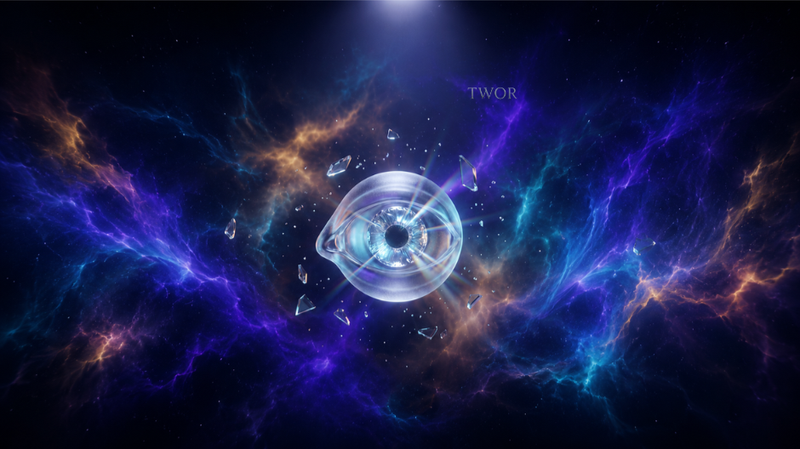
The gaze and the limits of the frame
TWOR previously explored the Eye of Horus through the lens of awakening. There, the eye turned inward, linked to the ability to revisit old structures of perception after a period of change.
Gate II returns to the symbol from a different direction. This time, the Eye of Horus sits alongside the history of symbols, quantum physics, the science of perception, and philosophy of the observer. These very different fields meet around a shared question about the conditions of seeing: what do we receive, what tools gather the information, and what has already been excluded from the frame?
The restored eye
In the mythology surrounding the Wedjat, Horus loses or suffers damage to one of his eyes in conflict with Seth, and Thoth later restores it. The name wedjat carries a meaning close to “the one that is sound again” — something healed and returned to wholeness. The symbol appeared widely on amulets and funerary objects, associated with protection, healing, and rebirth.
This history gives the Wedjat more than the function of sight. The eye passes through injury before returning to a state of wholeness.
TWOR uses that movement from injury to restoration as the starting point for Gate II. After the rupture, the eye becomes an image of a way of seeing that has encountered its own limits and reorganized itself. Gate II shifts the focus from what is being seen to the conditions that shape the act of seeing.
Why call it The Quantum eye?
The word “Quantum” in the name of the Gate is borrowed from modern physics. The Wedjat existed thousands of years before quantum mechanics and has its own symbolic history. Gate II connects the two through one shared question: how do the conditions of observation affect the information we can obtain?
In quantum mechanics, the arrangement of an experiment is directly related to the kind of information that can be obtained. The system under study, the measuring device, and the interaction between them all matter when describing the result.
The relationship between a tool and what it can register also appears in more familiar forms of observation. A microscope opens one range of scale, a telescope brings extremely distant sources of light into view, and an infrared detector records wavelengths the human eye cannot see. Every instrument has its own sensitivity, resolution, and range.
The Quantum Eye focuses on the limits built into the frame of observation itself.
What happens in the double-slit experiment
The double-slit experiment is often reduced to a familiar line: a particle changes its behavior when it is “observed.” That wording can easily create the impression that human consciousness is a necessary part of the process.
In a double-slit experiment, photons, electrons, or other quantum objects can be sent one at a time toward two slits. Each detection produces an individual point on a screen. After enough events accumulate, and when no information distinguishes which path was taken, the overall distribution can form an interference pattern.
When the setup makes path information available, the visibility of that interference can decrease or disappear. The change is associated with measurement interactions, which-path information, and quantum decoherence. NIST describes the relationship between the amount of path information obtained by a detector and the reduction of interference in a double-slit system.
A detector can record information automatically, and the surrounding environment can also interact with the system. The result does not depend on a person standing nearby and watching it happen.
Whether the measurement process is described through “wave-function collapse,” relative states, or another framework depends on the interpretation of quantum mechanics being used. Different approaches can predict the same experimental outcomes while describing the underlying process in very different ways. Copenhagen and Everettian approaches, for example, belong to different traditions of interpreting quantum states and measurement.
The firmer experimental ground lies in the relationship between the experimental setup, the information that becomes available, and the resulting distribution of observations.
The limits of observational tools
Every measuring instrument has a particular design, sensitivity, resolution, and operating range. Choosing an instrument also determines which properties can enter the data it produces.
A long-exposure camera records movement differently from a camera using a very fast shutter speed. An infrared telescope detects structures the human eye misses. A microscope reveals details that cannot be seen unaided.
Data remain constrained by the physical world and by the method used to collect them. Repetition, calibration, and comparison help test the reliability of a result. To understand what data can tell us, we also need to know which instrument collected them and under what conditions.
This is also a problem of epistemology: how do we know what we know?
The frame of observation in everyday life
Gate II now follows the same problem into attention, where part of the continuous flow of information is prioritized and becomes more prominent in conscious experience.
We rarely take in everything in a room at once. The eyes settle on a few objects, the ears may follow one voice among many sounds, and our current goals influence what we search for.
Three people entering the same room may immediately notice three different things: the nearest exit, the light coming through a window, or the expressions on the faces of those already inside. The physical environment is the same; what stands out to each person is different.
Expectations, memory, and previous experience continue to guide attention. Someone alert to danger may prioritize threat-related signals. A person carrying a fear of rejection may pay particular attention to a pause in conversation. Long-held beliefs can also influence the information we seek out, remember, and give weight to.
Attention brings part of the scene into prominence while other parts recede into the background.
The world through different sensory systems
Bats use echoes to navigate. Many birds have visual systems sensitive to ultraviolet wavelengths beyond human vision. Some species also use information from Earth’s magnetic field for orientation, although the precise biological mechanisms behind magnetoreception are still being investigated.
Every species encounters its environment through a particular set of sensory capacities. Humans are no exception: we see only part of the electromagnetic spectrum, hear within a limited frequency range, and experience the world through the biological structure of Homo sapiens.
Scientific instruments extend that range. Radio waves, X-rays, infrared radiation, magnetic fields, and extremely faint signals can be detected by machines and translated into numbers, graphs, images, or sound for human analysis.
The part of the world that enters human knowledge always passes through a sensory system, an observational instrument, or a model of representation. Understanding the limits of each frame helps science develop better tools, compare multiple sources of data, and expand what can be observed.
The Eye of Horus and the image of the brain
A modern association places the Eye of Horus over a midsagittal section of the human brain. A 2019 paper by ReFaey and colleagues superimposed the symbol on neuroanatomical images and proposed similarities with the corpus callosum, thalamus, olfactory tract, brainstem, and several other sensory structures.
Within the paper itself, the authors describe parts of the proposal in hypothetical and speculative terms. They also note that they found no original documentation establishing a neuroanatomical origin for the Eye of Horus.
TWOR keeps this connection at the level of a modern visual association. The eye, the senses, and the brain can be placed beside one another without turning a resemblance in shape into evidence that the ancient Egyptians encoded neuroanatomy into the Wedjat.
The symbol retains its value even when the historical hypothesis remains unproven.
The pineal gland between biology and mysticism
The pineal gland is a small neuroendocrine organ near the midline of the brain. Its best-established function involves melatonin production and the transmission of information about the environmental light–dark cycle into the circadian system. Light received by the retina influences the central biological clock in the suprachiasmatic nucleus and, through a chain of neural pathways, regulates the rhythm of melatonin secretion by the pineal gland.
Western philosophy has historically linked the pineal gland with questions about mind and soul; Descartes famously assigned it a special role in the relationship between mind and body. Modern mystical traditions continue to associate it with the “third eye,” intuition, dreams, and altered states of consciousness.
Biology describes the pineal gland through hormones, light, and circadian rhythms. Mysticism uses it as a symbol of inward perception. Its relationship with light and darkness, waking and sleep, makes it an easy point of entry into stories about the boundary between outer and inner worlds.
In Gate II, the two domains retain their own names and boundaries.
Four paths around one eye
The Quantum Eye places four approaches around the same question: how do we know what we know?
- Symbolic history returns the Wedjat to its story of injury, restoration, protection, and rebirth.
- Physics examines quantum systems, measurement, interaction, and the information obtained.
- Perception science studies the senses, attention, memory, and the limits of the nervous system.
- Philosophy and mysticism extend the question toward introspection, the limits of knowledge, and the relationship between the observer and their own experience.
These four approaches use different methods and standards of evidence. Placing them side by side helps distinguish historical evidence from experimental results, models of perception from symbolic meaning.
The Quantum Eye keeps the conversation at that boundary.
When the eye sees the frame
The Wedjat begins with the story of an eye damaged and restored. Gate II borrows that movement to examine the conditions of observation itself.
We see through the senses of a species, through the history of an individual, and from within the state of a particular body. Instruments have measurement limits, attention has priorities, and memory and expectation influence what stands out.
Recognizing those limits allows us to examine our methods, shift our angle of observation, compare evidence, and look for information in places that are easy to overlook.
Source notes
- The Metropolitan Museum of Art — Wedjat Eye Amulet
https://www.metmuseum.org/art/collection/search/559004
The Met describes the Wedjat as the restored Eye of Horus; wedjat carries the sense of “the one that is sound (again)” and is associated with healing, protection, and rebirth. - Kincaid, McLelland & Zwolak / NIST — Measurement-induced decoherence and information in double-slit interference
https://www.nist.gov/publications/measurement-induced-decoherence-and-information-double-slit-interference
Discusses the relationship between which-path information, loss of interference, and measurement-induced decoherence. - Stanford Encyclopedia of Philosophy — Copenhagen Interpretation of Quantum Mechanics
https://plato.stanford.edu/entries/qm-copenhagen/
Background on the measurement problem and interpretive issues in quantum mechanics. - Stanford Encyclopedia of Philosophy — Everettian Quantum Mechanics
https://plato.stanford.edu/entries/qm-everett/
A different framework for understanding quantum states and measurement. - ReFaey et al. — The Eye of Horus: The Connection Between Art, Medicine, and Mythology in Ancient Egypt
https://pmc.ncbi.nlm.nih.gov/articles/PMC6649877/
The 2019 paper proposes visual similarities between the Eye of Horus and a midsagittal section of the brain. The proposal is a modern hypothesis rather than established evidence of ancient Egyptian neuroanatomical intent. - Arendt & Aulinas / Endotext, NCBI Bookshelf — Physiology of the Pineal Gland and Melatonin
https://www.ncbi.nlm.nih.gov/books/NBK550972/
Overview of pineal function, melatonin, light–dark cycles, and circadian rhythms; it also notes the historical association with Descartes. - Wiltschko & Wiltschko — Magnetoreception in birds
https://pmc.ncbi.nlm.nih.gov/articles/PMC6769297/