Gate I | The senses
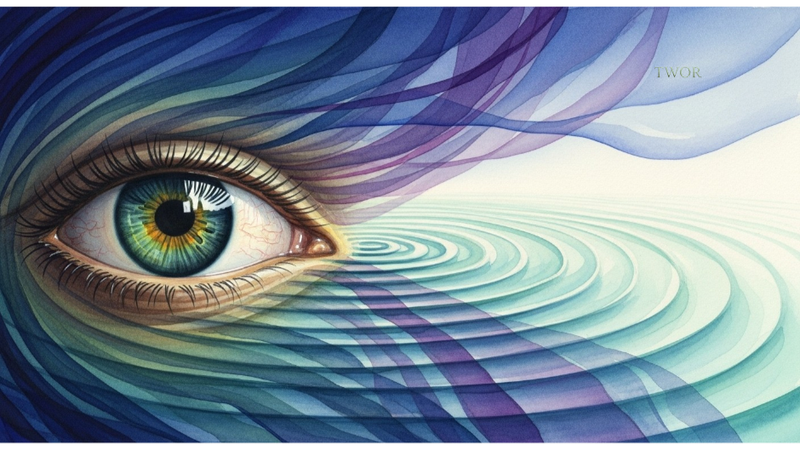
When the world enters consciousness
We open our eyes and see the room. A sound comes from behind us. The smell of coffee brings back the memory of an old morning. It all happens so seamlessly that the world can seem to enter the mind already intact.
Between the thing outside us and the experience within lies a complex series of transformations. Light, vibrations, chemical molecules, temperature, and pressure activate different sensory systems and are converted into neural signals. The brain combines sensory information with memory, bodily state, context, and previous experience to shape our experience of the world.
Signals begin in the environment, while perception continues to take shape within the body and mind of the person experiencing them.
Before the image comes light
The scene before us does not enter the eye as a finished image.
Light reflected from surfaces passes through the cornea and lens before being focused onto the retina. Photoreceptor cells respond to light and begin the process of converting it into neural signals. Information continues to be processed through the retina and multiple parts of the nervous system before contributing to the meaningful scene that enters conscious experience.
Sound follows a different route. Vibrations in the air move the eardrum, pass through the tiny bones of the middle ear, and affect the fluid and hair cells of the cochlea. Mechanical movement is converted into neural signals, which the auditory system then processes into experiences such as speech, music, footsteps, or the sound of an object hitting the floor.
Smell and taste begin with chemical molecules. Bodily sensation relies on different kinds of receptors that respond to touch, pressure, vibration, temperature, and potentially damaging stimuli. Each sensory system uses its own mechanisms, but all begin by converting physical or chemical stimulation into signals the nervous system can process.
Conscious experience therefore arrives as color, sound, scent, taste, and bodily sensation rather than as wavelengths, air vibrations, or chemical reactions.
The body has more than five sensory doors
The five-sense model is so familiar that it can easily become the default description of how humans encounter the world. Neuroscience distinguishes several additional sensory systems, and the exact number depends on how they are classified.
Alongside vision, hearing, smell, taste, and touch, our experience also draws on:
- Proprioception, which gives us information about the position and movement of our limbs without having to look at them.
- The vestibular system, which contributes to balance and our sense of head movement in space.
- Interoception, which receives and organizes signals from inside the body, including heartbeat, breathing, hunger, thirst, nausea, and internal tension.
- Nociception, which detects potentially damaging stimuli and contributes to protective responses.
- Thermoception, which allows the body to register heat, cold, and changes in skin temperature.
Even what we casually call “touch” includes several kinds of information. Light touch, vibration, pressure, itch, temperature, and pain rely on different receptors and neural pathways.
The state of the whole body also affects experience. Posture, heartbeat, breathing, stress level, and other physiological conditions can influence attention, emotion, and how a situation is evaluated.
A hallway may seem completely ordinary when the person walking through it is relaxed. In a state of fear, a dark corner, a faint sound, or an ambiguous detail in the same hallway may attract far more attention. The scene has remained the same; what stands out within it has changed with the state of the observer.
The brain organizes the world
The brain continually selects and organizes sensory information.
Sensory information always has limits. Human vision detects only a small part of the electromagnetic spectrum, hearing operates within a particular frequency range, and sensitivity to smell varies greatly depending on the molecule involved. Other species encounter their environments through different sets of sensory abilities.
To handle the constant flow of information, the nervous system selects, compares, and uses context together with previous experience. We can recognize a face from only a few lines. A missing sound in a spoken sentence may still be understood from the surrounding words, while a partly obscured object is usually experienced as one continuous object.
Visual illusions make this organizing process easier to notice. Two regions with the same color value can appear different when surrounded by different patterns of light and shadow. The same drawing may alternate between two objects depending on how its lines are grouped. Some static arrangements can even create a sense of movement.
Context and experience help the nervous system work with incomplete information. Some current theoretical frameworks, most notably predictive processing, describe perception as a process in which the brain continually compares incoming signals with expectations and updates when the two do not match. This has become an influential area of research, while its specific mechanisms and explanatory scope are still being tested.
Rapid organization helps humans navigate their surroundings, but it can also create blind spots. In some situations, information that fits expectations may be noticed more readily, while details outside familiar patterns can be missed. Previous experience can therefore affect what receives attention and how new information is understood.
Memory travels with perception
Smell offers a familiar example of the connection between perception and memory.
The smell of food may return one person to a childhood kitchen. For someone else, the same scent may be linked to a hospital, a journey, or someone who has died. The present stimulus may be similar while the emotional experience differs because each person brings a different history to it.
Music works in much the same way. A melody may feel relaxing to someone with no particular memory attached to it, yet evoke grief in someone who once heard it during a painful goodbye.
Connections like these form through learning and experience. The brain recognizes sensory information while also activating networks of associations built over time, where memory and emotion can both influence present experience.
We see a new face through experience accumulated from faces we have encountered before. A glance may be read through a history of trust, judgment, or hurt. Perception combines signals from the present moment with what the observer already carries.
Emotion changes the scale of things
Emotion affects how we direct attention and evaluate events as they unfold.
When alertness rises, attention can narrow and signals related to possible threats may receive greater priority. Research on anxiety has also found a tendency toward threat-related attention, although its strength and form vary across people, circumstances, and methods of measurement.
During anxiety, a silence may be more easily read as distance. When angry, a neutral remark may sound more provocative. When exhausted, a minor request can feel far heavier than it normally would.
The same event can carry different meanings depending on the state of the body and mind at the time. A brief pause gives us room to examine what may be shaping the first response: whether the body is tense or relaxed, which memory has just been activated, or which emotion is narrowing attention.
Recognizing these factors can help separate the signal itself from the reaction and the conclusion that follows.
The physical world and the world we experience
Philosophy has long distinguished things themselves from our experience of them.
We can measure the wavelength of light, while “red” is a perceptual quality produced by the visual system under particular conditions. We can measure sound frequency, while the experience of a melody emerges when the auditory system organizes vibrations into a meaningful sequence. Temperature can be recorded as a number, while the feeling of comfort, bitter cold, or burning heat also depends on the body encountering it.
The physical world sets conditions and limits. The body receives part of the information available within that world, and the nervous system organizes that information into experience. The two are closely connected without being completely identical.
We live in relation to an external reality while always approaching it through our own sensory, neural, and experiential structures.
Perception has limits, which makes measurement, verification, comparison, and multiple perspectives valuable. We can misunderstand, overlook evidence, or be influenced by bias; knowing that perception has limits is one reason we develop methods for checking what we think we have seen.
The senses in mystical maps
Many mystical and spiritual traditions describe the senses as doors connecting embodied consciousness with the physical world. The body gives experience form, duration, and limits.
Neuroscience studies sensory mechanisms, the nervous system, and the processing of information. Ideas of the soul or embodied consciousness belong to philosophy and mysticism. This map places both in view while keeping the boundary between neural mechanisms and mystical ideas clear.
Mystical traditions often connect the “clearing of perception” with recognizing how fear, prejudice, attachment, or automatic reactions can affect the way we see. At a practical level, this idea can be brought down to very ordinary acts:
- Distinguishing evidence from inference.
- Noticing the state of the body before reaching a conclusion.
- Checking whether an old memory is coloring the present.
- Listening to other perspectives when personal experience begins to feel unquestionably certain.
- Paying attention to details that are usually filtered out of awareness.
Recognizing these filters gives the observer a better understanding of how their own perception is working.
The first gate
Gate I lays the foundation for what follows with a simple premise: experience passes through many stages before it appears in consciousness as a world of color, sound, and meaning. The body receives signals, and the nervous system organizes them together with memory, emotion, and the current bodily state.
This process helps us navigate the environment quickly while making some information more prominent and leaving other information easier to miss. Seeing how perception takes shape also brings attention to the center of the map.
What enters awareness? What recedes into the background? How does the frame of observation affect experience?
This is where Gate II begins.
Source notes
- NCBI Bookshelf — Sensation and Sensory Processing
https://www.ncbi.nlm.nih.gov/books/NBK10955/ - StatPearls / NCBI Bookshelf — Physiology, Sensory Receptors
https://www.ncbi.nlm.nih.gov/books/NBK539861/ - NIH / PMC — The Emerging Science of Interoception: Sensing, Integrating, Interpreting, and Regulating Signals within the Self
https://pmc.ncbi.nlm.nih.gov/articles/PMC7780231/ - McGann, Science — Poor human olfaction is a 19th-century myth
https://pubmed.ncbi.nlm.nih.gov/28495701/ - Hodson, Mehta & Smith, Neuroscience & Biobehavioral Reviews — The empirical status of predictive coding and active inference
https://pubmed.ncbi.nlm.nih.gov/38030100/ - Dennis-Tiwary et al. — Heterogeneity of the Anxiety-Related Attention Bias
https://pmc.ncbi.nlm.nih.gov/articles/PMC7983558/